


In 1985, the visionary (and slightly mad, some would say) Doc Brown – from the movie Back to the Future – decided to turn a DeLorean into a time machine. To do so, he used plutonium and ended up in 1955. But how does one fuel a car with plutonium in the 1950s? Robert Zemeckis solved the problem with cinematic creativity: a lightning bolt capable of delivering 1.21 gigawatts directly into the flux capacitor, providing the car the power it needed to operate; in other words, it was the first time we watched a car move thanks to electricity.
Let’s return to 2025 – not to Hill Valley, but to another laboratory: INESC TEC’s x-energy. Here, there is no need for Hollywood lightning… just a working charger and the knowledge required to address a future in which electromobility will inevitably take centre stage.
The European Union has set ambitious targets, requiring manufacturers to progressively reduce the average CO₂ emissions of new cars, and to end the sale of combustion-engine vehicles by 2035. Portugal, while showing fast evolution in electric vehicles and charging infrastructures, remains below the European average. According to data from the European Alternative Fuels Observatory, in the second quarter of 2025 there were around 443,528 vehicles powered by alternative fuels (including electric and plug-in hybrids) in a total fleet of approximately 7.34 million cars. Therefore, it’s safe to say the electromobility is changing the way we move, how we consume energy, and even how we conceive the power system itself.
When chargers can think
Like Doc Brown, INESC TEC researchers are working on solutions that will only make full sense a few years from now or rethinking what already exists from a new perspective. A good example is electric vehicle chargers. Statistics show that Portugal benefits from one of the most advanced infrastructures supporting electric mobility worldwide, but researcher Pedro Pascoal believes there is still unexplored potential. “We want to develop intelligent chargers – equipping them with software that decides how much, when and how to charge, to protect the power grid and make better use of energy. We are creating technologies capable of understanding user habits, forecast renewable production, current tariffs or the specific needs of each vehicle; based on that, they’ll be able to make decisions. Current chargers can’t do that, since they don’t ‘know’ the best time to charge, nor whether the charging should be faster or slower,” he explained.
Examples? Imagine a scenario in which photovoltaic panels are feeding the grid. This means that on a sunny day, when generation is high, the charger speeds up the charging process. This not only saves money for the user, but also protects the infrastructure itself – which, as Pedro Pascoal stressed, is not prepared for this new world of electric vehicles connected to the grid and may collapse under high demand. “It’s impossible to reinforce the entire grid overnight, so intelligent charging is essential,” he warned.
Current technologies also show other limitations: to charge an electric car, users often need QR codes, RFID cards or apps that don’t always work first time. The future that INESC TEC is building is Plug & Charge: automatic authentication with no extra steps. The technology already exists and is being tested with international manufacturers, but there are bureaucratic obstacles to overcome, according to researcher José Silva. “This solution seems simple, but it depends on digital certificates that allow the car and charger to recognise each other automatically. For that, we need a full infrastructure of secure communication and brand interoperability, ensuring that manufacturers comply with the same protocols. Regulatory targets under the Alternative Fuels Infrastructure Regulation (AFIR) already require manufacturers to follow industrial standards for new products by 2027,” he explained. In practice, AFIR is driving sector standardisation – and, in time, all manufacturers will comply with said standards, just as they did with USB chargers or telecoms roaming.
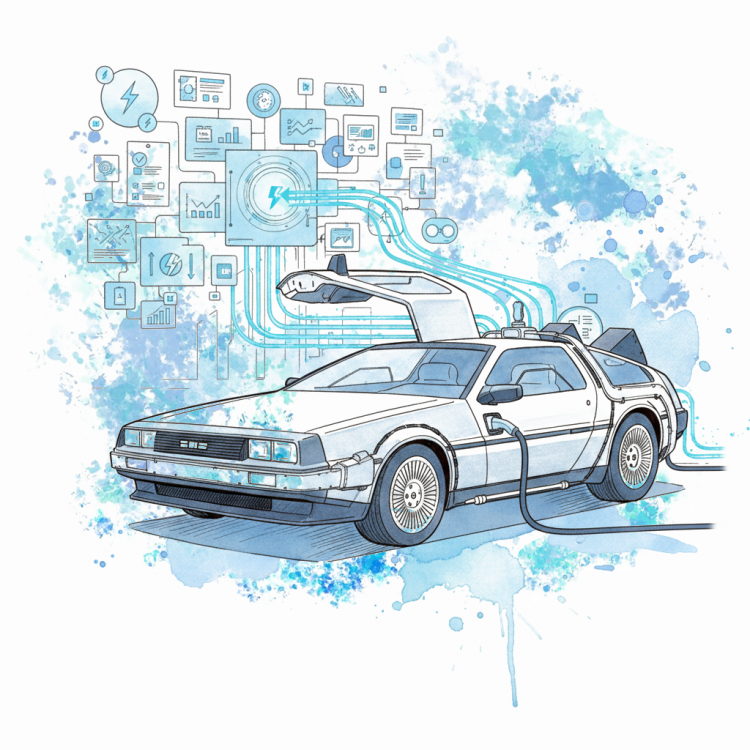
If we think about it, Doc and McFly’s time-travel journey would have been much easier if the flux capacitor had been even half as efficient as INESC TEC’s chargers.
Next stop: bidirectional charging
Intelligent chargers and Plug & Charge are excellent examples of technological progress; however, the true revolution in electromobility is bidirectional charging, i.e., enabling energy to flow not only from the grid to the car, but also from the car to the home or the grid. Hence, the car becomes a “battery on wheels”.
“With this ability, the user can charge the car when electricity is cheaper – for example, overnight or during periods of high solar energy production – and then use that same energy to power the home when tariffs are higher,” explained José Silva. The logic is simple: the car stops being just an energy consumer and becomes a supplier too, helping balance the grid, reduce costs, and integrate more renewables into the system. However, both the car and charger must be prepared for this feature. Today, only 3% of cars on the market support bidirectional charging, but José is confident that, by next year, this percentage will be significantly higher: “From what we witnessed at the Hybrid and Electric Car Show, every brand will have at least one model in 2026.”
Pedro Pascoal added that with the Charging Management System (CMS) – which acts as the “brain” managing several chargers simultaneously within a building or car park – bidirectionality can move to a new level. “While bidirectionality decides where the energy can flow, the CMS decides how that energy is distributed, ensuring that no charger uses more power than it should, that the local grid is not overloaded, and that each car gets exactly the energy it needs,” he stated. Much like Biff Tannen’s sports almanac that offered perfect predictions, the CMS uses real data to generate reliable foresight when charging a car.
Together, they complement each other: bidirectionality turns the car into an active component of the power system, and the CMS ensures that even with dozens of cars charging, everything works in a balanced and efficient way.
“This is heavy”: an invisible infrastructure that can change everything
There is a complex and invisible infrastructure behind the technology that reaches users. It is indeed a case for paraphrasing Marty McFly: “This is heavy!” Currently, alternating current (AC) is the type of electricity that circulates through our grid, designed for long-distance energy transportation. But electric vehicle batteries only accept direct current (DC). This means that whenever a car connects to a charger (as in most public charging points), the energy must be converted before reaching the battery.

Researcher José Silva explained that the charging speed is limited by the power of the internal converter. Thus, even if an AC point can supply a lot of power, the car only receives what it can convert. “That’s why INESC TEC is already testing DC chargers capable of operating under a new logic. As they already send DC energy directly to the battery, the car can charge much faster and reach much higher power levels,” he added.
Now imagine your home or office operating under a DC microgrid, where conversions are no longer necessary. For example, energy generated by solar panels could directly supply batteries or EV chargers. “This allows us to reduce conversion losses, improve energy control, lower operating costs and make infrastructure more stable and resilient,” said Pedro Pascoal.
INESC TEC is researching and developing said microgrids because they enable more efficient local ecosystems, where multiple elements interact. “Our research involves control algorithms to coordinate DC energy flows, stability mechanisms for DC networks, integration of bidirectional charging and market models that allow energy exchange within the microgrid itself. And because microgrids are connected to the conventional (AC) grid, they allow AC-DC exchanges, essentially creating hybrid DC microgrids,” emphasised José Silva.
Electromobility is more sustainable
José Silva believes Portugal could be a living laboratory of innovation in electromobility: “We have key companies in charging technology, testing conditions, and very advanced research.”
And the future? Both researchers anticipate a scenario in which the electrification of mobility becomes dominant – in an ecosystem where corporate fleets, public transportation and private vehicles are all electric, and where charging is simpler, faster and perfectly integrated with the grid. But they warn that the transition will not be challenge-free – whether bureaucratic, technological or environmental.
The latter is where public debate remains intense. The production of lithium-ion batteries requires the extraction of critical materials such as lithium, nickel and cobalt, a process with significant environmental and social impact in producing regions. Still, the researchers emphasised that the analysis must consider the vehicle’s entire life cycle, not just the production phase.
“Battery production has significant impact, but the operation of an electric vehicle is incomparably cleaner. Even when the energy used to charge it is not fully renewable, the electric vehicle has no direct emissions. And as electricity generation incorporates more renewables, the energy that powers these vehicles becomes progressively cleaner – unlike combustion engines, whose emissions tend to rise as they degrade over time,” said Pedro Pascoal.
According to José: “An electric vehicle, from beginning to end of life, pollutes far less than a combustion car, especially when bidirectionality is incorporated, since energy management becomes much more efficient.”
This position meets the independent assessments from international bodies. According to a study by the International Council on Clean Transportation (ICCT), electric cars sold in the European Union in 2025 have greenhouse gas emissions 73% lower than petrol vehicles across their life cycle.
Overall, the researchers argued that the environmental impact of electromobility must be judged from a systemic perspective, and that INESC TEC’s research can help ensure the transition is not only technological, but truly sustainable.
We still need roads – but we don’t need cables
“Roads? Where we’re going, we don’t need roads.” Doc Brown delivers this line at the end of the iconic Back to the Future, at the wheel of a futuristic flying DeLorean. And the phrase could well apply to 2025, with wireless charging for electric vehicles.
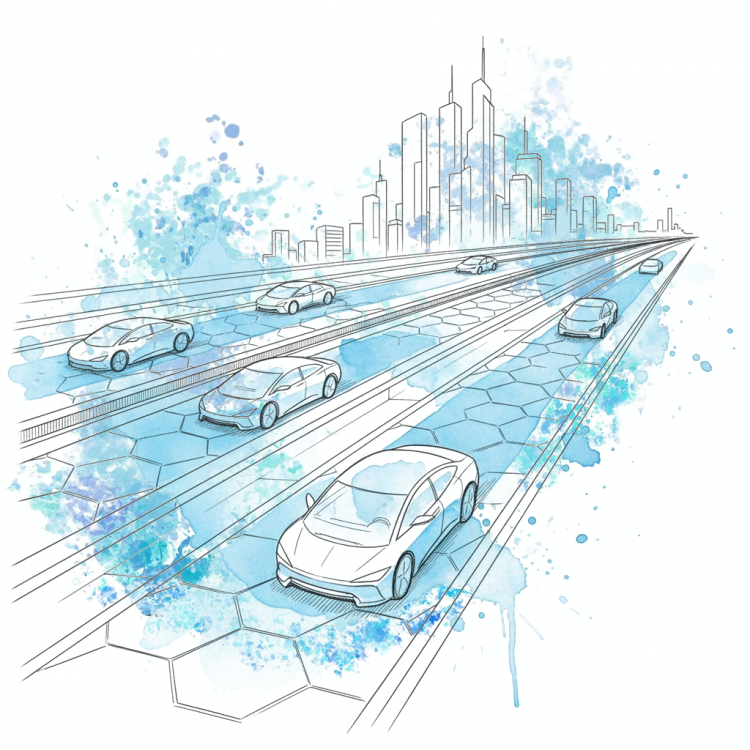
“We’re developing a prototype that allows the car to charge without cables, without a plug. On the ground, there is a charging pad and, in the car, a compatible coil enabling energy transfer through electromagnetic induction. It’s the same principle as wireless phone chargers,” explained Pedro Pascoal.
This type of charging, known as Wireless Power Transfer (WPT), may become one of the most promising areas in electromobility. Some countries are already testing roads that charge cars in motion. In France, a 1.5 km stretch near Paris (on the A10 motorway) has been installed to test induction technology in moving electric vehicles. In Sweden, several demonstrations are underway, including on the E20 road between Hallsberg and Örebro.
INESC TEC is currently focused on static prototypes, ideal for car parks, but without losing sight of dynamic solutions that will eventually allow vehicles to charge simply by driving.
Between bidirectional converters, intelligent algorithms, DC microgrids and new interoperability protocols, INESC TEC is preparing the future – ensuring that electromobility becomes more efficient, simpler and far more integrated with the power grid and renewable energy sources. Because, as José Silva concluded, “this isn’t just about charging cars – it’s about changing the whole system and the way we interact with it.”
 News, current topics, curiosities and so much more about INESC TEC and its community!
