


We are in Spring. January is gone, along with statistics and events that persistently linger in memory. It rained like it hadn’t for a long time in Portugal. Precipitation reached double the usual average – around 222%, according to IPMA data – making this month one of the rainiest in the last decade. Successive storms swept across the country, causing floods and severe damage. Does all this rain mean more water in a country that suffers deeply from persistent droughts? Much of this precipitation fell intensely and in concentrated rushes, running off quickly without time to seep into the soil and recharge aquifers. On top of that, Portugal still faces structural management problems, from losses in water supply networks to inefficient use of resources. The question is no longer how much water we have, but what we do with it. When you turn on the tap, do you know where that water comes from and what it carries with it?
In rivers, oceans, and even the networks supplying cities, there are signs that we keep ignoring – and these are the ones we are going to explore. How can technology help us tell a different story about water?
For anyone who grew up enchanted by The Little Mermaid[1], it is hard to accept that the seabed is not made of crystal-clear water, vibrant colours, and marine creatures living in perfect harmony and balance (and, incidentally, with a great sense of music!). No human impact (apart from that amazing collection of surface objects) or pressure on ecosystems. No pollution or contaminants.
But then the statistics emerge. According to the United Nations, in 2024, only 56% of domestic wastewater generated globally was treated safely. More than 60% of industrial wastewater returns to the environment without adequate treatment, based on limited data from 22 countries. According to the United Nations Environment Programme, between 19 and 23 million tonnes of plastic enter global aquatic ecosystems annually, including microplastics, revealing the extent of diffuse pollution that is difficult to control. In Portugal, the latest data from the Regulatory Entity for Water and Waste Services (ERSAR) shows that, also in 2024, 187.3 million cubic metres of water were lost in supply networks – the equivalent of 8.7 Olympic-sized swimming pools per hour.
(and thus, the magic of childhood ends)
Anticipation and optimisation: the greatest benefit of sensors
There are signals, patterns, and changes that we must identify. Water must be monitored and managed. And this time, we will need far more than the Little Mermaid’s two loyal friends to solve such a complex problem; we will need technology to detect, precisely, what is in the water.
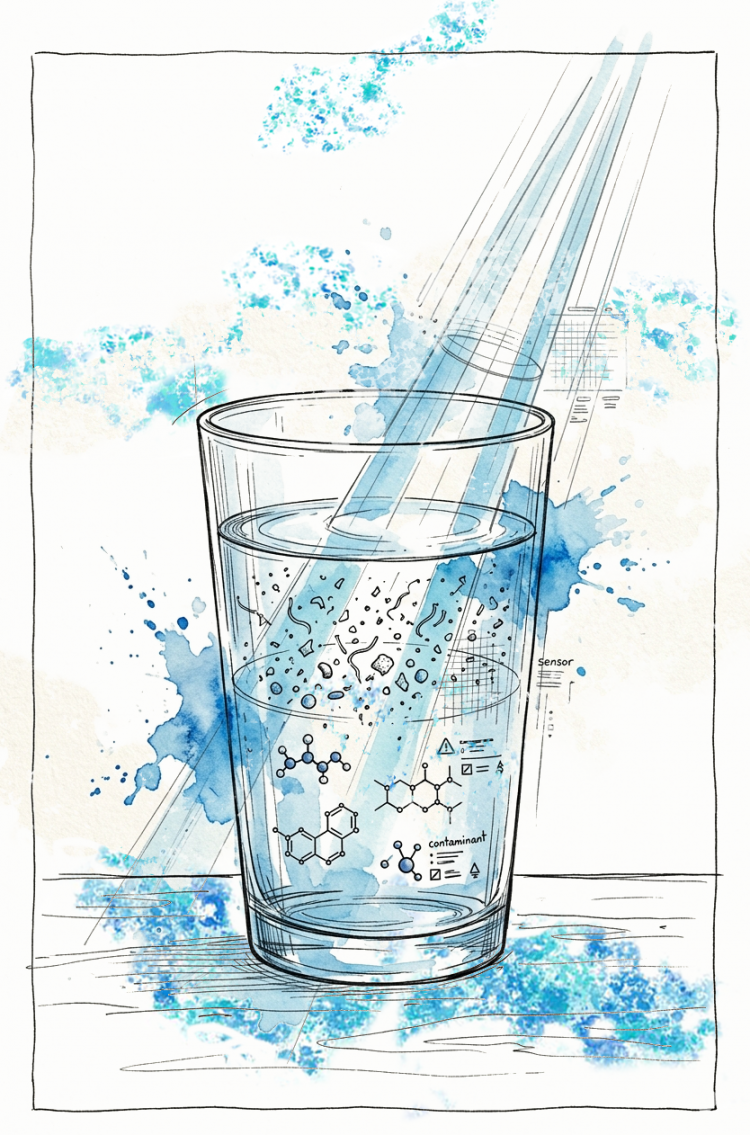
Part of the problem lies in invisibility. Many of the contaminants affecting rivers, coastal areas, and even the water we drink are not visible to the naked eye. They may be pharmaceuticals, illegal discharges, subtle chemical changes, or imbalances in production systems that only become obvious once the damage has been done. INESC TEC researcher Luís Coelho had the answer: “We’re developing more selective and sensitive optical sensors, using nanostructures to improve the detection of specific molecules. In the WAVESENSE and ELIANA projects, we’re significantly improving the sensitivity and applicability of plasmonic sensors, especially for detecting water contaminants and potential applications in biosensors.”
The goal is not just to detect that “something” has changed in the water, but to understand exactly what has changed – a task far from simple.
“The main problem is not detecting variations with our sensors. We need to understand whether this variation corresponds to the analyte we intend to measure. If the sensor detects everything indiscriminately, it is useless,” the researcher explained. In other words: the lab work focuses on developing optical and nanotechnological solutions to create sensors that can be applied in various contexts. For water, this allows us to detect a change and act on the specific source of the problem.
Luís Coelho provided another example: illegal discharges into rivers and streams, with concrete impact. “In the case of the Leça River, for example, there is an identified environmental problem with contaminated waters leading to beach closures. Or there are pharmaceuticals used in agriculture and livestock that end up in freshwater courses that we later consume. Our sensors can make a difference in detecting these discharges so that, over time, they can be reduced,” explained the coordinator of INESC TEC’s photonics centre. Ariel, spoiler alert! There aren’t two separate worlds after all – it’s a deeply interconnected system.
This technology can also optimise production processes, reduce waste, and support more circular production models. In the INNOAQUA project, for instance, the idea is to use water from fish aquaculture- rich in nutrients and carbon dioxide (CO₂) – to feed algae production before returning the water to the system. Sensors developed for the project measure nitrates, dissolved CO₂, turbidity, temperature, and light, precisely to optimise algae growth and better manage the process. “In the future, the goal is zero water waste. We want to extend usefulness, preventing it from leaving the system prematurely,” sated Luís Coelho. The same logic applies in the BigAlgae project, which continues this research line, adding new parameters such as ammonia and biomass. “The goal is to implement this optimisation on a larger scale, across all production tanks. Therefore, it is important to have well-developed technology that can be easily applied in any industry needing to monitor specific parameters,” he added.
From the laboratory to the real world
What are the main challenges of implementing these technologies on a large scale? Are there technological, regulatory, or economic barriers? Only outside the lab can the real implications be understood. Remember, Ariel also thought that just having legs would be enough to live among humans.
Luís Coelho’s work extends to the ocean, monitoring floating structures that could serve as bases for offshore wind turbines. The goal is to reduce material waste, increase infrastructure durability, and monitor both the structures and the environment. “Our role is to develop sensors that monitor the concrete structure. At the same time, these structures can act as laboratories where we add sensors with other features, like observing marine ecosystems. Everything must be carefully planned because we are dealing with saltwater,” he explained, emphasising that saltwater penetration or ocean biomaterial could compromise sensor operation. A good example of how one technology can serve multiple purposes: protecting infrastructures, monitoring the environment, collecting data on biofilms and microalgae, and even supporting future applications.
The future? Integrated sensors with autonomous systems, digital twins, and Artificial Intelligence. “The combination of all these technologies is clearly beneficial, as it allows fully autonomous detection systems that can act quickly to optimise processes. This is a way to reduce wasted resources,” mentioned Luís Coelho.
(can we still hope for that ocean the Little Mermaid promised us?)
Circularity: harder than it seems
For a long time, we considered water as a sure resource. Today, that notion is increasingly under threat. Pollution, growing pressure on water resources, scarcity in some regions, and the impact of climate change on previously stable systems compel us to rethink the issue – perhaps with the sceptical, watchful eyes of Sebastian the crab.
This is precisely where António Baptista’s research at INESC TEC becomes crucial: treating wastewater and treatment plants not as a necessary evil, but as part of critical infrastructures that can also create economic value, alongside the essential service of human well-being and mitigating natural ecosystem impacts. “These plants address basic public health issues, but they still have significant environmental costs, such as greenhouse gas emissions – whether direct or indirect CO₂, or methane,” he warned. Methane, he added, deserves special attention, as recent studies indicate it could have a warming effect up to 30 times more powerful than CO₂ over 100 years.
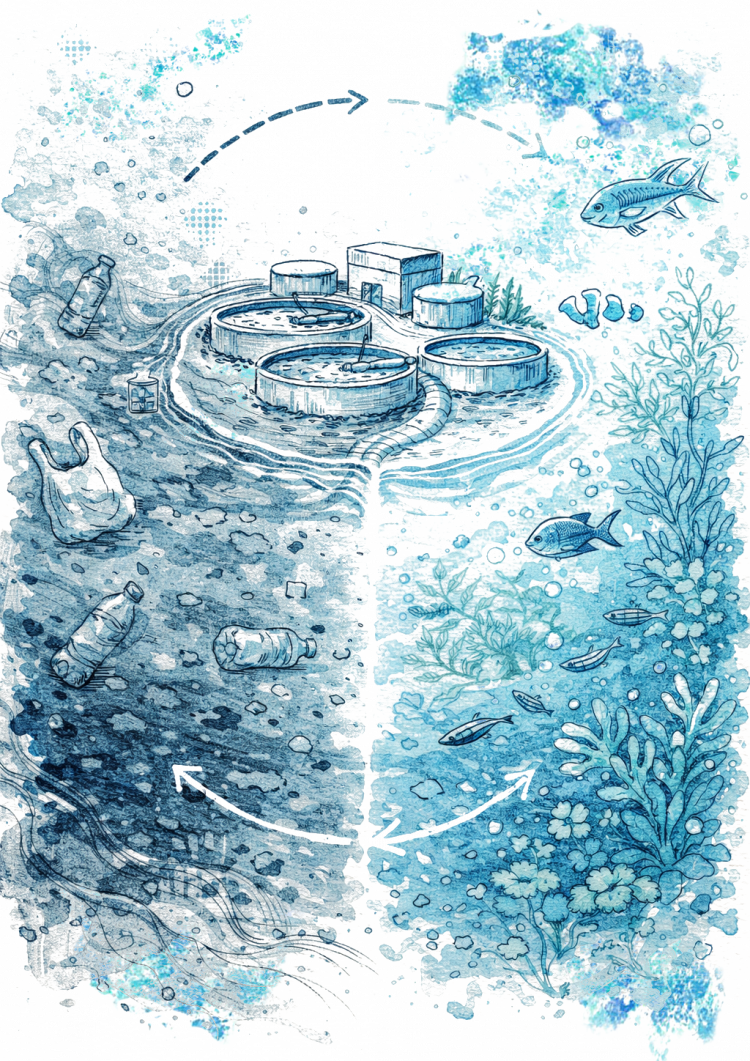
This highlights the ambivalence of these systems: what protects local human health and mitigates ecosystem damage can still have significant global climate side effects. The WOOSU project tackles this by reducing energy consumption and rethinking plants0 outputs, seeking symbiosis with the surrounding territory. “We aim to map areas where the plant can supply treated effluent or material waste that can be valorised economically or environmentally. We are using a multi-symbiotic evaluation model to map and match donors and recipients,” the researcher explained. Circularity becomes more than an idea – it becomes reality. What waste do the plants generate? Who can use it? Under what conditions? With what quality, frequency, and cost?
One example is reusing treated water for industrial purposes. “A key industrial symbiosis we are exploring is returning treated water at a suitable quality (class B) for industrial use,” said the researcher, emphasising the benefit: “This avoids using potable water (class A) for industrial applications.” Moreover, treated water can also irrigate public spaces such as municipal gardens or farmland, closing the cycle efficiently. “Sludge can also be valorised; it can be dehydrated, treated, and used as fertiliser. Anaerobic digesters convert organic fractions into biogas and biofertiliser,” António Baptista explained, highlighting that biomethane can directly replace fossil natural gas. This industrial symbiosis logic extends to energy, using covered or underutilised areas for local renewable electricity production via photovoltaics. Rooftops of plants’ buildings or nearby shaded areas could increasingly serve this purpose.
Many ideas and solutions seem easier to realise than giving a mermaid legs. But circular economy remains far from dominant. “End-of-year data show that globally, the circular economy represents only around 7% of human economic activity. The world still largely operates linearly: extract, transform, use, and discard,” the researcher explained. Barriers include lack of trust and inaction among economic agents and consumers, regulatory issues, and environmental damage costs not being reflected in final prices.
Is there enough material to supply operations? Is the quality consistent with technical requirements? Is the availability consistent with time? Can secondary material compete with established virgin raw materials costly-wise? All these factors can block solutions that, in theory and by (ancient) common sense, are the best ones – and were the norm three centuries ago, when circular economy prevailed. (so that contract signing with Ursula the sea Witch seems simpler to understand after all these questions)
From detection to mitigation
INESC TEC research is evolving towards systemic approaches, such as the SIMBLO4WWTP project (Multi-Symbiotic InterOperable Model for AI-Optimised Sustainable Wastewater Treatment Plant). “We seek to create ecosystems that move towards carbon neutrality and ideally regenerative operations – a system that returns value, creates positive impact, and does more than simply mitigate problems,” said António Baptista.
The backdrop is climate emergency, water scarcity, ecosystem pressure, and increasingly vulnerable civil infrastructure. Baptista mentioned a “triple planetary crisis”: global warming, diffuse pollution, and biodiversity loss, warning that even if greenhouse gas emissions stopped today, recovery could take three decades. Water is central: “It will clearly become scarcer in some regions, such as the Mediterranean latitude where Portugal is located. Proper water management will be increasingly imperative.” Immediate issues cannot be ignored. One of the most serious is waste: “Over 50% of water currently injected into the national supply network is lost through leaks and inefficiencies. It is unacceptable and should mobilise local management and citizens for change.” Beyond scarcity, we must seriously consider ageing infrastructures, poor territorial planning, and economic models treating finite resources as abundant.
Luís Coelho highlighted the need for more precise sensors to turn monitoring into actionable capacity. António Baptista emphasised integrated action, decision models, and recovery networks. Without monitoring, there is no good management – and without systemic vision, monitoring falls short.
At a time when the Iberian Peninsula alternates between extreme drought and heavy rainfall, when data centres reopen discussions on the water cost of digital transition, when war exposes critical infrastructures’ vulnerability and access to potable water and resilient sanitation, and when cities face ageing networks, INESC TEC wants to make a difference.
The question is no longer just how to treat water better. It is how to use it well, measure it, and return it better to the system.
“Life is (really) better down where it’s wetter”
 News, current topics, curiosities and so much more about INESC TEC and its community!
