


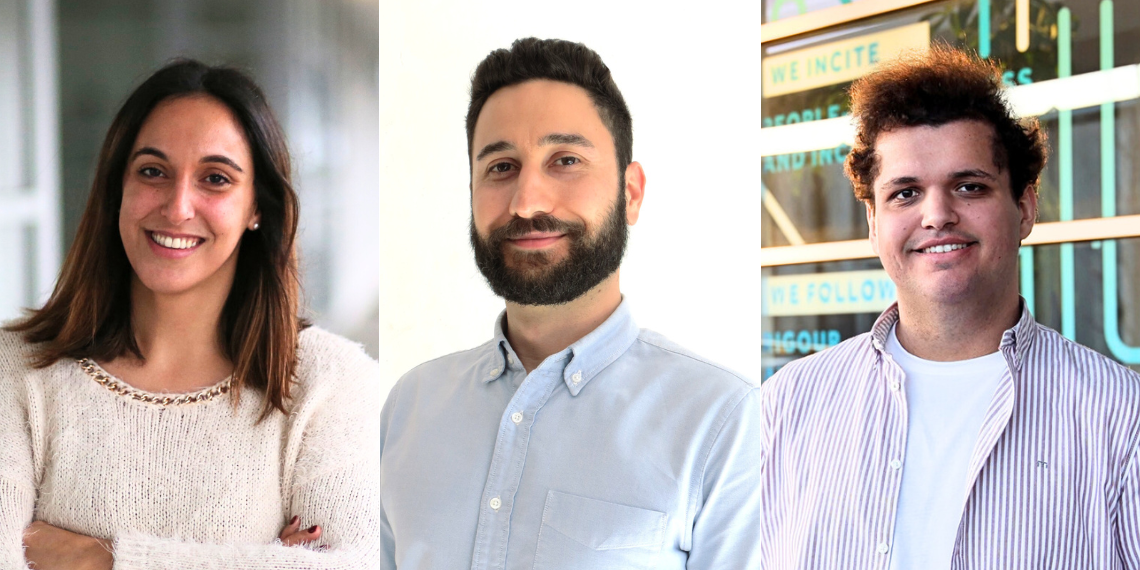
Paula Rodrigues
“The HASLab coordinators would like to nominate Paula Rodrigues for her exceptional performance and decisive role in promoting and communicating the Deucalion Supercomputer, contributing strategically to the positioning within the national and European advanced computing landscape. Through clear, consistent communication complying with the objectives of the Supercomputer within the CNCA, she has translated the technical complexity of the project into an accessible and inspiring narrative for different audiences: from researchers and students to policymakers and international partners. Her work has been fundamental in strengthening the visibility of Deucalion as a national and European reference infrastructure, highlighting the scientific, technological and socio-economic impact. It’s worth mentioning her path in creating the Deucalion identity and visual branding, as well as in community building – which has enabled the creation, establishment and consolidation of a strong, modern and coherent brand across all communication channels. The design and development of the new website, which will be launched shortly, represents an important milestone in this process, offering a clear, functional and visually appealing platform capable of effectively communicating services, results and opportunities to the community. In addition, her dedication, proactivity and ability to liaise with multiple stakeholders (Paula and the rest of the HASLab team working on Deucalion played a key role in the success of the visit of the European Commission Vice-President, Henna Virkkunen, to Deucalion) have been decisive in ensuring a consistent institutional presence, contributing to establishing Deucalion as a strategic infrastructure within the European HPC ecosystem and INESC TEC as a reference entity in the European HPC community.”
– HASLab coordinators
How was the process of communicating this project to such diverse audiences?
The starting point is the same as for communicating science: understanding who is on the other side and what that person needs or wants to know about the Deucalion supercomputer. For researchers and students, the idea is to disseminate more technical capabilities, use cases and opportunities. Concerning policymakers and institutional partners, the task revolves more around impact, strategic position and the scientific and socio-economic return the machine can generate. What has worked best is building a coherent, established narrative and explaining “what it is for”, “who can benefit from it”, “how to access it” and “how it can influence”. More recently, we’ve highlighted real examples, project stories and results that make advanced computing more tangible and relevant, both in Portugal and internationally. For those who wish to explore further, we are about to launch the Deucalion website here.
In what way did continuity (BOB, MACC, Deucalion) help to consolidate the community and the brand?
Continuity was decisive because the entire path, from BOB and MACC, consistently established the same community, which not only remained but also grew over time. This journey allowed us to create a common language, communication routines, trust with users and partners and, above all, a sense of belonging to this community. This is now very clear, since many current Deucalion users already had experience with the BOB supercomputer, and have always been part of this community (e.g., in the field of physics).
When Deucalion arrived, that community remained our focus, as it made perfect sense, from a communication perspective, to supplement, consolidate and serve that user base, reinforcing key messages, maintaining a modern and clear identity and giving visibility to people and projects.
What was the significance of the visit by the European Commission Vice-President, Henna Virkkunen?
It was a very important moment for several reasons. First, because of the institutional recognition of Deucalion as a strategic infrastructure within the European HPC context. The Vice-President travelled to Portugal for the Web Summit and specifically requested a trip to northern Portugal to visit this infrastructure. That makes us very proud. Secondly, it helped position INESC TEC as a credible and active partner within the national and European HPC ecosystem. Finally, this type of visits has a very positive internal effect: they reinforce our sense of mission and give visibility to our work, particularly the scientific team that has been working in this area. In my case, as we were working on the rebranding of the Deucalion/CNCA brand, the goal was to improve the brand’s presence in the data centre, reorganising and decorating the space to make this and future visits more impactful. It is worth mentioning that the preparation of this visit also involved the HASLab team working on Deucalion, which was crucial to ensuring everything met the standards we had set.
Which aspects of your job do you enjoy the most?
One of the aspects I value most is transforming complexity into clarity and seeing that clarity generate action – whether in the form of an application, a partnership, a project or a growing community. The other aspect is the human dimension. As at INESC TEC, Deucalion also brings together people with very different scientific backgrounds and profiles, creating multidisciplinary teams, combining different objectives and establishing a common thread. I feel that communication around Deucalion has been opening doors and bringing science closer to society, which is extremely positive.
How do you comment on this nomination?
I’m very happy with this recognition, since it reflects an ongoing, long-term teamwork, particularly with HASLab, the National Advanced Computing Centre and everyone involved with Deucalion on a daily basis. Ultimately, what matters most to me is communicating this scientific infrastructure effectively: giving it visibility, making it understandable and demonstrating the value for research – within the national and European contexts.
Serkan Sulun
“We’d like to nominate the researcher Serkan Sulun to acknowledge his effort, professionalism, motivation and dedication over the past months. His commitment led to high-impact results for CTM during the month of January, notably within the scope of the European MechEye project – which will enable the leveraging of new research activities – and the acceptance of a paper in IEEE Transactions on Multimedia (stemming from his PhD work). It’s also worth mentioning his responsibilities concerning students’ work, whose continuity needed to be ensured. The coordinators of CTM would like to thank Serkan Sulun for all his contributions and for this high-quality work, which is of great relevance to CTM’s national and international standing in the areas of multimedia, computer vision and Artificial Intelligence.”
– CTM coordinators
You’re part of the MechEye project; could you tell us more about this project (main goal, key results, challenges, innovative factor, etc.) and about your activities/work within its scope?
The MechEye project focuses on using AI to improve and automate monitoring and safety in industrial environments like factories, laboratories, and workshops. While recent Vision Language Models (VLMs, such as the image analysis mode of ChatGPT) perform well on general tasks, high-risk industrial settings require models trained specifically for these conditions. High-quality datasets for this purpose do not exist in the literature. We address this challenge by creating new datasets and training models on them to advance the state of the art, while also providing a valuable resource that the research community can build on. The exciting part is that this project improves human safety without replacing human workers. Monitoring in these high-risk environments cannot rely entirely on AI. Instead, these models augment human oversight, running 24/7 without fatigue and providing early detection of potential hazards.
Regarding your PhD work – leading to the acceptance of a paper in IEEE Transactions on Multimedia – what was the main area you’ve explored? And how does it harmonise with the work carried out at CTM?
My work focused on creating a complete prototype that can automatically compose music for any given video, seeking harmony with both the video’s emotional tone and time structure. Like MechEye, the goal is not to replace human composers, since AI is far from matching human creativity. Instead, it provides content creators, such as YouTubers, with a fast and free tool to add music to their videos, enhancing viewer engagement. The project’s multi-modal nature meets other multimedia work at CTM, including video, image, text, and audio analysis, as well as sequence generation.
Which aspects of your job do you enjoy the most?
Most AI researchers might say the best parts are the autonomy, the “non-routine”, and the constant improvement. While I certainly enjoy all of these, what gives me the most satisfaction is helping others. Watching my students run the first program they ever coded, seeing my advisees get happy about the output of their first research project, or receiving emails from researchers around the world thanking me for my open-source code, is simply heartwarming for me.
How do you comment on this nomination?
I think I am far from being “Incredible” (people who know me would agree), and many of my colleagues deserve this recognition more than I do. Nevertheless, I am very grateful to the CTM coordinators and my supervisors for this nomination. This brings a gratifying closure to a long PhD full of ups and downs. Looking back, it’s easy to focus on how I could have done better, but I realise that I only hold these high expectations because the difficulties during my PhD – which ultimately allowed me to develop skills and insight I didn’t have at the start. It’s not always easy to keep this in mind, and we can all experience “imposter syndrome” to some degree. I hope this nomination can ease that feeling, at least for a few weeks.
Sérgio Silva
“The CTM coordinators would like to nominate the researcher Sérgio Silva to acknowledge the exemplary work carried out within the European project SuperIoT. Within this European project, Sérgio Silva played a particularly relevant role in contributing to the development of the digital twin of a reconfigurable IoT node in ns-3, capable of using both radio and optical signals for communication and energy garnering. His leadership in integrating the software developed by the INESC TEC team with the project’s external partners is also noteworthy, making it possible to successfully validate the operation of the cross-layer optimisation solutions developed. The level of excellence of the work carried out, also recognised by the consortium partners, resulted in a decisive contribution to the success of the SuperIoT project demonstrators, particularly INESC TEC-led demo. This performance reaffirms INESC TEC’s position as a relevant international partner in the field of emerging, energy-efficient and sustainable wireless communication networks, a strategic area for CTM since 2011, enabling the strengthening and creation of relevant international partnerships.”
– CTM coordinators
You’re involved in the European project SuperIoT; could you tell us a little more about this initiative, as well as about the activities you carried out during the project?
SuperIoT focused on the development of next-generation Internet of Things (IoT) systems, capable of operating in a sustainable and efficient way. I focused on the creation of a digital twin for reconfigurable IoT nodes in the ns-3 simulator, enabling the modelling of hybrid communications (radio and optical) and energy garnering. The key differentiating factor was the ability to integrate this software with our partners’ solutions, validating the robustness of our digital twin when deployed in a network of physical nodes.
What is the importance of this type of project for the communications domain, for the centre’s team and for the Institute?
These projects are essential because they place us at the forefront of sustainable wireless networks. For CTM and INESC TEC, they reinforce our reputation as partners of excellence at international level. Projects such as this allow us to develop practical solutions that address current challenges, enabling us to influence the evolution of emerging communications.
Which aspects of your job do you enjoy the most?
What motivates me most is the challenge of solving complex problems that have a real impact. I particularly enjoy the connection between software development and the practical application in physical systems. In addition, the collaborative environment – both internally, at INESC TEC, and with international partners – enables continuous learning, which I particularly enjoy.
How do you comment on this nomination?
I was very pleased, and I’d like to thank the Centre’s coordinators. This nomination is an additional motivation to keep working with dedication, and I share this acknowledgement with all the colleagues who collaborated on the project, as this success was a collective effort.
 News, current topics, curiosities and so much more about INESC TEC and its community!
