


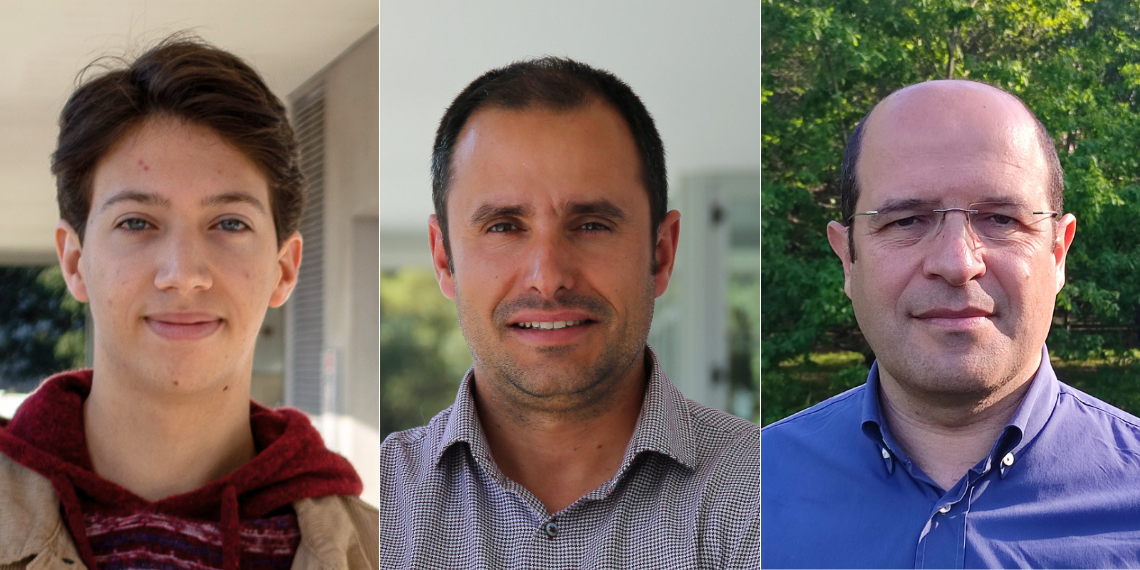
Domingos Bento
“We’d like to nominate Domingos to acknowledge his cross-cutting work across multiple service activities in the areas of robotics and IoT. Throughout this period, he has demonstrated a high level of technical competence and professionalism, with concrete, high-quality contributions that have been instrumental in meeting demanding deadlines across the six ongoing projects in which he is involved.”
– CTM coordinators
The CTM coordinators highlighted your work in providing different IoT and robotics services; could you tell us a bit more about these activities?
My work focused on the development and integration of solutions within the TRIBE laboratory context. I contribute to the design, implementation, and testing of systems, namely optimising these solutions for their future transition into industrialisation processes. Although I am directly involved in several technical stages – from development to on-site support – the results achieved stem from a collective work. The coordinated efforts of the entire team, whose complementary skills are essential, has made it possible to transform concepts into robust systems prepared for real-world challenges.
Moreover, you are involved in six projects; could you tell us which ones they are, outlining their objectives, key results, diferentiating factors, etc.?
I can mention some of the projects I have been involved in, such as ModularX_CEMTEX, ModularX_INIAV, Robo_Didático, and Orioos4Patrol. What these projects have in common is the development of robotic platforms whose main objective is to take the first steps in transitioning research and development solutions into products with industrialisation potential.
These robots are being prepared to operate in very different environments: from agriculture to military or patrol scenarios, as well as educational applications. This diversity requires robustness, reliability, and ease of operation to be priorities, as these are critical factors for ensuring that these technologies are effectively adopted by end users with very different profiles. All these advances are only possible thanks to the team’s joint effort, whose complementary expertise has been essential in transforming laboratory prototypes into more mature solutions ready for real-world use.
Which aspects of your job do you enjoy the most?
What I value most is the opportunity to work with a talented team that is always ready to tackle demanding technical challenges. The combination of continuous learning, project diversity, and the real impact of the solutions developed makes this work extremely motivating.
How do you comment on this nomination?
With gratitude and a sense of responsibility. It is an honour to know that the coordinators value my work, but I believe this nomination mainly reflects the collective effort of the team I work with. Many of the results we have achieved were only possible thanks to the dedication, professionalism, and collaborative spirit of all colleagues involved in these projects. This nomination is also theirs.
Francisco Ribeiro
“The CTM coordinators would like to propose researcher Francisco Ribeiro for his decisive contribution to the success of the CONVERGE Challenge and to the preparation of the associated multimodal dataset. This international challenge on Multimodal Learning for 6G Wireless Communications, organised within the scope of the European CONVERGE project and the ICASSP 2026 conference, provided a new multimodal dataset to the scientific community – collected in INESC TEC’s experimental infrastructure, combining radio, vision, and ground truth data for research in 6G communications and sensing. Francisco played a central role in producing, annotating, and organising this dataset, as well as in preparing and publishing (in record time) the baseline solution made available to participants, and in evaluating submissions from competing teams. This work was carried out alongside the coordination of a core task in the CONVERGE project, contributions to the A-Mover project, supervision of students, and participation in service provision with companies. For the dedication, quality, and impact of these activities, we believe Francisco fully deserves this recognition.”
– CTM coordinators
What were the main challenges in creating the multimodal dataset used in the CONVERGE Challenge? What is the differentiating factor of this solution?
The main challenge lays in integrating and synchronising several very different components within a single data collection: radio data, video, and positioning information from radio equipment used as ground truth, all with the level of consistency required to be genuinely useful to the scientific community. At the same time, this data collection also helped finalise some integration details of the experimental infrastructure developed within the CONVERGE project, which ended up taking more time than expected before the final data collection could take place.
This meant that the examples and baselines provided to participants had to be developed within a particularly demanding timeframe, requiring the design, training, and testing of three different algorithms for three separate tasks, while still ensuring the quality needed to support those taking part in the challenge.
I would say the main deciding factor of this solution is precisely the combination of complementary modalities within a real and controlled experimental environment. The dataset brings together radio, vision, and positioning data from radio equipment to study key problems in 6G communications, creating a highly relevant foundation for research in multimodal learning applied to wireless networks.
How did you manage all your responsibilities (CONVERGE, A-Mover, student supervision, etc.) simultaneously without compromising the quality of your work?
I think the most important thing is knowing how to set priorities and closely monitor the different strands of work. When we are involved in projects with different rhythms and demands, it is essential to understand what is most critical at each moment, allocate time effectively, and ensure that each task progresses with clear objectives. In more practical terms, having a well-organised task list is essential to keep track of everything without missing deadlines or details. That helps me manage multiple responsibilities in parallel without losing direction.
Which aspects of your job do you enjoy the most?
What I enjoy most is the opportunity to explore new topics and work on real problems with scientific impact and potential influence on society. This combination of research, experimentation, and practical application is highly motivating for me.
How do you comment on this nomination?
I am very happy with this nomination and would like to thank the CTM coordinators. I perceive it as a result of the collective effort of the teams I have worked with, particularly within CONVERGE – where building the infrastructure and preparing outputs such as this multimodal dataset depend on the contribution of many people.
Jaime Dias
“Last month, Jaime Dias completed one of the most complex technological processes INESC TEC has ever faced: the transfer of around 1,900 user email accounts and more than 200 application and system accounts, all managed internally, to the Microsoft 365 ecosystem. The task required much more than technical competence – it involved many hours, nights, and weekends to ensure that migrations took place when most people were not working, minimising the impact on the organisation’s day-to-day activities. It was also necessary to minimise message loss, merge accounts with different designations, and preserve calendars and contacts already rooted in the routines of hundreds of people. The result is a significantly more robust platform, with advanced protection capabilities against phishing, malware, and spam, tripling the threat blocking rate compared to the previous solution. This work even reached the University of Porto, which contacted us to exchange experiences on this type of process. If this is not incredible, what is? Hence, I’d like to nominate Jaime Dias – an entirely deserved acknowledgement.”
– Luís Seca, member of the Board of Directors
The complexity and duration of the migration process were mentioned; what motivated you to maintain this level of dedication throughout?
When you work on people’s email, you are working on a central tool in their daily lives. There was a responsibility to ensure that everything remained operational with minimal impact for around 1,900 users, and an understanding that many tasks had to take place outside working hours to minimise disruption. But this level of dedication is not unique to this endeavour: it is standard procedure within SAS. In this case, it was more visible due to the scale and impact, but the commitment is the same in any intervention.
What were the main challenges? Was there a more “critical” moment? How did you manage to overcome said obstacles?
If this had simply been a matter of migrating email accounts to the cloud, it would have been relatively straightforward, as Microsoft provides recommended procedures. However, at INESC TEC, the scenario was far more complex: many users had already been using Office 365 accounts for several years (the service became available around 10 years ago, even before Microsoft Teams existed) and had accumulated data that could not be lost. The challenge was to consolidate everything into a single account without losing information and without interrupting email services – something for which Microsoft does not provide tools or procedures. And when you step outside the expected path, particularly with Microsoft products, the question is no longer “if” a problem will arise, but “when”.
We always had a Plan B, and it had to be used a few times. There was one Saturday evening when I had tickets for a concert. An hour before leaving, I launched a process that should have run automatically overnight. All I had to do was press Enter. I didn’t make it to the concert.
These are the moments that define this kind of project: the ability to react under pressure when something does not go as planned, with everything in production and no possibility of going back.
How do you perceive the contact from the University of Porto regarding sharing information about this process – personally, professionally, and for INESC TEC?
I perceive it as recognition of the work that was done; on a personal level, it is rewarding to know that what we achieved has become a reference beyond INESC TEC. Those who followed the process understood that, in our case, this was not a trivial task and that it went very well – not only technically, but also in terms of communication with users, keeping them informed without requiring too much intervention. Fewer than 1% of users experienced difficulties accessing email, which in this type of intervention is considered a success. I believe that experience motivated the contact to exchange experiences. The University of Porto’s scenario is different; they did not face the same need to merge local and cloud accounts, so they were able to follow Microsoft’s recommended procedures. Even so, this type of inter-institutional exchange is not common – but it should be.
Which aspects of your job do you enjoy the most?
What motivates me most is the variety. No two weeks are the same, and each new problem requires a different way of thinking. Then there is the satisfaction of delivering something that is useful and important to many people, even if the work often goes unnoticed. When everything works well, no one notices – and paradoxically, that is the best sign that it is working.
How do you comment on this nomination?
I appreciate the recognition, and particularly Luís Seca’s words, but this project was not the work of a single person. The SAS team was involved throughout the entire process, and the result reflects that collective effort. If this nomination helps to give visibility to that shared work, then I am doubly pleased.
 News, current topics, curiosities and so much more about INESC TEC and its community!
