


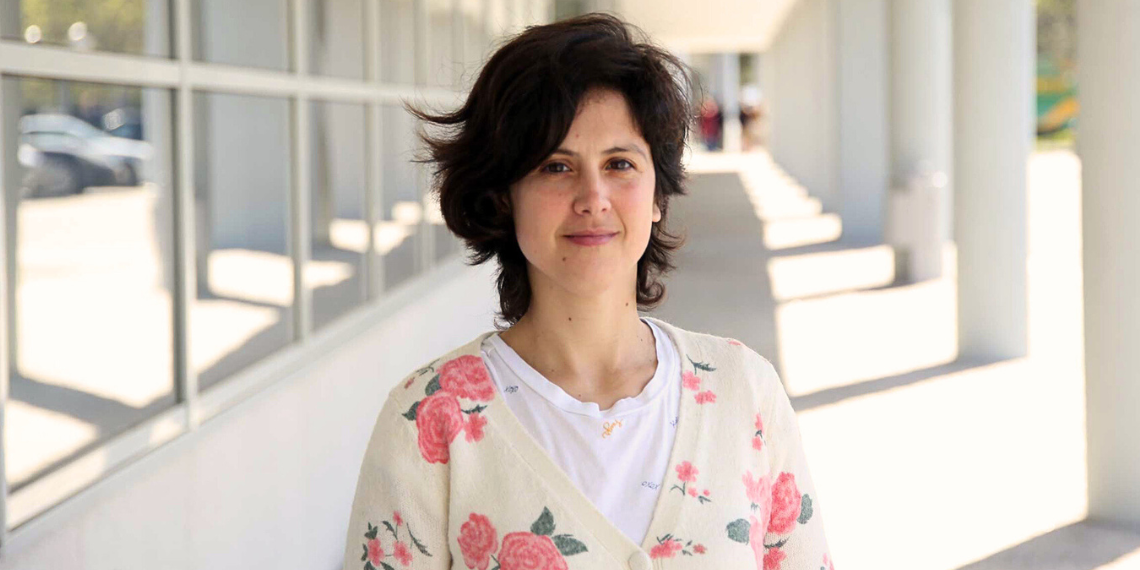
Rita Lopes
“I would like to nominate Ana Rita Lopes for the following reasons: given her participation in the TTO Circle and the quality of her work, she was invited to speak at the Pan European Conference of LESI-YMC on 7 November (Lisbon), an event dedicated to young talents in the field of technology transfer, bringing together managers and lawyers working in this area. In addition, Rita has been taking on an important role in open-source management at INESC TEC, with a workshop she is organising with an international expert (13/11) being just one of several initiatives she has been leading. Her contribution to the valorisation of the PrediCo software (in partnership with CPES), as well as the work she has dedicated to INESCTEC.Ocean, deserve significant recognition from SAL and INESC TEC.”
– Daniel Vasconcelos, manager of the Technology Licensing Office (SAL)
You participated, as a speaker, in the Pan European Conference of LESI-YMC, an event dedicated to technology transfer. Could you tell us a little more about that experience? What positive aspects do you draw from your participation, both professionally and personally?
Taking part in the Pan European Conference of LESI-YMC was extremely rewarding, both professionally and personally. LESI – Licensing Executives Society International – is a major global community in the field of intellectual property and technology transfer, bringing together experts from multiple sectors who work daily with IP transactions, asset valorisation and monetisation, innovation protection, technology commercialisation, IP management, licensing, and litigation.
It was a great pleasure to take part in this event, which brought together representatives from public and private organisations, research centres, and multinational technology companies. I also had the opportunity to be the only Portuguese representative from a research and technology organisation (RTO), reinforcing the importance of bringing INESC TEC’s viewpoint to the table. Being part of this network and contributing actively to the discussions helped strengthen relationships, expand contacts, and promote the exchange of experiences that are essential to the innovation ecosystem.
The conference addressed particularly relevant and current topics. Among them were the challenges posed by Artificial Intelligence to intellectual property rights:
- Who owns the rights when an invention involves AI?
- How should autonomously generated outputs be protected or paid?
- Where is the threshold between human authorship and algorithmic contribution?
- What might happen in a future shaped by quantum computing?
The participants also raised critical questions regarding data protection, management, and valorisation, including the complementarity between the GDPR and the Data Act, strategies for cataloguing and protecting trade secrets, clarifying ownership, defining data governance from the start of projects, and understanding how major institutions and companies are navigating these challenges – which clearly influence all sectors.
It was also valuable to learn about the differences between countries regarding the management of employee inventions and to reflect on key questions such as:
• How can we balance the need to attract investors (who often demand specific ownership terms) with the position of universities and public entities regarding IP rights in spin-offs?
• How can IP be protected without compromising academic freedom to publish, and vice-versa?
• How should IP resulting from publicly-funded research be managed to ensure both protection and access?
Among the main take-home messages, I would highlight:
• The need for thorough due diligence to understand prior commitments associated with IP used across multiple projects;
• The fact that open-source decisions must be strategic rather than merely procedural, choosing the licence and dissemination model that maximise impact while protecting the institution.
Taking part in this conference allowed me not only to deepen technical knowledge and follow international trends, but also to reflect on the role institutions like INESC TEC should play in an ecosystem where solutions must necessarily be collaborative, involving multiple stakeholders and requiring inter-institutional approaches. On a personal level, it was also motivating to feel the relevance of our work recognised by such a qualified and dynamic international community.
You’re also involved in open-source management at INESC TEC. What activities have you been carrying out in that area? And beyond the workshop, which actions are planned?
Yes, I have been involved in the initiative to disseminate, manage, and valorise INESC TEC’s open-source software, contributing to the development of institutional guidelines that support informed and strategic decisions on when and how to make code available as open source. This initiative is the result of a multidisciplinary effort involving INESC TEC’s Board, SAL, SAAS, and CPES. The goal is to maximise scientific and technological dissemination while ensuring adequate protection of institutional assets.
I believe that public investment in research should return to society not only in the form of publications, but also through economic, social, and technological impact. In this context, it is also important to highlight the open-source software developed at INESC TEC, promoting it as an integral part of the institution’s scientific and technological portfolio. In the medium-term, we want open source to become a showcase of the institution’s capabilities, accelerating knowledge transfer to industry and the wider community.
Internal capacity-building actions are essential; open source involves legal, technical, and strategic dimensions, and empowering our researchers requires a solid understanding of these layers. The workshop Unlocking Research Value: Valorizing Intellectual Property Rights, from patents to open source, in Software Transfer, held with the contribution of expert Malcolm Bain, is a step in that direction. It addressed legal and strategic aspects and included practical case studies of INESC TEC open-source projects in health (Moodbuster), energy (PrediCo), and robotics (RobotAir), presented by the respective researchers – Artur Rocha, Ricardo Andrade and Rafael Arrais.
We’re planning additional actions at the Centres’ level, promoting knowledge-sharing sessions, explaining the guidelines, and identifying specific needs. The goal is to build a coherent and impactful institutional approach to open source, combining training, specialised support, and strategic guidance.
Effective open-source management requires informed decisions, clear institutional guidelines, and specialised skills, ensuring a solid and impact-oriented strategy.
You also dedicate time to other initiatives, in partnership with different structures within INESC TEC (such as CPES or INESCTEC.Ocean). How do you find balance in this “multiple” roles, and what challenges have you faced?
Finding balance across different initiatives and teams has naturally been a challenge (perhaps the biggest), but also a unique opportunity for improvement. The main challenge is maintaining focus: understanding the priorities at each moment and context, without losing touch of the strategic vision and of what is being built. It is a constant exercise in managing priorities, knowing when to “zoom into the detail” and when it is essential to “zoom out” to anticipate future needs and understand how today’s decisions shape tomorrow’s path.
Working across multiple teams requires, above all, strong communication skills. The greater the multiplicity of roles, the greater the need to ensure said balance, presence, and transparency: clearly understanding what I can deliver, recognising what I cannot do alone, and, above all, identifying key colleagues with whom I can build bridges to overcome those limits. This collaborative work is essential for teams to evolve cohesively and efficiently.
Which aspects of your job do you enjoy the most?
The opportunity to valorise knowledge in many ways. Even starting from a common base, each technology, context, and team brings new perspectives – nothing is automatic. There is a strong sense of collaboration and communication, both with researchers and external partners; this dialogue allows us to discover the best protection, management, and valorisation strategy for each IP asset.
I particularly enjoy telling the “story” of a technology, from creation to integration or implementation in the real world. Being, in some sense, one of the “guardians” of these assets is a responsibility I value greatly.
I am motivated by thinking about the “why” and the “how” behind each development: where it fits, what problem it solves, who can help complete the puzzle, who we should contact to move forward. I also appreciate the dynamic nature of the process – adjusting, re-planning, and redirecting the strategy as we gain new knowledge and identify new opportunities.
Ultimately, it is a role that thrives on collaboration, discovery, and bridge-building, and that is what motivates me every day.
How do you comment on this nomination?
First, I am very grateful, since it’s a recognition of the work I have been developing, particularly in areas that are new to the institution – and where we are still building reference models and practices. This nomination carries weight when we are working on the foundations of new capabilities, as it confirms we are moving in the right direction.
This year I have been involved in several fronts – from training initiatives to the effort to maximise the impact of INESC TEC’s open-source software, as well as the work within INESC TEC OCEAN, focused on defining an intellectual property management framework. Seeing this effort recognised reinforces my motivation to continue contributing to the institution’s strategic development.
 News, current topics, curiosities and so much more about INESC TEC and its community!
