


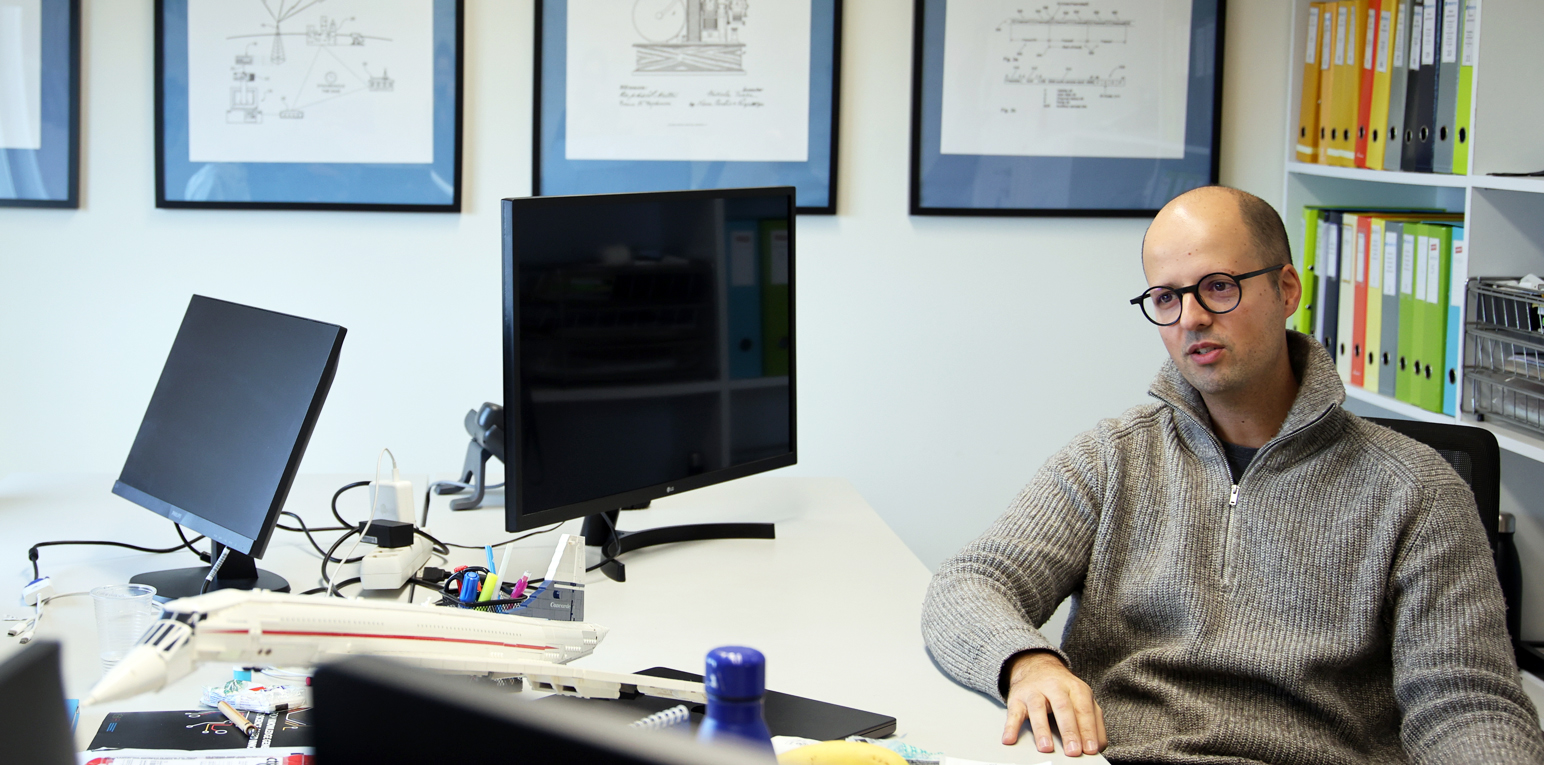
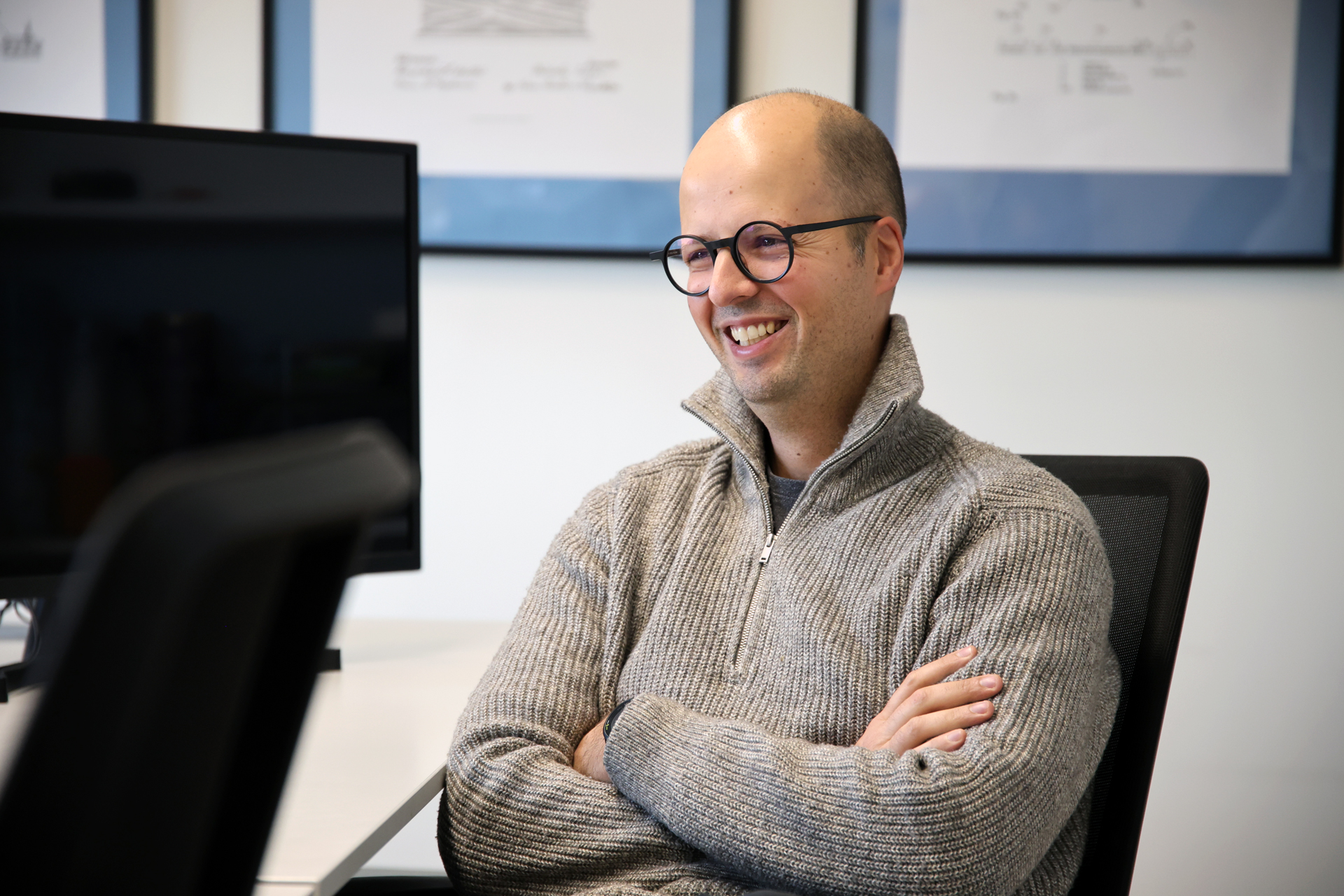
Daniel Vasconcelos is responsible for taking even further what “2,000 brilliant people” do every day at INESC TEC. The Manager of the Technology Licensing Office began his career as a researcher but discovered he works better as a manager eight years ago. It was then that he started to learn that what he does is a “contact sport”.
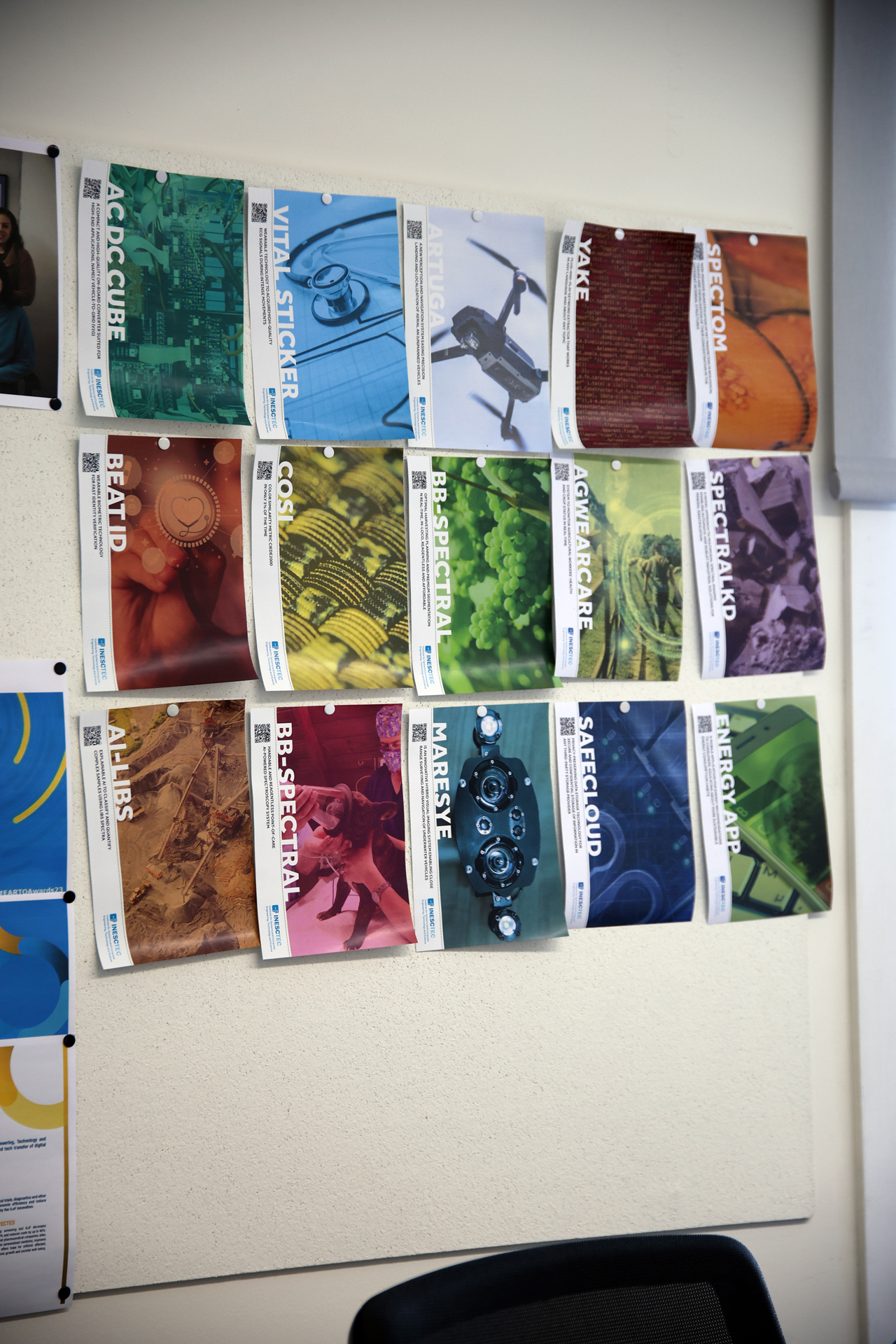
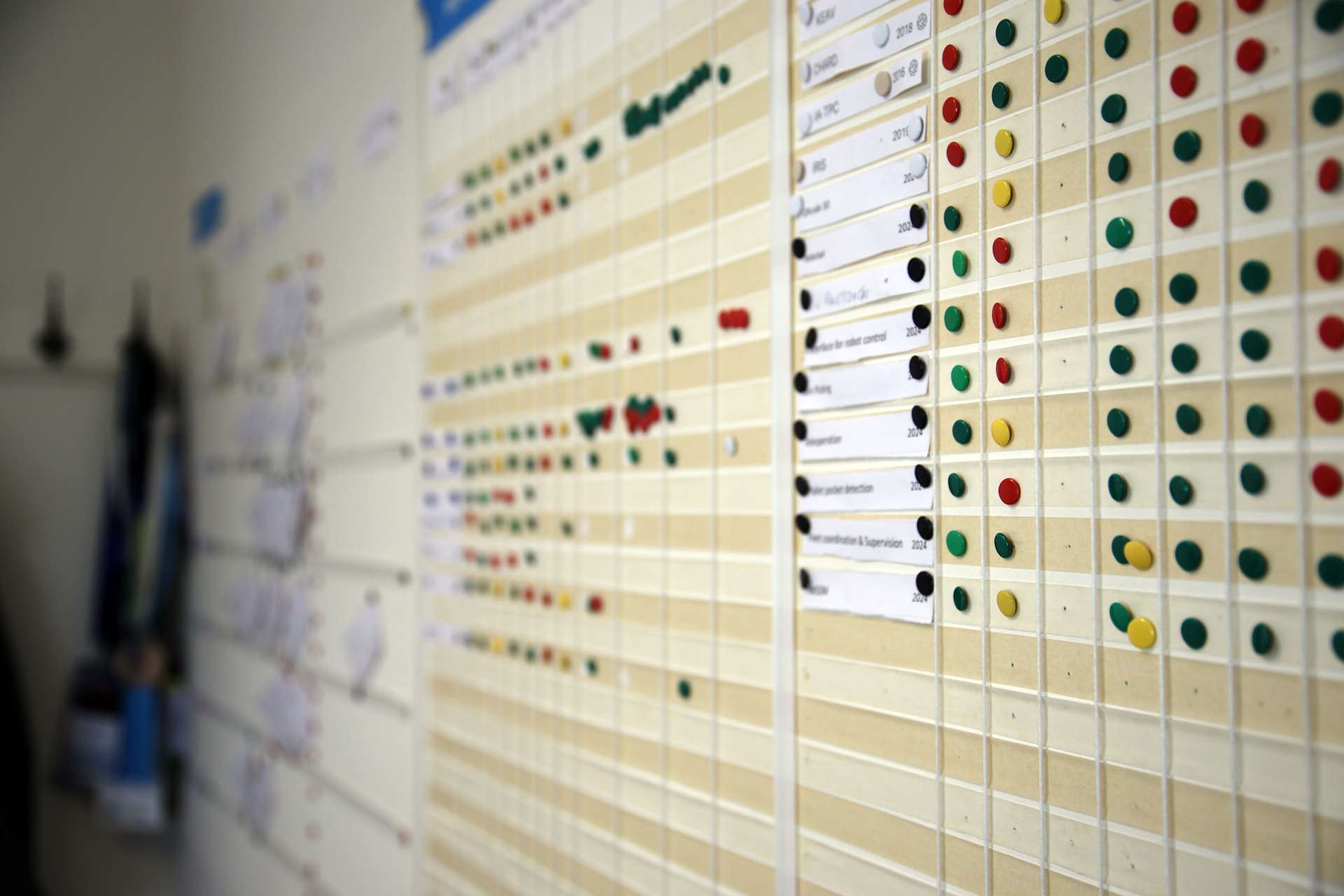
Every square metre is precious in Daniel Vasconcelos’ office; the four walls of the rectangular room, with an open view over the Asprela knowledge campus, are covered in paper, boards, colourful pushpins and a scribbled whiteboard – the result of the team’s latest brainstorming session. From this “laboratory”, INESC TEC “exports” knowledge to the world. There is a sense that everything is in motion, and that the neat rows of coloured pins marking ongoing technology transfer processes represent a snapshot that could change within hours.
But if he could choose, he would not be working on the Institute’s third floor; that’s because if there is no fixed time for innovative ideas to “collide”, and they do not wait their turn to knock on the door. Yes, “part of the work happens here”, but also on the stairs, in the cafeteria, etc. “If I could choose a place to work, I think I’d go for the welcome desk, where everyone passes through,” Daniel said, smilling. After all, this really is “a contact sport”.
What kind of sport is this? Daniel Vasconcelos leads a team that paves the way for the development and commercialisation of INESC TEC’s technological solutions. Every day, he rehearses the best way to build bridges between the labs and the market. From the front row, he has watched how a “living organism of hundreds of people” has evolved and grown into one of the national driver positioning Portugal as a relevant technology transfer player in Europe.
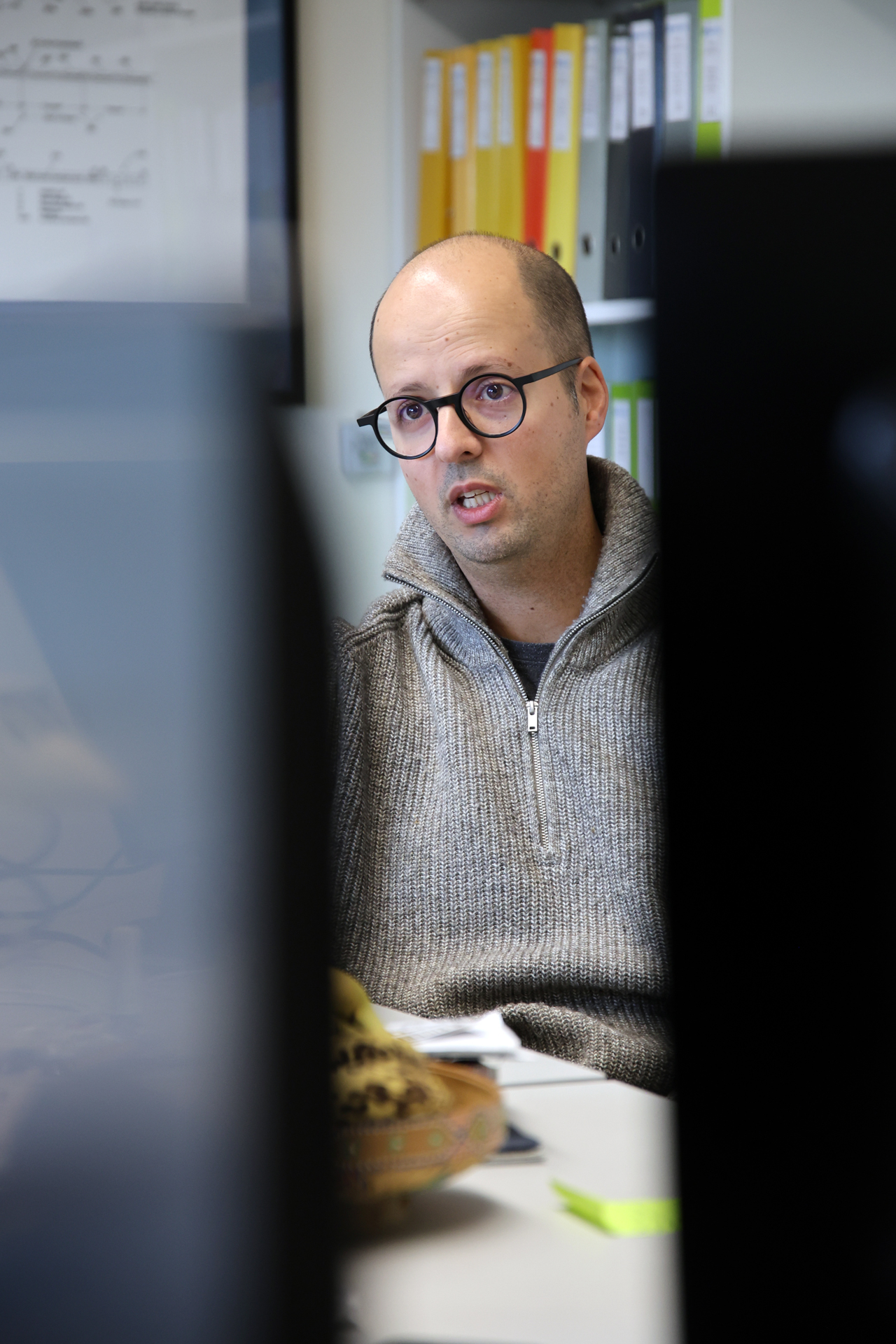
He has spent eight years “building the future” at INESC TEC. Recently, his responsibilities expanded to include the newly created Office for Entrepreneurship and Spinoffs. Always ready to learn, expose himself and “acknowledge his own ignorance”, he found space to reinvent himself. In this “amusement park”, he sees “2,000 people doing brilliant things” every day. Which means: 2,000 people within conversational reach. “I can talk to each of them and understand what’s going on, how I can help. Essentially, my role is to take what researchers tell me and pass that information on to other partners, so that ideas can reach the market.”
Hardwork
And to think it all unfolded through “a series of coincidences”: INESC Porto first catching his attention after stumbling upon an entrepreneurship event in a hall at the Faculty of Engineering of the University of Porto (back when Daniel still had his sights set on a future in bioengineering research); later, during his PhD at i3S, another chance encounter at a workshop led him to João Claro, now Chairman of INESC TEC’s Board of Directors.
By the third sign, he realised that this might indeed be the right path. “When I was a researcher, I started developing a new biomaterial that I tried to protect with a patent – and it went very badly. That led me, during my PhD, to pursue a second master’s degree in Economics and Management.” His interest in technology transfer was growing, and in one class he heard one of the programme’s directors say that INESC TEC was “the institution that does the best technology transfer in the country” – and Daniel took note.
“I started checking opportunities on the INESC TEC website, until a grant in this area came up, and I applied.” That was his first glimpse of the “machine”. Catarina Maia – “with a very distinctive culture of continuous pursuit of excellence” – was then in charge of the service. She “infected” him with that spirit. “I found a very relaxed but also demanding environment. I remember that when I arrived, the questions were very much: ‘What do you know?’ ‘What do you know about open source? What do you know about software?’ I wouldn’t say I was afraid, but I felt I had to work hard.”
He had already done a good warm-up; after all, his obstacle course towards INESC TEC began in 2011, during the difficult years of the financial crisis. He belonged to the first cohort of a Bioengineering degree programme that had not yet had time to mature. “Nobody really knew what a bioengineer did.” There was a sense that everything still had to be built: a start-up ecosystem yet to emerge, many classmates leaving the country, and opportunities few and far between.
Until one appeared in the form of a research project that took him to the orthopaedic operating theatre at Hospital de São João every Friday. But that was not his path, and the turning point came during his PhD. “I realised how precarious our situation was when there was no money for reagents. I had to step outside my comfort zone and learn about other domains – namely management and economics.”
The “death squad” learned how to care for the tiger
At INESC TEC, he discovered he worked “better as a manager than a researcher”. He immediately felt he was in the right place. “At that early stage, it was critical – even for my self-confidence – to learn from the best, whether at CEIPI (Centre d’études internationales de la propriété intellectuelle), the European Patent Office, or Harvard. I needed to be able to discuss these topics at an international level. My perception was that INESC TEC would soon become a relevant European player.”
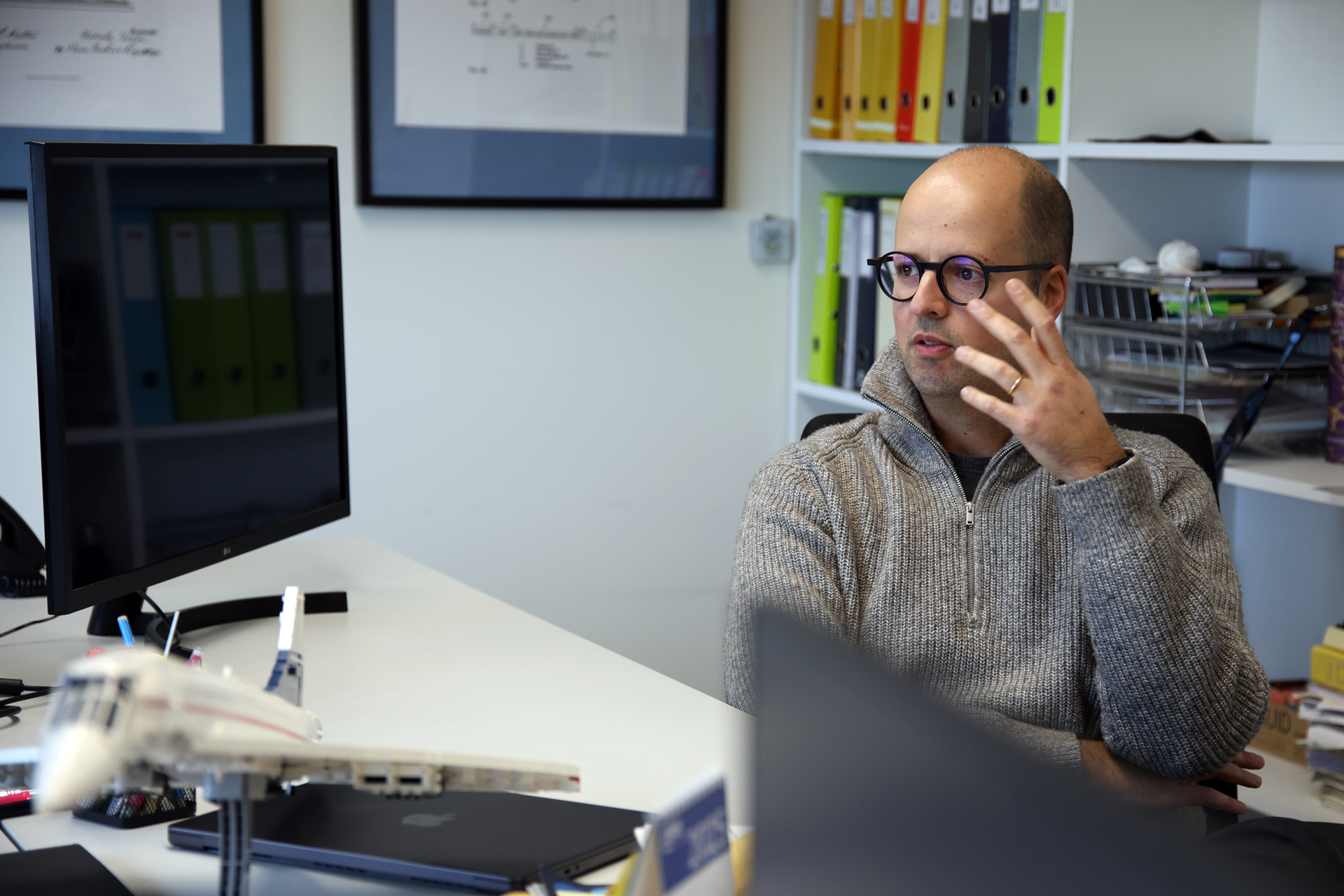
Beyond the knowledge collected over years of study, he always had strong support. He shares his days with researchers, lecturers, “people who enjoy explaining things” and spending hours sharing information. It was early on that he heard the definition that would summarise the years to come: this is a “contact sport” – one must step forward, get closer to people, and be willing to expose oneself.
Technology transfer is more than paperwork, and Daniel gradually crushed the idea that he leads a team of “bureaucrats”. He now feels that proximity work has generated a “change in attitude”. “Over time, we’ve come to understand that researchers are extremely busy, and when they don’t reply, it’s genuinely because they don’t have time. Part of my journey has been figuring out how to become an internal partner rather than being seen as part of an annoying structure,” always ready to poke holes in years of work.
“We’d go to the cafeteria and sometimes people would say, ‘Here comes the death squad, watch out’,” he recalled. Pedagogy helped – maybe becoming a father along the way did too, he suggested. He’s not dealing with children, but aren’t scientists also “free spirits”?
“This is like trying to walk a tiger on a leash – you don’t walk a tiger. You can offer the tiger some rewards, spend time with it, and hope it doesn’t jump on you. That’s it. We’re more relaxed now, because we realise that people gradually come closer and give us what we need, so we can help the Institute. They understand us, and we understand them better when they tell us their wildest ideas, their ambitions, why they think a particular technological path is the best,” Daniel summarised.
From lab coat to apron
Many of the paths these technologies may take are displayed in his office. Side by side with INESC TEC’s patented technologies, the avalanche of pushpins is a symptom of the frenetic activity of an institution going through a “concrete evolution”. The walls reflect the making of the future Daniel referred to.
“By selecting the cases we devote more time to, the technologies we protect or promote more intensely, we are effectively creating real options – options that can allow the Institute to grow in a specific direction. Many of these seeds won’t sprout, but our role is to ensure that, in the future, there are always points we can leverage, if they align with the interests of INESC TEC and the researcher.”
Sometimes he wouldn’t mind having a “predictable” day in his calendar. But that’s difficult in a service where every week starts with a blank agenda. “I operate on the principle that managers have total freedom. They have full autonomy and responsibility within the sandbox I give them.” According to Daniel, sometimes it’s enough to put on the motivator’s hat: “At times, I feel it’s enough to share with people some of the knowledge I’ve acquired, as well as confidence, energy, while being available for whatever comes up.”
Whether in the office, at the “reception desk”, on the stairs or at a distance. And because he doesn’t want knowledge locked away, far from where it can make a difference, ideas often emerge while reading the newspaper, listening to a podcast or watching a play. There it is: the missing puzzle piece, or the need to change the colour of a pin.
“I get ideas about how to connect dots when I’m doing other things. I let it flow and jot it down on a Post-it, or send myself a message or an email. We try not to take work home, but I don’t think there’s any way around it when you work in any knowledge dissemination field,” he mentioned.
So, when he really wants to relax, he ties around his waist a different kind of coat from the one he wore early in his career and retreats to his home laboratory: the kitchen. He said he enjoys “optimising” recipes. “My colleagues don’t believe me, but I would genuinely love to have formal training in this area. I feel very connected to my past life as a researcher – to method.”
Theatre, cooking, walks – as long as they’re with family, they’re always “great” – all have Espinho as their backdrop. He saw no reason to trade the smell of the sea, the open view of the ocean, and the way the sun bids farewell to the coastal city every evening, for anything else.
It helps to know that the next day he’ll make the journey back to Porto. He remains driven by a “strong sense of responsibility”, a commitment to the country’s social and scientific development. Now, the plan is to continue working every day on “the principle of autonomy”: “It’s very important to me to feel that people can continue their journey even if one day I’m no longer here. That’s the direction I’m trying to move in.”
And one certainty for the future: there will be days of disagreement – and that’s normal, he said – but in INESC TEC’s corridors, “people will talk, smile and share their preferences and experiences”. And from those conversations, more pushpins will end up on the wall. Then, it’s up to Daniel’s team to find a way forward.
 News, current topics, curiosities and so much more about INESC TEC and its community!
