


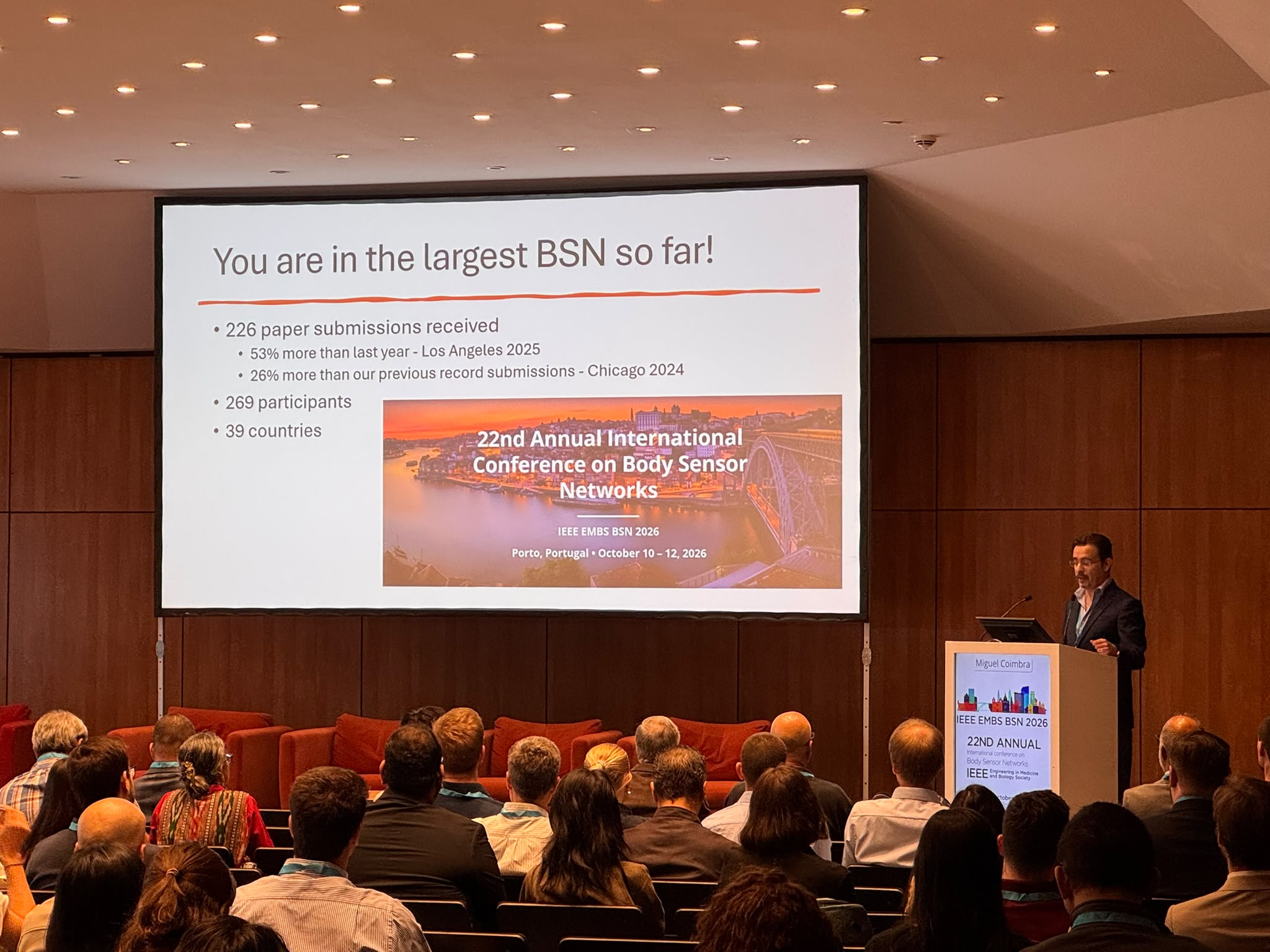
From Lab to Life: Scaling Intelligent Sensors for Personalised Health was the theme of the 22nd IEEE-EMBS International Conference on Body Sensor Networks (BSN 2026), organised by INESC TEC researchers. The event brought together more than 250 participants from nearly 40 countries in Porto, making it the largest edition in the conference’s history.
The event focused on wearable body sensors, physiological monitoring, mobile health, Artificial Intelligence (AI) in healthcare, computational medicine and rehabilitation technologies. One of the key messages was the need to bring scientific advances closer to real-world applications, particularly in clinical practice and in improving citizens’ quality of life.
This theme was reflected in the three keynote lectures, which addressed rehabilitation robotics (Hermano Krebs, MIT), prosthetics with multimodal feedback (Solaiman Shokur, EPFL) and the use of AI in healthcare delivery (Catarina Farinha, Sword Health). The programme also featured scientific sessions, poster presentations, technology demonstrations, workshops and two panel discussions, one of which focused on the relationship between research and industry. The number of scientific submissions increased by around 50% compared with the previous edition, exceeding the previous record by 20%.
Several INESC TEC researchers played key roles in organising the event, including Miguel Coimbra as Conference Chair and João Paulo Cunha as TPC Chair, alongside Carlos Ferreira, Duarte Dias, João Pedrosa, Francesco Renna and Eduarda Almeida. The organisation also involved researchers from other institutions, including the Faculty of Sciences of the University of Porto (FCUP), where Miguel Coimbra is also a lecturer, as well as students and early-career researchers from IEEE EMBS student chapters, who supported communication and outreach activities.
“For INESC TEC, the conference was an opportunity to strengthen the international visibility in healthcare technologies, particularly highlighting the work carried out by the Institute’s researchers in bioengineering, in the fields of wearables and signal analysis, and to establish Porto as a hub for research and innovation in this area”, explained Miguel Coimbra.
The overall experience was one of the most praised aspects of the event. The Alfândega do Porto, a performance by a university musical group (tuna académica) and a dinner featuring a Douro experience allowed participants to discover the city without having to take time away from the conference.
The event was supported by PLUX, Cardio-ID, Porto City Council and FCUP, while student grants received support from the NSF and IEEE EMBS.
 News, current topics, curiosities and so much more about INESC TEC and its community!

