


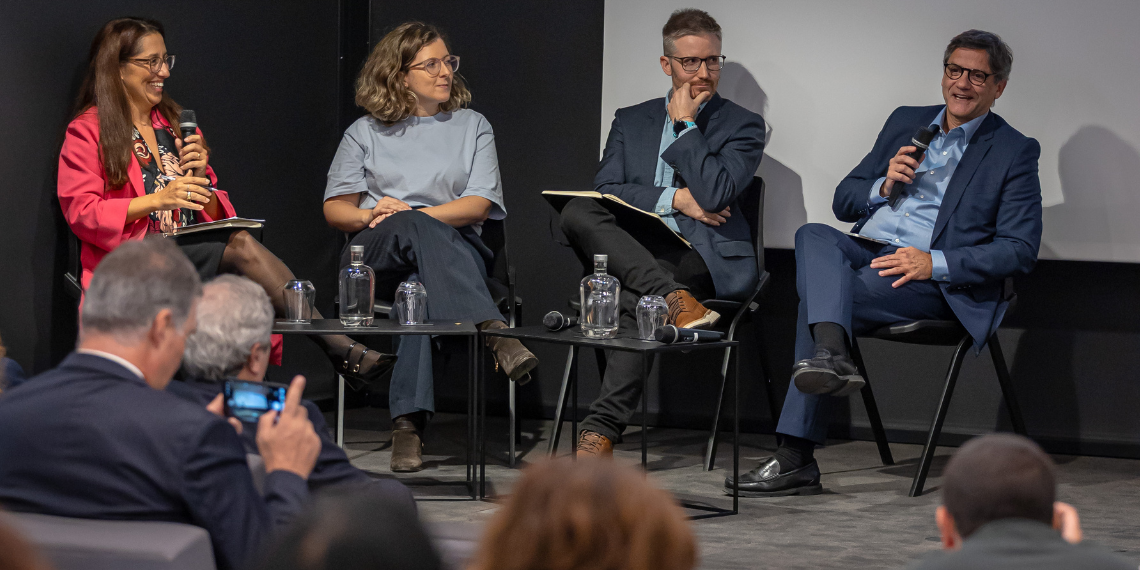
What steps must be taken to ensure sustainable and efficient data centres in Portugal? And what role can supercomputing play in this process? INESC TEC took part in an initiative organised by APDC – Digital Business Community, in collaboration with VdA and Portugal Data Centers, to discuss the installation, operation and future of these infrastructures in the country.
The event The Future of Data Centers in Portugal brought together experts from sectoral associations, companies and academia. The participants discussed key questions like regulation, compliance and legal certainty; investment and the sector’s development in Portugal; the sustainability and energy efficiency of data centres; technological innovation and the future of data centres and the digital ecosystem in Portugal.
Rui Oliveira, INESC TEC’s Director, joined the discussion on this last topic – more specifically, in a conversation alongside Sandra Almeida (APDC), Ângelo Monteiro (NVIDIA) and Cláudia Alves (Google), Rui Oliveira highlighted the “absolutely vital role for the country” played by the Deucalion supercomputer, mentioning that it is part of the European network of supercomputers, EuroHPC. Thanks to this computing infrastructure, it has been possible to “open the door to a range of initiatives – in education, academia, research and knowledge, as well as in capacity-building and professional training – which can now capitalise on data centres and AI factories,” he said.
According to Rui Oliveira, Deucalion – operated by the National Advanced Computing Centre (CNCA) in partnership with INESC TEC and the University of Minho – addresses what he considers a fundamental component of European technological sovereignty: human skills – especially given the lack of technical expertise in the design, technological oversight and operation of the technology required to implement and manage data centres. “There is a huge gap in our ability to create value in terms of applications and services within the country; without this becoming yet another import-driven investment. The key piece of the puzzle is the sustainability of infrastructures in terms of services that set us apart,” he stressed.
And for this to take place, training professionals and ensuring a labour market capable of harnessing that talent is essential. The strategy must focus on people and skills, since “the installed technology is imported investment and Portugal does not produce a single chip for a data centre.” “Sovereignty is not about having a set of physical strongboxes where we store data. If we ignore the sovereignty of human skills, which span the entire value chain (everything that happens inside those strongboxes), we risk having resources where the technology, software, applications and management are all done ‘somewhere else’.”
In addition to skills, Rui Oliveira also highlighted sustainability issues linked to the development of AI, as well as the importance of collaboration, whether at European level – where he believes Portugal must “assert itself through complementarity” in areas that set it apart from the rest of the countries – or globally, presenting as an example partnerships with US universities (particularly the University of Texas, in fields like supercomputing and energy).
The event took place on 5 November and was organised by APDC – Digital Business Community, in collaboration with VdA and Portugal Data Centers. More information about the initiative (including the topics covered in each panel) is available here; readers can also watch the event’s video here.
The researcher mentioned in this news piece is associated with INESC TEC and UMinho
 News, current topics, curiosities and so much more about INESC TEC and its community!
