


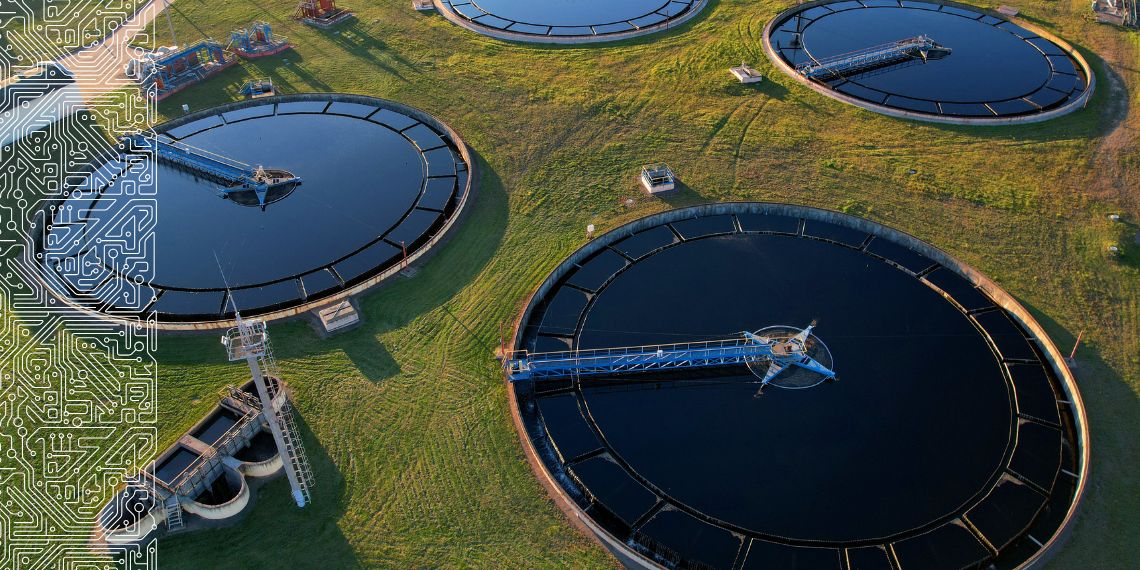
Making wastewater treatment plants even more sustainable and efficient? It’s possible. Within the scope of the WOOSU project, INESC TEC is developing an advanced technological solution dedicated to optimising the operation of these infrastructures. The future lies in unlocking new circularity opportunities involving different elements of the system – water, energy, and materials.
Although the collection and treatment of urban wastewater in Portugal is already widespread, the proportion of treatment plants equipped with more advanced treatment stages still leaves room for innovation. This is where the WOOSU project comes in, by proposing a strategic response for the country. In addition to transforming these infrastructures into more efficient, environmentally responsible systems that are better integrated into their surrounding territories, the project aims to valorise traditionally underused by-products such as sludge, biogas, and heat, reintegrating them into the value chain. To achieve this, INESC TEC will develop new multi-aspect industrial symbiosis models. But what exactly are these models, and how can they help reduce operational costs, minimise environmental footprint, and promote local reuse of treated water?
Multi-aspect industrial symbiosis models are based on the sharing and valorisation of by-products within an organisation and/or the exchange of resources between different companies and infrastructures. In other words, they will enable the integration of different resources, sectors, and flows. As INESC TEC researcher António Baptista explained: “These models will make it possible to materialise new circularity opportunities both within and beyond said infrastructures, involving system elements such as water, energy, and materials. The planned developments will be translated into software artefacts and integrated into a digital platform able to support decision-makers in assessing multi-aspect symbioses, enabling interoperability with existing systems and maximising the potential use of the solutions generated within the project.”
These advanced decision-support solutions are expected to be applied to planning, monitoring, and managing the operation of different types of plants and territorial contexts, boosting the economic, environmental, and social sustainability of the infrastructures, and increasing overall operational efficiency.
“This platform will enable the involvement of municipal authorities, business and civil associations, water resource management entities, and other regional stakeholders in defining new inter-company and territorial circularity models. During the operational phase, the technology will provide continuous support to business or municipal managers, reinforcing infrastructure control and resilience,” added Paulo Sá Marques, the project coordinator on behalf of INESC TEC.
The beneficiaries include natural ecosystems – which will face lower direct pollutant loads – and citizens, who will enjoy cleaner environments, improved public health conditions, and reduced pollution that contributes to greenhouse gas emissions and global warming.
The impact of the WOOSU project also extends to the future of research at INESC TEC. “The approach adopted strengthens and expands a line of work dedicated to multi-symbiosis models supported by advanced digital platforms, which can be combined with technologies such as Artificial Intelligence, advanced optimisation, or interoperable digital platforms applied to broader territorial systems such as industrial zones, metropolitan networks, or business clusters,” explained Cristóvão Sousa, the researcher who will coordinate the digital platform components and their integration with AI technology.
Funded by COMPETE 2030 with more than €1M, the project also involves ONCONTROL, AGR, and CEMMPRE (an interdisciplinary R&D unit of the University of Coimbra).
The researchers mentioned in this news piece is associated with INESC TEC and IPP-ESTGF.
 News, current topics, curiosities and so much more about INESC TEC and its community!
