


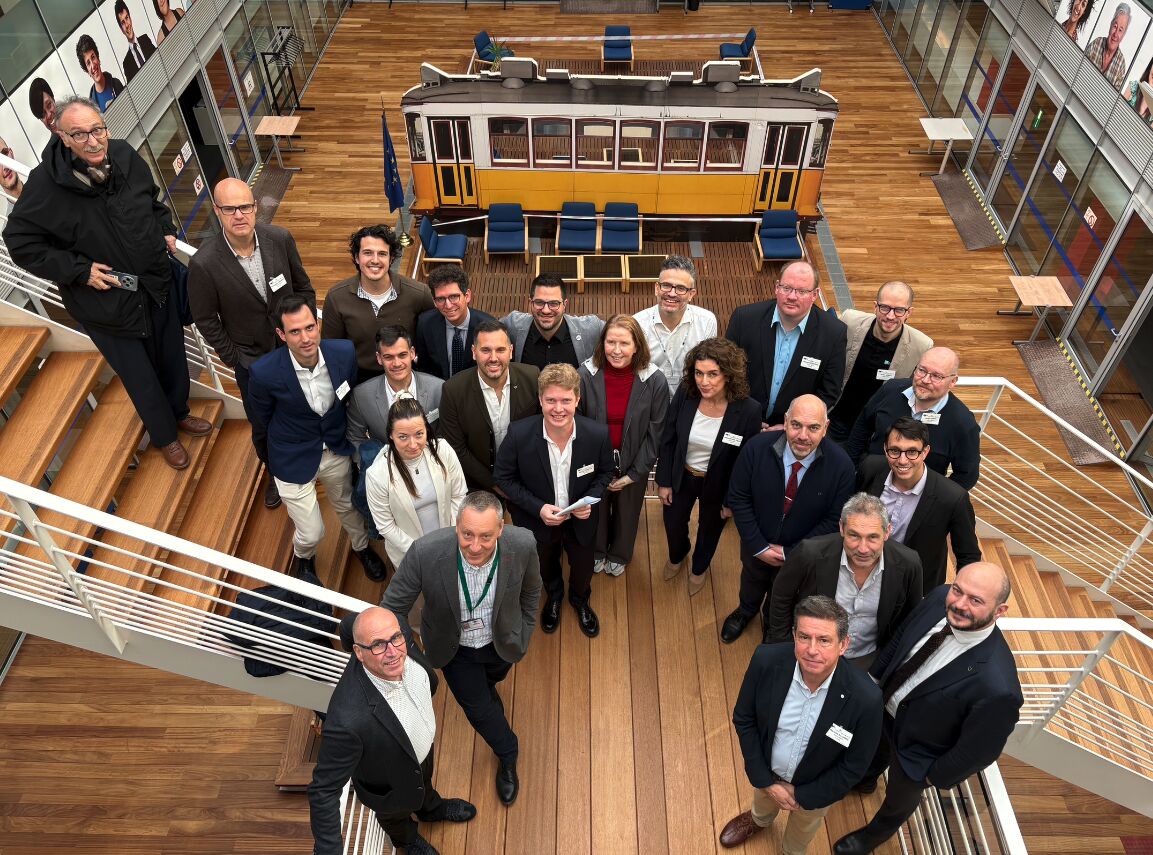
Position Paper on Virtual Worlds Technologies for Defence is INESC TEC’s latest contribution to European public policy. The document, now available, is the result of a series of workshops organised in March 2026 by the Virtual Worlds Association within the scope of the European Partnership for Virtual Worlds – supported by the European Commission. INESC TEC, represented by researcher Fernando Cassola, was among the contributors involved in drafting the paper.
The document’s main objective is to define research, innovation and skills development priorities so that Europe can strategically harness the potential of virtual worlds (particularly in the defence domain).
But what exactly are “virtual worlds”? According to Fernando Cassola, they are “immersive digital environments based on extended reality (XR) – including virtual reality (VR), augmented reality (AR) and mixed reality (MR) – that operate as a real-time fusion of the physical and digital worlds, combining simulation, visualisation, Artificial Intelligence (AI), sensors and digital twins”.
According to the paper, these technologies are set to become foundational for European defence, since they boost situational awareness, support real-time decision-making, enable the processing of large volumes of data and AI, and are crucial to European defence data spaces.
As highlighted in other position papers featuring contributions from INESC TEC -albeit in different fields, such as Power & Energy Systems – this document also raises an important concern: Europe remains heavily dependent on non-European technologies, including hardware and software, and there is a clear need to reinforce European technological sovereignty. The immersive technologies market in Defence is estimated to grow at an annual rate of 28.6%, raising the risk of Europe becoming increasingly dependent on other global players.
The document clearly structures the application of these technologies across the military lifecycle in five phases: design and development, planning, training and preparation, real-time operations, and post-mission analysis.
In terms of research priorities (the basis of the paper), there are five key areas: 1) digital twin battlefield, 2) human-centred XR interfaces, 3) AI and simulation, 4) resilient networks and computing and 5) production tools
The first concerns a continuously updated digital replica of the battlefield, integrating data from multiple domains, including land, air, maritime, space and cyber. This system enables real-time visualisation, understanding and prediction of operational scenarios, supporting decision-making. However, it also raises significant challenges, particularly in handling large-scale data integration, security, interoperability and the need for real-time computing.
Human-centred XR interfaces focus on developing immersive systems that are effective in demanding operational environments. This includes designing robust XR devices suited to harsh conditions, as well as natural interfaces (e.g., voice, gesture and sensor-based interaction) that improve human–machine communication. A key challenge is ensuring that these technologies improve user capabilities without causing cognitive overload, while also addressing ergonomics, health and ethical considerations.
Artificial Intelligence and simulation play a central role in bringing virtual worlds to life, enabling the generation of scenarios, data analysis and the prediction of operational developments. This priority includes the development of advanced simulation models, decision-support systems and intelligent training tools. However, there are some challenges in ensuring access to representative data, improving model robustness, and maintaining transparency and compliance with European ethical principles.
The fourth priority, resilient networks and computing, addresses the need to support virtual worlds in Defence contexts through highly reliable infrastructures. This involves developing solutions capable of operating in environments with limited or unstable connectivity, using distributed (edge) computing and advanced networks such as 5G and 6G. Security, real-time data synchronisation and the ability to perform under reduced conditions are all critical factors in this area.
Finally, production tools are highlighted as a key priority; creating virtual worlds for Defence applications remains complex and costly, making the development of new production tools essential. This includes collaborative platforms, the use of AI to generate environments and synthetic data, and solutions that enable the rapid creation of realistic and scalable scenarios. The goal is to make development more accessible, efficient and united with operational needs.
“By contributing as authors to this document, we once again demonstrate our position as a leading RTO in Portugal in discussions on strategic priorities for the European Union,” Fernando Cassola emphasised.
The Virtual Worlds Association is a European initiative focused on virtual worlds, XR and the metaverse. It brings together R&D centres like INESC TEC, CERTH, CNRS, Fraunhofer, IMEC and VTT; academic institutions including KU Leuven, Poznań University and the Universitat Politècnica de València; and industry players such as the Sopra Steria Group, SAP and Siemens. The initiative is directly supported by the European Commission, through DG CONNECT, and aims to produce position papers, define European priorities and foster collaboration among stakeholders.
 News, current topics, curiosities and so much more about INESC TEC and its community!
