


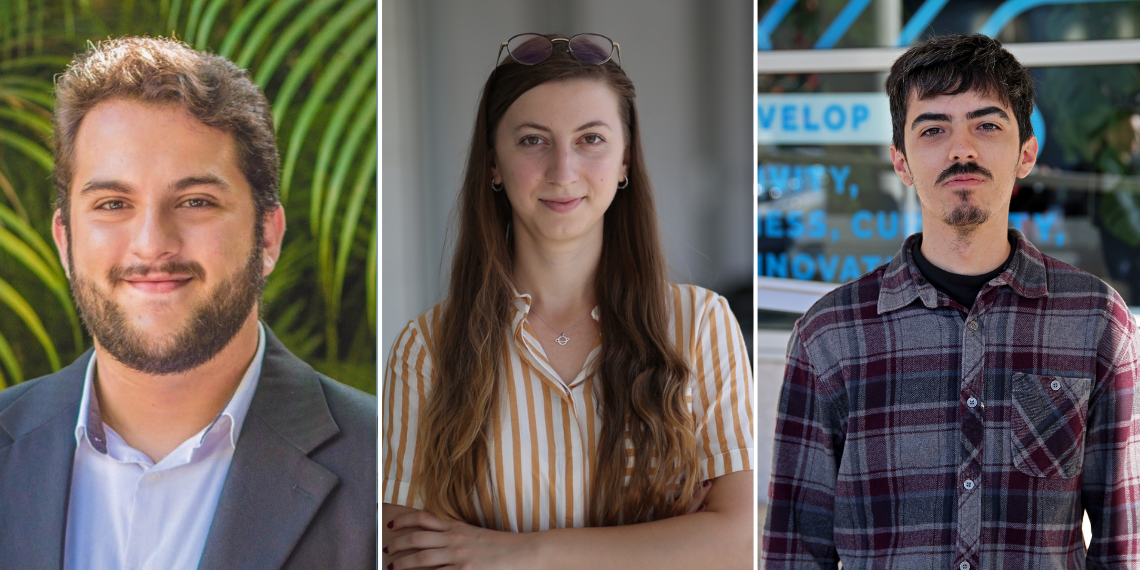
Robotics, Artificial Intelligence, Energy Systems, and Systems Engineering and Management; there are new completed PhDs in these domains at INESC TEC. This achievement reinforces the institution’s relationship with academia and the commitment to scientific output, often developed within projects of strategic importance.
Artificial Intelligence and Robotics – a new way of teaching robots
In Modular and Multi-Stage Semantic Perception System for Robotics, INESC TEC researcher Bruno Georgevich, supervised by Armando Jorge Miranda de Sousa (also a researcher at INESC TEC and a lecturer at the Faculty of Engineering of the University of Porto) presents HIPaMS, a modular framework designed to bridge the gap between low-level perception (which captures and interprets raw sensory data) and high-level agent-based reasoning – in which systems use information to make decisions or act intelligently. This comes at a time when autonomous robotics is advancing significantly. Through a proof of concept that enabled the implementation of HIPaMS, it became possible to improve the ConceptGraphs semantic mapping process, alongside the introduction of a refined interaction system based on four main contributions.
Georgevich, who attended the Doctoral Programme in Informatics Engineering at FEUP, identified that current AI systems lack the reliability required for autonomous navigation, particularly in assistive robotics contexts. According to the researcher, “in the case of functional models, their application in the real world presents critical flaws”, including false positives resulting from the detection of non-existent objects. In addition to this disadvantage, there is a need for “architectural rigidity and cloud dependency”, which in real-world scenarios may lead to issues caused by network failures or latency, with consequences for robotic performance. These factors – alongside “a lack of topological awareness in current maps”, which “prevents advanced spatial reasoning” – motivated the choice of research topic.
By introducing new concepts related to spatial AI and autonomous mobile robotics, aimed at facilitating robot operation in environments dominated by human activity, the research seeks to ensure that “robots not only understand complex commands in natural language, but also operate safely and continuously even when external internet or cloud infrastructure fails”. Georgevich believes his work represents “a fundamental step towards the practical and safe adoption of assistive robots in everyday life, where operational resilience and safety are essential”.
Citizen behaviour and engagement in the energy transition
Bianca Banica focused her research on citizen engagement in the energy transition - a topic that first interested her during her master’s in Service Engineering and Management, because it features “a concrete social factor that complements the technical progress in the field of Energy”. This “micro perspective” is a concept she highlighted as meeting a vision “focused on individuals and communities”, which she advocates in scientific research (and which she had the opportunity to keep exploring during her PhD). Within the context of the PhD in Industrial Engineering and Management at FEUP, Bianca Banica developed her research as part of a European project – POCITYF - which included seven cities from seven different countries; this allowed her to access solid empirical foundations and to engage with different stakeholders.
With a PhD positioned “at the intersection of engineering, social sciences and public policy”, Bianca Banica dedicated herself to studying “citizen engagement behaviours and perceptions of energy-efficient technologies”, providing a “complementary viewpoint to that of energy consumption”. Among the topics analysed in Citizen Engagement Perspectives within Local Energy Transitions are citizens’ everyday practices, the most vulnerable groups in the context of the energy transition - namely the concept of energy poverty - and public engagement as a recurring practice at city level, through the integration of social and digital elements rather than only through isolated initiatives.
“Citizen engagement is an essential component in ensuring fair and inclusive transitions in democratic systems. This aspect has been strongly promoted and required by the European Commission in initiatives related to the sustainability and resilience of cities and systems,” Bianca explained. “The main focus is advancing to sociotechnical solutions, leaving no one behind and fostering the active participation of diverse actors in said transition.”
Robotics for industrial supply chains
Returning to robotics, Artur Cordeiro addressed the challenge outlined in Configurable Perception Pipeline for Bin-picking in Industrial Scenarios, a common issue both in the field and in research developed at INESC TEC: the “difficulty of advancing effective picking approaches in unstructured environments”. Alongside this, the “lack of training data for deep learning algorithms, particularly for object detection and pose estimation”, defined the direction of his research.
During his PhD in Electrical and Computer Engineering at the University of Trás-os-Montes and Alto Douro, Cordeiro highlighted the development of a “configurable perception framework”, given the complexity and number of parameters involved. He also pointed to “the need to innovate in such a widely explored field, especially in the current technological landscape marked by the rapid evolution and use of large language models (LLMs)” as a challenge he successfully overcame.
Due to the “direct applicability in industrial environments”, Cordeiro stated that his research to be highly relevant; the practical value lies primarily in “the ability to optimise efficiency and simplify how industries introduce new objects into their picking chains”. To achieve this, he developed “an autonomous framework capable of generating annotated datasets – for detection, classification and object pose estimation – based on photorealistic simulations that comply with physical principles”.
Combined with a second framework focused on localisation, pose estimation and grasp planning for objects in dynamic and uncontrolled environments, the system facilitates “the integration of new objects, with the expectation that future work will benefit from a drastic reduction in implementation time and manual effort”, according to the researcher.
 News, current topics, curiosities and so much more about INESC TEC and its community!
