



Mobile networks of the future will become faster and smarter, without compromising users’ security and privacy. How? The answer lies in the technologies developed by the European project PRIVATEER, which involved INESC TEC and has now come to an end.
The future of telecommunications will inevitably rely on 6G. But this technological advance will introduce new challenges: ensuring network security without compromising user privacy. Over the three years of the project, researchers sought to develop several technologies that allow networks to identify threats and protect services without exposing users’ sensitive data.
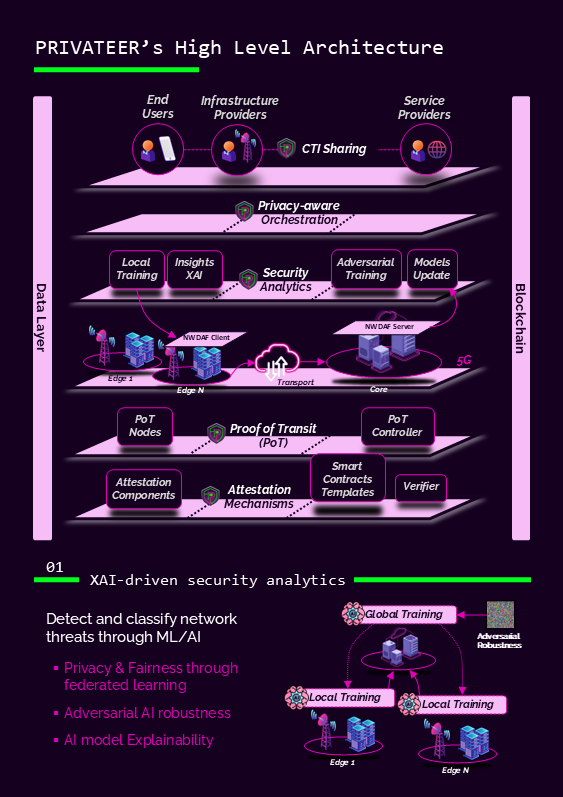
“These mechanisms, which we call security enablers, were implemented in telecommunications networks, albeit in a test environment, demonstrating that it is possible to adopt a privacy-first/security-first approach for future 6G networks,” explained INESC TEC researcher and professor at the School of Management and Technology of the Polytechnic of Porto, António Pinto.
Among the various solutions developed, one stands out: cyber-security threat detection using Artificial Intelligence, while preserving the privacy of those involved. The technology makes it possible to identify cyberattacks in a decentralised way and with explainability of the decisions taken, without compromising personal data.
Another contribution of the project relates to the possibility of defining privacy preferences (privacy intent) in service orchestration processes between telecommunications operators and virtual operators – something particularly relevant in future 6G networks, where different services may coexist on the same infrastructure. The project also developed mechanisms for confidential sharing of cyber-security threat information and distributed validation systems for the state of the network and services (network attestation), ensuring criteria such as integrity, trust, and privacy.
In practice, the technologies developed aim to address increasingly common scenarios in the digital context, being capable of introducing changes to existing processes in 5G/6G networks to maintain adequate levels of security.
“Imagine that a person’s mobile phone has been infected with a certain malware and, together with others, is actively participating in a cyberattack without the person’s knowledge. In this situation, it makes sense to alert other telecommunications operators to the characteristics of the attack so that they can block it without including the name, phone number, or any other information about the person whose phone has been compromised. In other words, the attack is blocked without exposing personal data,” the lecturer exemplified.
Some of the technologies developed may be implemented in real-world scenarios. In the case of INESC TEC, the solutions created were designed to be made available as open-source software, expanding their impact and adoption in two particularly relevant areas: “The first focused on the anonymisation of data used for cyber-security threat detection, allowing the protection of user identity without compromising the identification of attack sources. The second focused on the secure sharing of said information with relevant entities, always preserving high levels of privacy.”
 News, current topics, curiosities and so much more about INESC TEC and its community!
