



The development of new solutions for sensors, photonic devices and highly sensitive monitoring systems is one of the outcomes of a study carried out by INESC TEC, which explored the implementation of Fano-like resonance in fibre Bragg gratings (FBGs). The research was recently selected as an Editor’s Pick by the Journal of the European Optical Society (JEOS) – Rapid Publications, recognising the scientific relevance of the study and the contribution to advancing photonics research.
The paper Fano-like Resonance in Optical Fiber, authored by INESC TEC researchers Vinicius Piaia, Paulo Robalinho, Susana Silva and Orlando Frazão, explores the implementation of Fano-like resonances in optical fibre technology, with a particular focus on fibre Bragg gratings. In this work, the researchers provide a chronological overview of the development of Fano-like resonance and explore their application in optical fibre devices. In particular, the study uses numerical simulations to demonstrate the typical resonant behaviour of this phenomenon.
But why implement it in fibre Bragg gratings? These small structures are embedded within optical fibres and act as light filters, reflecting only specific wavelengths. In practice, fibre Bragg gratings enable the control and analysis of light – a capability that is essential for creating highly accurate optical sensors capable of measuring parameters such as temperature and pressure.
Fano-like resonances, in turn, have an asymmetric spectral profile, resulting from the interference between different physical mechanisms, and have gained increasing relevance across several areas of photonics. Put simply, they are light-wave interference phenomena that produce optical responses that are extremely sensitive to small changes in the surrounding environment.
By studying resonant behaviour in fibre Bragg gratings, the researchers are taking another step towards the development of more sensitive and precise optical sensors. “This research contributes to a better understanding of the interaction between interference mechanisms in optical fibres and may support the development of new solutions for sensors, photonic devices and highly sensitive monitoring systems,” they explained.
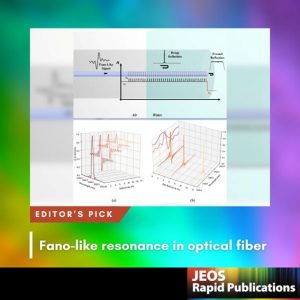 According to the team, the resonance produces a distinct and asymmetric spectral response that is attractive for a wide range of photonic functionalities. “Key applications include fibre-integrated sensors, where the high spectral sensitivity enables the detection of changes in refractive index, temperature, pressure or biomolecular interactions, as well as narrowband filtering and spectral shaping for telecommunications systems and optical signal processing.”
The selection as an Editor’s Pick by JEOS Rapid Publications “highlights the impact and quality of the work carried out, reinforcing the importance of research in photonics and advanced optical technologies,” the researchers concluded.
 News, current topics, curiosities and so much more about INESC TEC and its community!
