


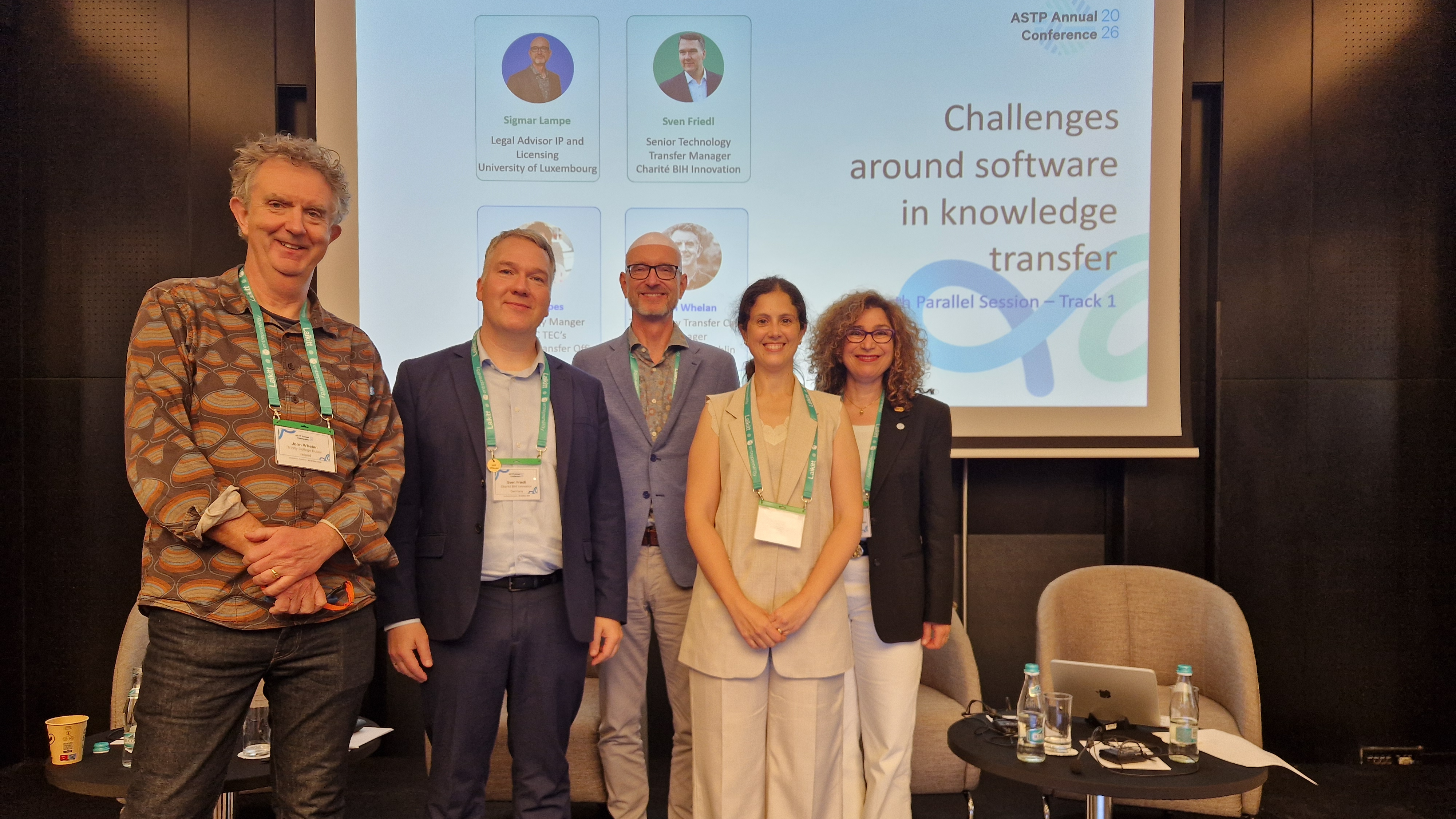
Rita Lopes, from INESC TEC’s technology transfer office, participated in the Annual Conference of the Europe’s Knowledge Transfer Association, ASTP, on a panel dedicated to the challenges of software in technology transfer. One clear conclusion emerged from the discussion: software and artificial intelligence are becoming central to the way scientific impact is created, protected, managed and delivered.
Joined by John Whelan, Technology Transfer Case Manager at Trinity College Dublin, and Sigmar Lampe, Legal Adviser on IP and Licensing at the University of Luxembourg, Rita Lopes was one of the speakers on a panel that explored the specific challenges of software-based innovation transfer. Moderated by Sven Friedl, Senior Technology Transfer professional at Charité BIH Innovation, the session focused on how to identify and capitalise on value in complex projects where technology, products, data, artificial intelligence and specialist knowledge are closely intertwined.
“We addressed key topics that both TTOs (Technology Transfer Offices) and Research and Development institutions are currently facing, particularly in the valorisation and transfer of software and AI-based technologies. Among the topics discussed were the need to manage the entire digital asset chain, from data and AI models to software and services, the definition of appropriate protection and valorisation strategies, including intellectual property and open source vs proprietary approaches, the measurement of the impact of open-source software initiatives, and the integration of licensing considerations, technological dependencies and compliance throughout the software development lifecycle,” explains Rita Lopes.
 According to INESC TEC’s technology manager, the discussion brought confirmation of something all technology transfer professionals have been experiencing: “software and artificial intelligence are no longer niche topics in technology transfer, they are becoming transversal to different areas of technological development and are challenging the way we create, protect, manage and deliver impact from science.”
Regarding software-related technology transfer, Rita also highlights that INESC TEC launched, this year, the OSS (Open-Source Software) initiative, an online platform that centralises access to the open-source software produced by the institution. In line with the evolution of European research and innovation policies, the Institute aims, through this step, to help accelerate science-based innovation, increase transparency and foster collaboration.
The ASTP Annual Conference took place in Bucharest, Romania, at the end of May, and invited discussion around “Hot Topics & Cool Solutions”, a theme designed to explore the most pressing issues currently facing the knowledge transfer community. ASTP is a non-profit organisation dedicated to knowledge transfer between universities and industry and currently has 1,829 members.
Disclaimer: this news piece was translated by Claude.ai
 News, current topics, curiosities and so much more about INESC TEC and its community!
