


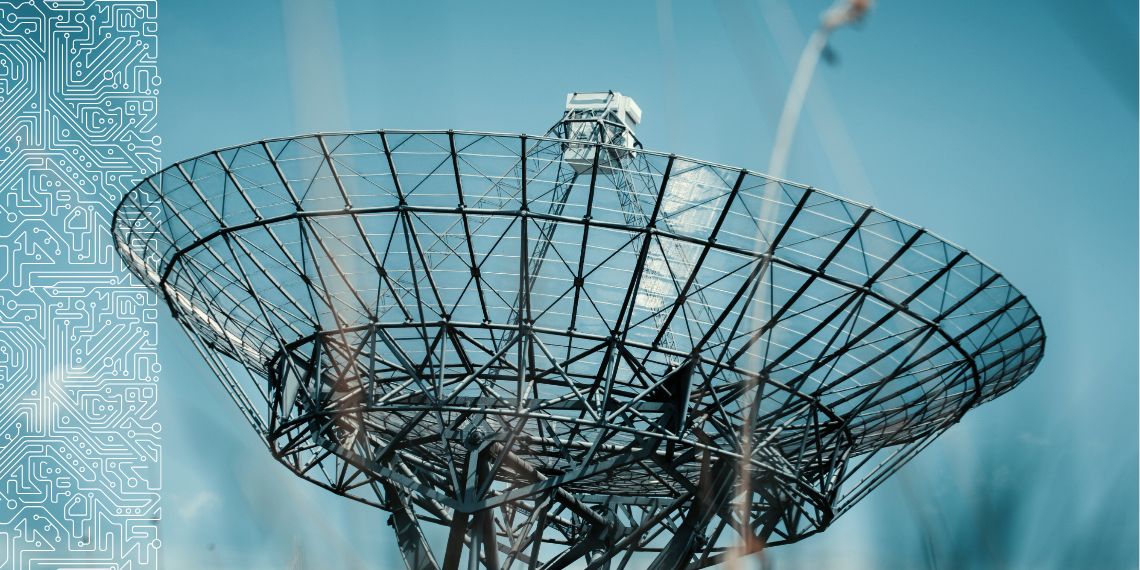
What if it were possible to communicate on a global scale with levels of security that are virtually impossible to compromise? The answer may lie in quantum communications. INESC TEC is studying, optimising, and validating solutions to ensure reliable, stable, and secure transmission at 1550 nanometres (nm) under real or near-real conditions.
Let us start from the beginning. Optical communication (the transmission of information via light) is already widely used in telecommunications networks. In this case, instead of passing through a fibre-optic cable, the laser beam travels directly through the atmosphere at 1550 nm (i.e., invisible to the human eye). This means it is possible to create links between buildings and even between ground stations and satellites without any cables. Quantum communication adds an encryption layer, enabling information to be transmitted through quantum states of light, opening the way to new forms of highly secure communication.
The problem? The atmosphere is not perfect, and various factors can degrade the signal. This is precisely where INESC TEC researchers Orlando Frazão, Susana Silva, and Henrique Salgado come in, bringing their expertise to the development and validation of a quantum signal reception system.
“This project seeks to address the challenges associated with quantum transmission in free space, particularly when it occurs through the atmosphere, where phenomena such as turbulence, attenuation, beam misalignment, environmental variations, and background noise can compromise the quality and stability of the optical and quantum signal. In this context, the work aims to study, optimise, and validate solutions to ensure reliable, stable, and secure transmission at 1550 nm in free space, as well as the capacity to receive quantum signals,” explains Orlando Frazão.
These solutions could be essential for protecting critical infrastructure, government networks, and future telecommunications systems, as well as for supporting secure quantum communications between ground stations and satellites.
“This research could play a structural role in the development of the Portuguese Ground Optical Station, by providing essential experimental and technological knowledge for optical and quantum communications in free space. The validation of an atmospheric link at 1550 nm represents an important step towards preparing future ground-to-ground, ground-to-satellite, and satellite-to-ground communications, including scenarios in which classical and quantum optical communications could be integrated within the same infrastructure,” says Susana Silva.
The future of telecommunications begins with a photon
Let us now turn to the technology underpinning this system: the BB84 protocol, which enables encryption keys to be distributed via particles of light (photons) and encodes information in different polarisation states. The key advantage is that any attempt to intercept the communication inevitably alters these states, enabling detection of intruders and achieving security levels impossible with conventional methods. At a later stage, the researchers will explore more advanced approaches, such as decoy-state systems, which improve the performance and robustness of quantum communications in real-world scenarios.
“Rather than relying exclusively on ideal single-photon sources, this technique uses weak optical pulses at different intensity levels, making it possible to improve the security and performance of quantum key distribution under real conditions. This strategy will allow for a better assessment of the impact of losses, noise, and potential channel vulnerabilities, contributing to more robust quantum transmission over atmospheric links,” explains Henrique Salgado.
In the coming years, the researchers are expected to continue working on optimising the atmospheric link, studying the behaviour of the transmission channel under different atmospheric conditions, and testing new quantum communication protocols. Trials at greater distances are also planned, in preparation for future scenarios compatible with satellite links and other space platforms.
“The results could contribute to the development of highly secure global communication systems, through quantum key distribution, protection of critical infrastructures, secure governmental and military communications, metropolitan quantum networks, and optical links between ground stations and satellites. These advances could also strengthen the national scientific and technological capacity in the areas of photonics, space, and quantum technologies,” concludes Orlando Frazão.
The primary beneficiaries will be the scientific and technological community in photonics, optical communications, and quantum technologies. The project may also contribute to Portugal’s integration into national and international quantum communication infrastructures, supporting the development of a future Portuguese quantum network and its alignment with European initiatives dedicated to secure communications.
This is research happening… at the speed of light!
 News, current topics, curiosities and so much more about INESC TEC and its community!
