


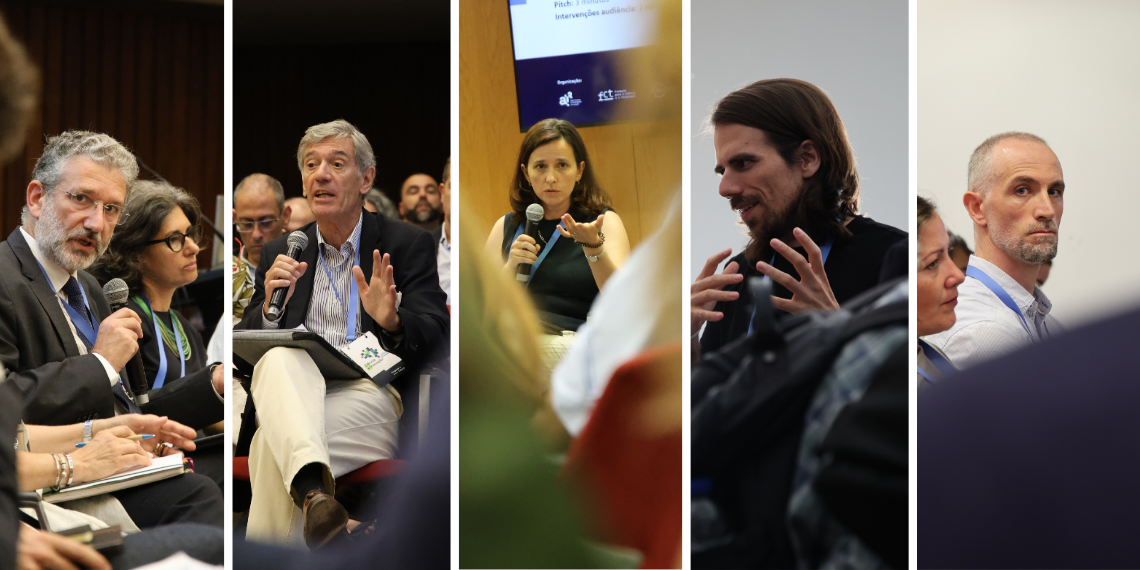
More than 1,200 participants. Two days of exchanging ideas and proposals on the strategic priorities of the new Agency for Research and Innovation (AI2). That was the Encontro Ciência e Inovação 2026, the first major event organised by the newly created AI2. Portugal’s science and innovation ecosystem gathered at the Lisbon Congress Centre on 15 and 16 July, and INESC TEC was proud to be part of the discussion.
INESC TEC submitted three proposals: From Knowledge to Competitiveness: Priorities for 2028–2034, Decarbonization and Reindustrialization: Energy, Technology, and Competitiveness, and Scientific Sovereignty – Current Challenges and Pathways for Science in Portugal and Europe, together with a wide range of scientific, business and funding partners. The Institute was also invited to contribute to several other proposals. The large number of submissions meant the event format changed, with each proposal allocated just a three-minute pitch. INESC TEC adapted and made important contributions, because helping shape the new agency is an important task, and there is still much to be discussed.
Day one
The event opened with references to the two driving forces behind AI2 – science and innovation -, highlighted by AI2 President João Barros and reinforced by Portugal’s Prime Minister, Luís Montenegro. The first morning featured a series of plenary sessions focused on priorities for science and innovation and on accelerating value creation.
In the afternoon, INESC TEC took part in two parallel sessions.
At the session International Partnerships for Excellence, INESC TEC was represented by José Manuel Mendonça, President Emeritus of the Institute, in his role as Coordinator of the FCT International Partnerships.
In his three-minute pitch, José Manuel Mendonça provided an overview of the partnerships with US universities launched two decades ago by Mariano Gago, which are now in their fourth phase. One of the success stories he highlighted was Feedzai, which emerged from these partnerships and has since become a unicorn company. “This is just one of many examples demonstrating the impact that international partnerships have had – and still have – on Portugal’s science and innovation ecosystem,” he said.
After introducing the partnerships, José Manuel Mendonça invited the national directors of each programme to present a short pitch: Inês Lynce (CMU Portugal), Rute André (UT Austin Portugal, hosted by INESC TEC), and Alexandra Ferreira da Silva (MIT Portugal).
Before opening the floor to the audience, José Manuel Mendonça also announced that the joint annual conference of the three partnerships (the Portugal-US Partnerships 2026 Summit) will take place in Aveiro on 30 October. The event will showcase the work carried out during Phase IV and the impact created through the new coordinated model.
International partnerships were not the only topic discussed; before the presentations, the pitch session focused on TEAMING projects, particularly those approved during 2026.
As José Manuel Mendonça also plays a leading role in INESC TEC’s TEAMING project, INESCTEC.OCEAN, he shared his perspective after listening to comments from the audience about recently funded projects. Addressing concerns around long-term sustainability, he stressed that “after four years, every TEAMING project must know what the institutional and governance model will be, and how they intend to ensure its future sustainability.”
An hour and a half later, João Claro, Chairman and CEO of INESC TEC, took part in the parallel session From Thematic Areas to Strategic Domains of AI2’s. His presentation From Knowledge to Competitiveness: Priorities for 2028–2034 was originally intended to explore how Portugal could strengthen the value chain connecting scientific and technological knowledge with competitiveness, territorial cohesion and social wellbeing in the context of the next European and national funding cycle. To support this discussion, INESC TEC brought together a distinguished panel including Álvaro Santos (President of CCDR-N), António Murta (CEO and Co-founder of Pathena), Aurora Teixeira (Professor at the Faculty of Economics, University of Porto), Bruno Azevedo (CEO of Addvolt) and Paulo Fernandes (Coordinator of the Mission Structure for the Reconstruction of Portugal’s Central Region).
With the revised format limiting presentations to three minutes, João Claro focused on four key conclusions emerging from the INESC Summer Meeting held in Brussels earlier this year, where the INESC institutes discussed the existing gaps in Europe’s technology stack. First, he noted that today’s challenges extend well beyond competitiveness. They also include security, defence, strategic dependencies, recurring crises and increasingly rapid technological disruption. “These challenges place new demands on the science and innovation ecosystem that have not always been sufficiently visible but are essential when defining AI2‘s strategic domains,” he explained. His second point was that cohesion and competitiveness must be considered together, with science and innovation playing a central role. “We have the right opportunity, both at European and national level, to make this happen.” Third, he argued that sector-specific differences matter, meaning policy instruments should vary according to the needs of each area. Finally, João Claro highlighted translation and orchestration as critical capabilities needed to make all of this possible, arguing that they should become fundamental principles in the design of AI2‘s strategic domains.
Day two
INESC TEC was represented in four different sessions on the second day. Clara Gouveia, a member of the Board of Directors, presented a three-minute pitch on decarbonisation and reindustrialisation. Researcher Nuno Guimarães introduced AMALIA, Portugal’s newest large language model. Researcher Bruno Ferreira contributed to the robotics session, while INESC TEC was also represented by a partner institution in the discussion on digital sovereignty, despite being the lead proposer.
The day began at 9 a.m., with the parallel session on Mobility, Robotics and Construction. INESC TEC had helped prepare the proposal Integrated Strategy for Intelligent Robotics in Portugal. Under the new presentation format, the pitch was delivered by lead proposer Pedro Lima from the Institute for Systems and Robotics at Instituto Superior Técnico, University of Lisbon.
Pedro Lima began by explaining the importance of combining Artificial Intelligence with robotics, and that the original proposal brought together 10 organisations, including INESC TEC. He highlighted robotics’ strong track record in attracting European, national and international funding, including through partnerships with US universities.
According to Pedro Lima, “robotics plays an important role across many areas of society; it contributes to social cohesion through search and rescue robots, hospital applications and physical rehabilitation, while also inspiring young people to pursue STEM careers.” He also pointed to a broader contribution to territorial cohesion, citing examples such as Portugal’s Exclusive Economic Zone and smart cities.
Pedro Lima stressed the importance of investing in fundamental research, even when projects begin at low Technology Readiness Levels (TRLs). “Without that investment, Portugal would never have reached the current position in robotics. Many of today’s achievements began with research driven purely by scientific curiosity, such as robotic football.”
Representing INESC TEC during the discussion, researcher Bruno Ferreira emphasised that excellence and competitiveness are achieved through research and innovation. “There are several success stories in this field. One is the annual exercise organised by the Portuguese Navy at the Troia technological free zone, which attracts thousands of participants. It’s a military robotics experimentation exercise that allows technologies to be tested in real-world conditions.” INESC TEC has participated every year, giving the Institute unique experience in this field. “REPMUS is an excellent example of how knowledge, infrastructure and unique natural conditions can come together,” he added.
Other important example, associated with the market, is supporting the entire value chain – from fundamental research through to higher TRLs that enable technologies to reach companies. Moreover, achieving this requires significant investment in equipment and testing capacity. Bruno Ferreira mentioned a key obstacle, however: a single day of offshore operations can cost tens of thousands of euros, making this level of experimentation inaccessible for many organisations.
At 1:30 p.m., the parallel session Energy, Decarbonization, and the Circular Economy brought together discussions on hydrogen, batteries, technological challenges and institutional perspectives.
Clara Gouveia delivered a three-minute pitch entitled Decarbonization and Reindustrialization: Energy, Technology, and Competitiveness. The proposal had originally been designed as a joint discussion involving PRODUTECH, CITEVE, REN and Simoldes, but under the revised format, the presentation reflected INESC TEC’s own perspective.
Her first conclusion was clear: “The new European Framework Programme links the energy transition directly with industrial decarbonisation.” When discussing the energy transition, Clara Gouveia highlighted Portugal’s structural advantage. “We have invested heavily in the energy transition, achieving significant integration of renewable generation and, consequently, competitive energy prices. This benefits the national economy by attracting new industrial consumers, such as data centres, while also creating opportunities for new industries.”
But what’s the main benefit to the national science and technology ecosystem? Clara Gouveia identified two areas where Portugal is particularly well positioned at European level. The first is energy storage, including batteries and hydrogen, where European and national projects already cover almost the entire value chain despite ongoing technology transfer challenges. The second is the country’s expertise in managing and integrating energy systems, combining both electricity and thermal energy – an increasingly important capability for industry.
However, she also posed an important question: “If we are so successful at attracting European funding, if we have launched so many national projects and pilot initiatives, and if we have built strong collaborative ecosystems through our Mobilising Agendas, what is still missing?”
Her answer was straightforward; Portugal needs scientific and technological infrastructures that enable companies to test new solutions and help the national science and technology system transform those solutions into scalable products. She also argued for “funding mechanisms better suited to this type of activity, without lengthy and complex evaluation processes”.
Finally, Clara Gouveia called for an urgent review of testbeds, Digital Innovation Hubs (DIHs) and Technological Free Zones to make access easier and provide the regulatory sandboxes needed to test new technologies, products and services.
Meanwhile, in the parallel session Scientific Sovereignty: Current Challenges and Pathways for Science in Portugal and Europe, Hugo Gamboa, from LIBPhys at NOVA School of Science and Technology, presented a proposal in which INESC TEC researchers Fernando Cassola and Ademar Aguiar had participated.
The central message was simple but important: Portugal cannot limit itself to being merely a user of strategic technologies. “We must strengthen our capacity to produce, integrate, audit, regulate and govern critical technologies – from AI, cloud computing, data and open-source software to digital infrastructures, digital twins, virtual worlds and cyber-physical systems,” said Fernando Cassola – who also believes that scientific sovereignty means strategic autonomy, resilience, freedom of choice and responsibility for the data, infrastructures and knowledge that support science, the economy, public services and democracy.
He argued that meeting this challenge requires the active involvement of the entire community – universities, associated and collaborative laboratories, companies, regulators, public administration and civil society – together with long-term funding capable of connecting fundamental science with technological development, demonstration, knowledge transfer and adoption in strategic sectors.
Just a few metres away, INESC TEC researcher Nuno Guimarães introduced AMALIA, Portugal’s newest large language model, during the AMALIA Demo Session.
By the end of the event, the two guiding themes – science and innovation – had become impossible to separate. They are inseparable partners, impossible to prioritise over one another or reduce to a simple slogan. Today’s national and international landscape has changed. AI2 now faces the challenge of guiding deep transformations across strategic sectors, and INESC TEC was proud to contribute to that conversation.
 News, current topics, curiosities and so much more about INESC TEC and its community!
