


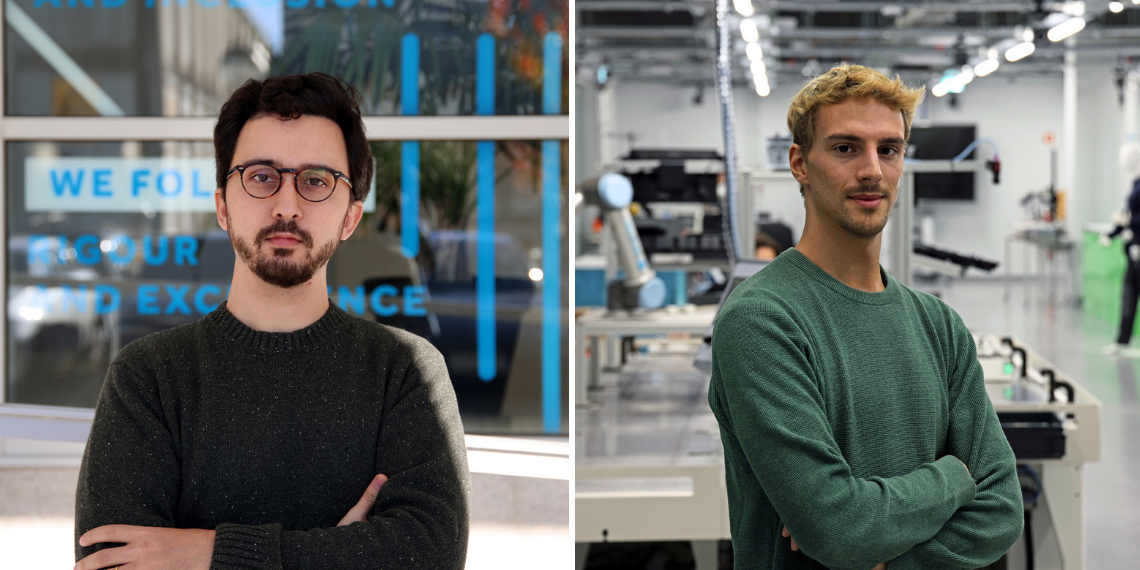
What happens when more than 70% of people in urban areas in Portugal live in apartment buildings that were built long before e-mobility became a reality, while incentives encourage the purchase of electric vehicles (EVs) and the country records an EV market share above the European average? This question became the starting point for Salvador Carvalhosa‘s PhD research, inspired by practical observation; this work lay a key challenge for making the energy transition in transport not only technically possible, but genuinely accessible.
Portugal’s housing stock is “predominantly old”, and most residential buildings were designed without “electrical infrastructure” capable of supporting large-scale EV charging. Combined with the lack of practical solutions for today’s needs, this creates a significant barrier to EV adoption and slows the pace of the transition. According to the INESC TEC researcher, “infrastructures – rather than a lack of vehicles or consumer interest – will ultimately determine how quickly this transition can happen”.
As part of the Sustainable Energy Systems doctoral programme at the Faculty of Engineering of the University of Porto, Salvador Carvalhosa showed that this “challenge” can be overcome without “major investment”. “The spare electrical capacity already exists; we simply need to manage it intelligently,” he explained. His research delivers three interconnected original contributions that provide both “practical results” and planning tools “ready for real-world application”.
The first is a centralised charging optimiser that makes “direct use of a building’s main electrical feeder through dynamic management of available power”. The second introduces a framework for “simultaneity factors based on fuzzy logic inference, specifically calibrated for EV fleets in apartment buildings using optimised charging”. The third adds a “degradation-aware scheduling layer that protects users’ batteries without compromising their mobility needs”.
Among the potential applications of the research, Salvador Carvalhosa emphasised the “simultaneity factor framework could help designers and network operators replace the current practice of oversizing electrical infrastructures”.
One of the main challenges throughout the project stemmed from the “limited amount of comparable research”. Existing literature largely focuses on single-family homes or public charging stations, leaving apartment buildings relatively unexplored. Working with a “residential condominium in Porto proved essential for validating the proposed models”. Another challenge involved bringing together the three main contributions – optimisation, simultaneity factors and battery degradation – into a single coherent framework.
Changes to Portugal’s regulatory framework during the doctoral programme also required parts of the thesis to be reviewed and updated.
When reflections hide defects: AI for quality inspection
As industrial processes become increasingly automated, Rui Pedro Nascimento set out to extend this trend to automated quality inspection systems, focusing on highly reflective metal components commonly used across a range of industries. His PhD research formed part of the Doctoral Programme in Electrical and Computer Engineering at the University of Trás-os-Montes and Alto Douro.
Reflective surfaces make automatic defect detection particularly challenging. Small changes in lighting or camera position can produce reflections, glare or contrast variations that conceal defects or make them difficult to distinguish. Manual visual inspection, meanwhile, is often tiring, subjective and difficult to perform consistently over time.
These challenges created an opportunity to develop “computer vision and Artificial Intelligence methods capable of supporting industrial inspection processes, making them more robust, repeatable and adaptable to real production environments”.
The “visual complexity of reflective components” proved one of the greatest obstacles. “Unlike objects with opaque or more uniform surfaces, reflective metal parts produce glare, reflections and texture variations that AI systems can mistake for defects or, conversely, that can conceal genuine flaws,” explained the INESC TEC researcher. Training AI models with strong generalisation capabilities also presented difficulties because annotated industrial datasets remain scarce. “In real industrial settings, defects may be rare, and manually annotating images is both time-consuming and demanding,” Rui Pedro Nascimento noted.
Close collaboration with industry shaped the research throughout the project, requiring continuous adaptation to real manufacturing scenarios. As the researcher pointed out, “A system that performs well in the laboratory is not necessarily ready to deal with real variations in lighting, component positioning, different types of defects, or the constraints of integrating with existing industrial software and equipment.”
Developing “solutions tailored to specific industrial problems” became a central objective. The research proposes “methods that bring AI closer to industry’s practical needs” by addressing not only detection models, but also image acquisition, data generation and annotation, and the interpretation of results. Together, these elements aim to deliver “inspection systems that are more reliable, efficient and easier to understand, helping operators and companies meet increasingly demanding quality control requirements.”
By combining several complementary methodologies that can be used either independently or as an integrated solution, depending on the inspection task, the proposed approach is particularly well suited to industrial environments like those in which it was developed and validated. It offers a practical solution for applications where “data are limited, defects are difficult to detect, or surfaces display complex optical behaviour.”
 News, current topics, curiosities and so much more about INESC TEC and its community!
