


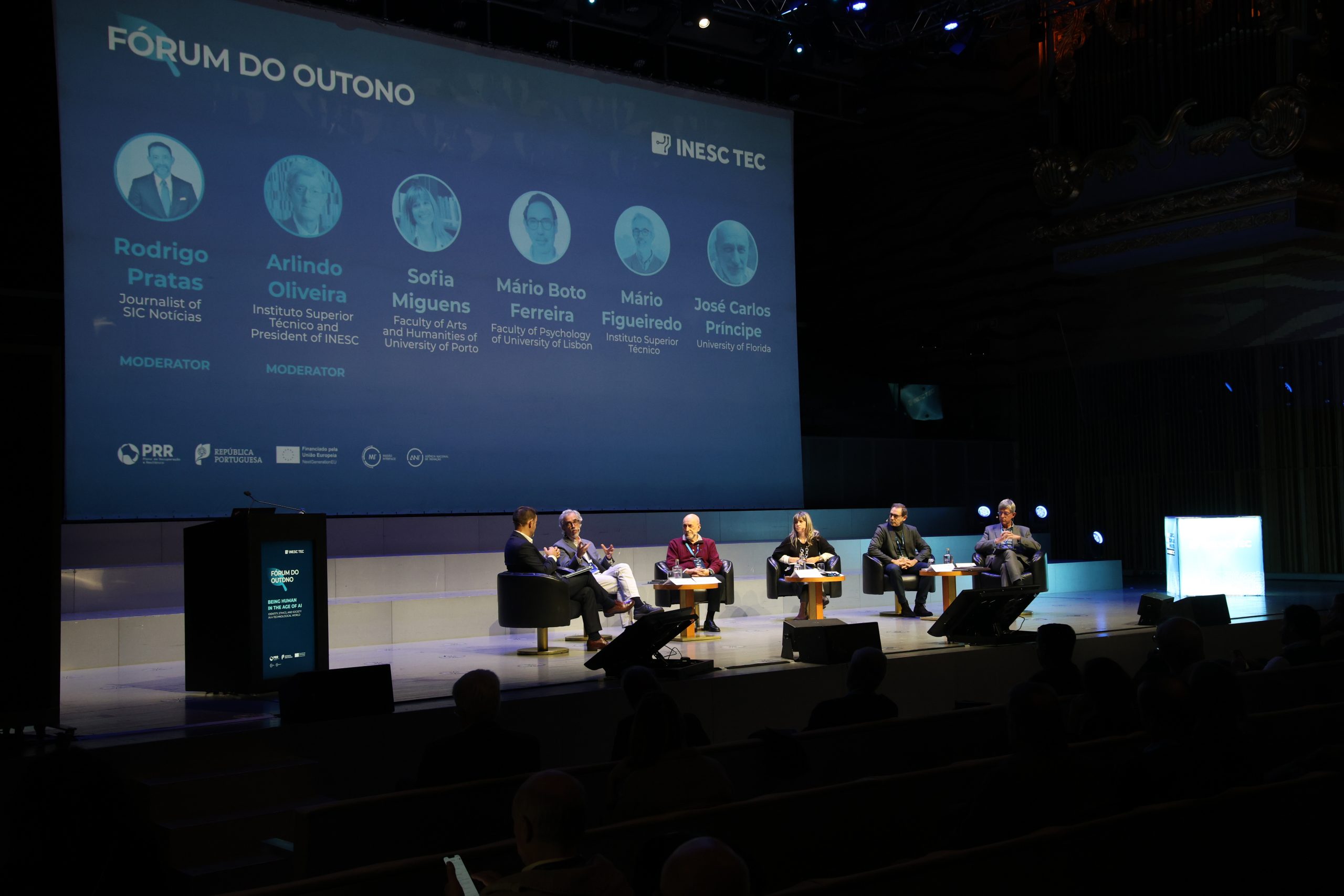
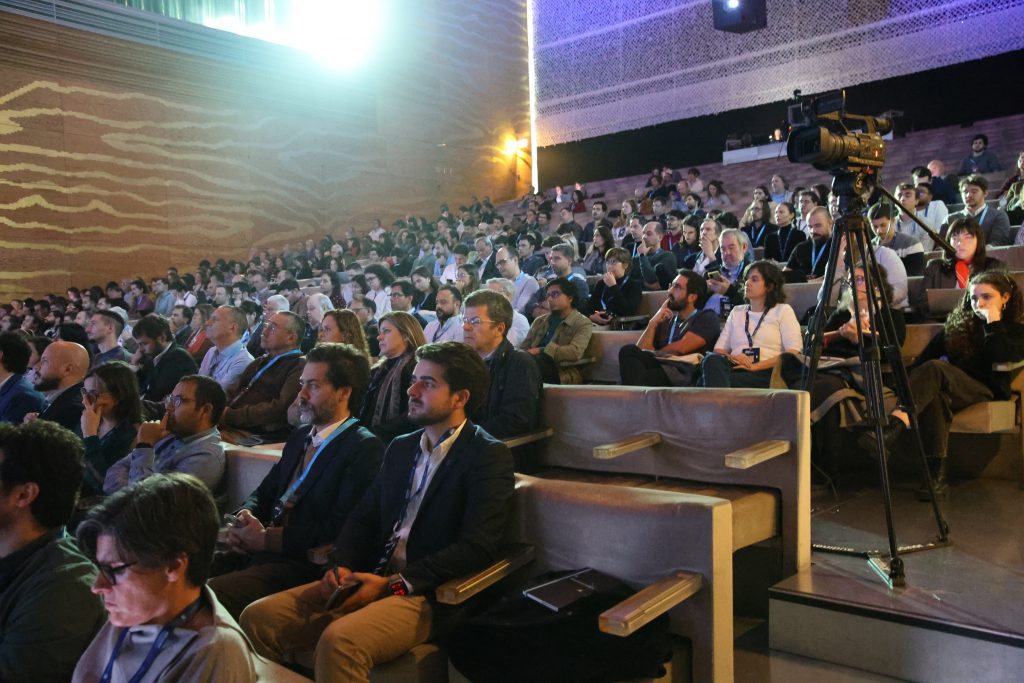
The 10th edition of INESC TEC Autumn Forum began with an idea: what does it mean to be human in the age of Artificial Intelligence (AI)? It was a question that demanded reflection across multiple areas of society, bringing to the table not only technological issues, but also ethical, philosophical, psychological and, naturally, political ones. On 17 November, the Sala Suggia at Casa da Música filled with more than 500 people from the business world, academia and a wide range of fields – from technology to the social sciences – all eager to understand what the future holds in the age of AI.
With two international keynote speakers and a roundtable filled with experts, the event opened with João Claro, Chairman of the Board at INESC TEC, who highlighted the special significance of this edition, as it marked the end of the public celebrations of the Institute’s 40th anniversary and the 10th anniversary of the Autumn Forum – an initiative that, since 2015, has promoted a debate on topics with scientific, economic and societal impact among thousands of people.
“Digital technologies, in general, and AI, in particular, have long been central to our work at INESC TEC and have been extremely important for the development of our science, for our collaboration with industry, for our contribution to public programmes and in training new generations,” João Claro underlined in his opening remarks.
The choice of this year’s theme was, as the President stressed, a continuation of a long-standing collective journey with many societal actors, in an era of major technological transformation.
“AI brings different questions to the conversations we have with one another – scientific, technical, social, ethical, cultural – and requires opportunities for broader dialogue in which all these viewpoints have valuable contributions to make and which are becoming highly relevant in the public debate.” For this reason, the theme reflects a clear intention to improve that comprehensive dialogue, “bringing together people who can help us improve our understanding and look to the future with a sense of purpose, curiosity and responsibility”, he added.
The international keynote speakers
Marzieh Fadaee, Director of Cohere Labs, and Gitta Kutyniok, researcher at Ludwig Maximilian University of Munich, were the keynote speakers at the 10th edition of the INESC TEC Autumn Forum.
Marzieh Fadaee opened the programme with the talk Building human-centric models from global voices, offering the most global and human-centred perspective of the day. She stressed that the future of AI depends on the ability to include people from around the world – linguistically, culturally and socially – in the development of new models. Her work at Cohere Labs focuses on creating multilingual LLMs with strong global community participation, something that directly echoes one of INESC TEC’s historical pillars: technology created not only for technological impact, but for social impact.
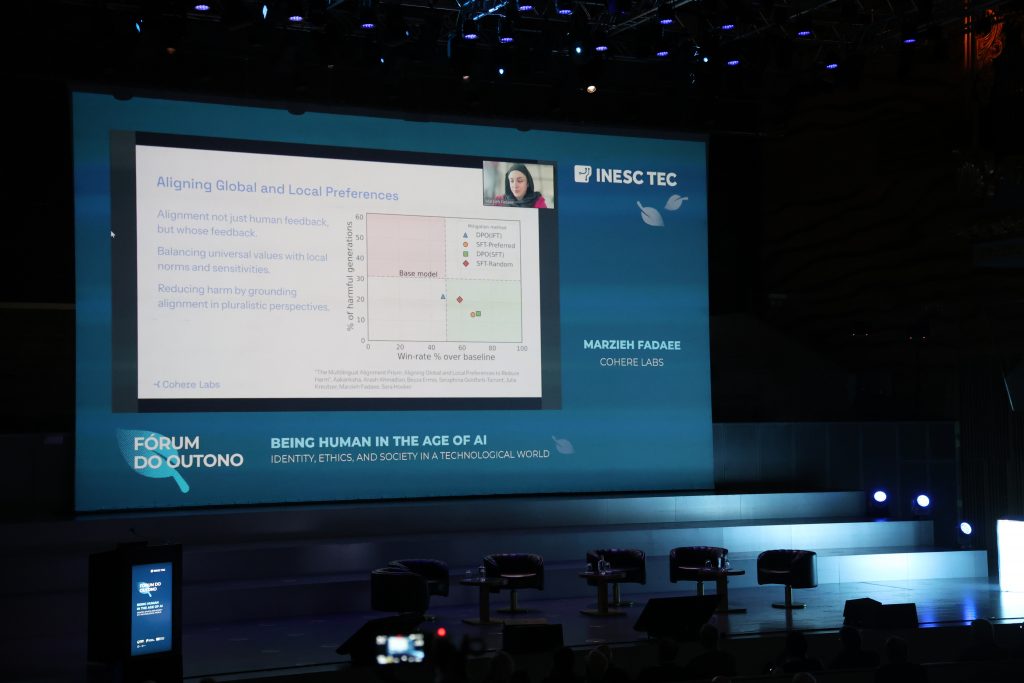
Marking INESC TEC’s 40th anniversary, Marzieh Fadaee left a powerful message: “there is no truly transformative innovation without diverse voices and without open science” – two key strategic vectors for the Institute.
Her talk introduced several core ideas, like the fact that multilingual AI is not a luxury, and the importance of human participation in these processes.
According to the speaker, models trained only in English generate inequalities and risks at several levels (including issues like misinformation). “If we train models in just four languages, we leave 96% of the global population exposed,” she emphasised.
Another central point was the crucial role of human participation in multilingual AI. To address this, Fadaee explained that Cohere Labs created a community of more than 4,000 researchers from 150 countries who contributed to the development of the AYA datasets – now a global reference.
More than translation, what is needed are locally relevant data, because automatic translations fail to capture cultural expressions, specific forms of discrimination or social contexts. Concerning this point, she stressed that “there are data which are global and data which are culturally situated, and models must be exposed to both.” Linguistic diversity strengthens the model, making even English-language performance more robust. In other words, diversity improves knowledge transfer, safety and alignment.
Finally, she argued that evaluation must also be global, not only American. Existing benchmarks largely reflect US-based epistemologies. With this in mind, her team created the first global benchmark of school-level knowledge in 44 languages.
The second keynote speaker, Gitta Kutyniok, presented The Next Generation of AI: Sustainable, Reliable, and Trustworthy. Complementing Fadaee’s humanistic angle, Kutyniok delivered a deeply technical and structural perspective. She clarified where we stand, where we fall short and what needs to be rebuilt to ensure AI that is trustworthy and sustainable, complying with European values.
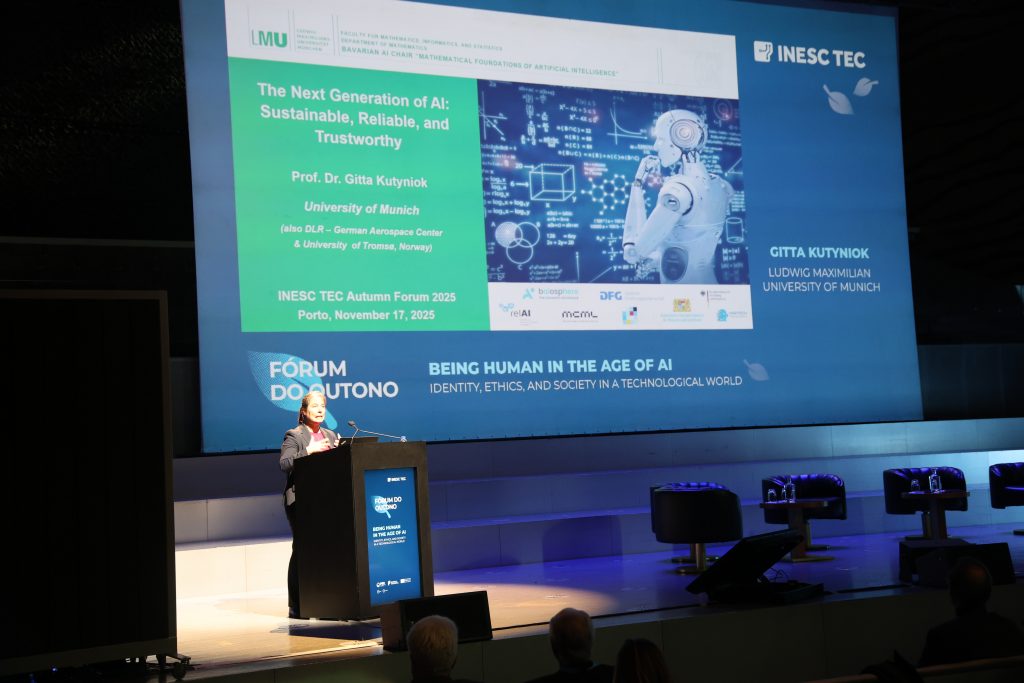
She highlighted that the fourth industrial revolution is accelerating and that AI is reshaping entire sectors: from public administration and justice to education and telecommunications – a highly relevant question to institutions such as INESC TEC.
Kutyniok emphasised that AI remains “fragile” and must become more reliable, as it continues to face structural problems related to security, privacy and bias; another idea was the fact that the lack of explainability undermines both public and institutional trust.
She also addressed the current energy crisis associated with AI, arguing that we need to train and deploy models that consume sustainable levels of energy. This requires urgent exploration of new paradigms – from analogue computing to neuromorphic computing, and even hardware-software co-evolution.
Kutyniok stressed that mathematics must form the basis of trust. She introduced thorough methods that allow us to evaluate generalisation, error and explainability and reinforced the importance of fundamental research – something very present at INESC TEC.
Finally, she argued that Europe must create, not merely regulate; otherwise, it risks becoming dependent on American or Chinese models and infrastructures. “Digital sovereignty is not a luxury – it is a matter of survival,” she declared.
The roundtable
The roundtable brought together four speakers: Sofia Miguens (Faculty of Arts and Humanities, University of Porto), Mário Boto Ferreira (Faculty of Psychology, University of Lisbon), Mário Figueiredo (Instituto Superior Técnico) and José Carlos Príncipe (University of Florida). It was moderated by SIC Notícias journalist Rodrigo Pratas and by Arlindo Oliveira, President of INESC.
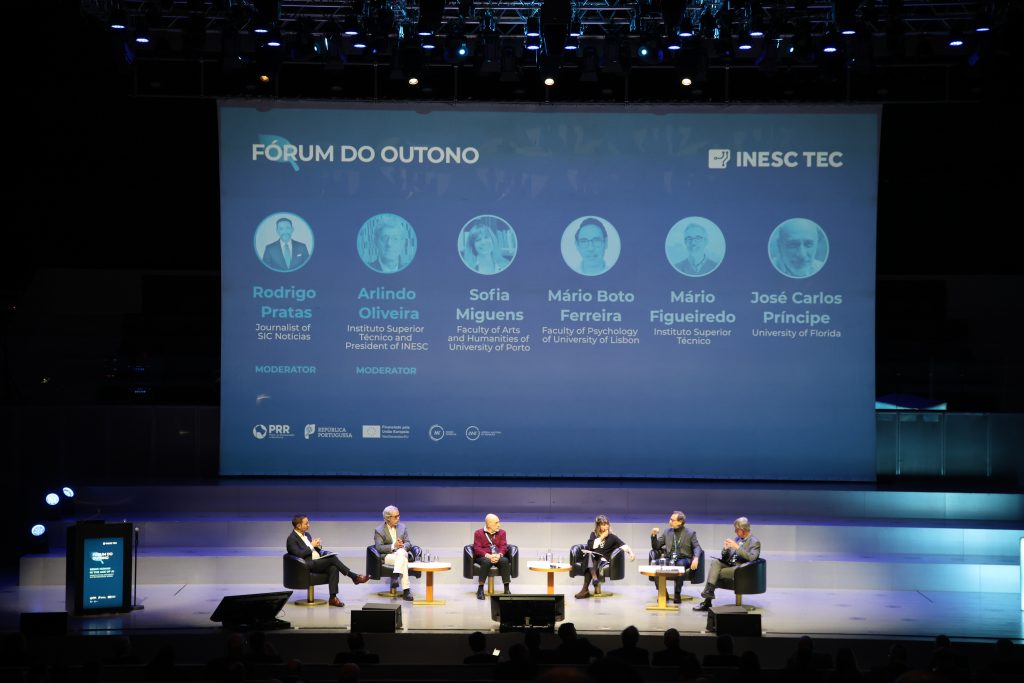
Over 90 minutes, a philosopher, a psychologist and three engineers – including Arlindo Oliveira, who joined the debate not only as moderator but also as a scientist from both INESC and Instituto Superior Técnico – discussed the risks, illusions, limitations, promises and responsibilities of AI, reflecting a core principle long advocated by INESC TEC: technology cannot be considered without society, nor society without technology.
There were opposing points, but many consensual ones too – starting with the idea that AI is not new; what has changed, and what might be considered radical, is the social impact and the technologies’ ability to shape behaviour, politics and culture.
“We should not fear machines, but those who control them” was one of the strongest statements of the debate, summarising a point raised by Mário Figueiredo when discussing who directs the development of AI. He stressed that models are not independent and that the greatest risk does not lie in the technology itself, but in the political and economic interests behind it.
Questions like education, higher education funding and the uncertainty surrounding the future of labour were also discussed. According to the scientists on the panel, AI will certainly replace some tasks, but again the major issues are political and social, not technological. The complementary perspectives of researchers from technological fields and from the social sciences – particularly philosophy and cognitive psychology – proved one of the most distinctive highlights of this year’s edition.
The issue of misinformation – which affects truth, reality and trust, all currently under strain and previously mentioned by both keynote speakers – returned to the discussion, associated with the urgent need for philosophical reflection in the face of growing difficulty distinguishing what is real from what is not.
Closing session
The event closed with remarks by Fernando Alexandre, Minister of Education, Science and Innovation, who joined the stage to reflect on innovation and science in Portugal and the need to invest more in research and scientific development.
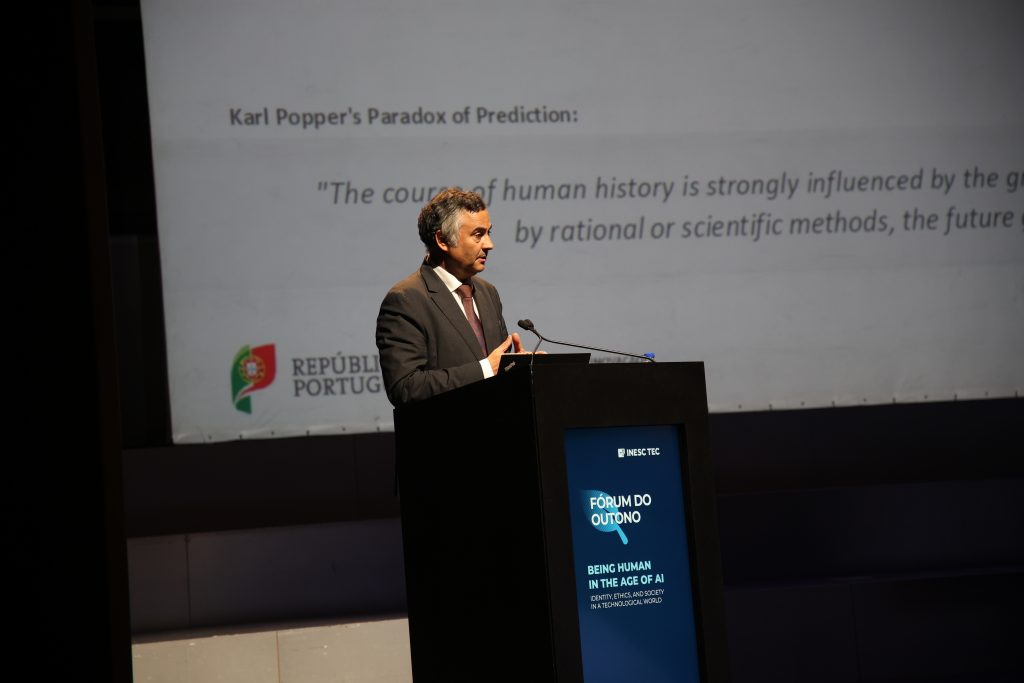
The Minister began by highlighting the World Uncertainty Index, an initiative covering 143 countries, including Portugal. Since the early 2000s, a series of shocks – including the pandemic, wars, financial crises and extreme climate events – has dramatically increased global uncertainty, making the world harder to understand. As Fernando Alexandre noted, anticipating the future (as discussed earlier in the roundtable) has become more difficult. “Predicting the future in this context of global uncertainty has become even more challenging,” he explained.
In this context, the role of institutions that make up Portugal’s scientific ecosystem – including INESC TEC – becomes even more important. The Minister stressed the need to invest more in science, research, education and the training of people. Society, he argued, must understand the importance of this investment and the benefits it generates, including in the fight against misinformation – a topic widely discussed throughout the afternoon. Fernando Alexandre also highlighted the need for effective communication of scientific results.
He also drew a parallel between the Forum’s theme – AI – and the structural transformations needed in education and science, referring to major labour-market trends based on the Future of Jobs Report 2025.
Finally, the Minister outlined several of the Government’s planned reforms in education and innovation, as well as the strategic vision that will guide necessary investments in these areas.
The summary
It is difficult to imagine a more accurate summary of what INESC TEC is – and has been over the past 40 years – after listening to all the contributions that marked the afternoon of 17 November.
But if one were to attempt a summary, it might be this:
Marzieh Fadaee brought inclusion and diversity;
Gitta Kutyniok added precision, sovereignty and sustainability;
and the roundtable provided critical, ethical and responsible reflection.
The INESC TEC Autumn Forum will return in 2026. Until then, the 2025 edition is available to watch on INESC TEC’s YouTube channel.
 News, current topics, curiosities and so much more about INESC TEC and its community!
