


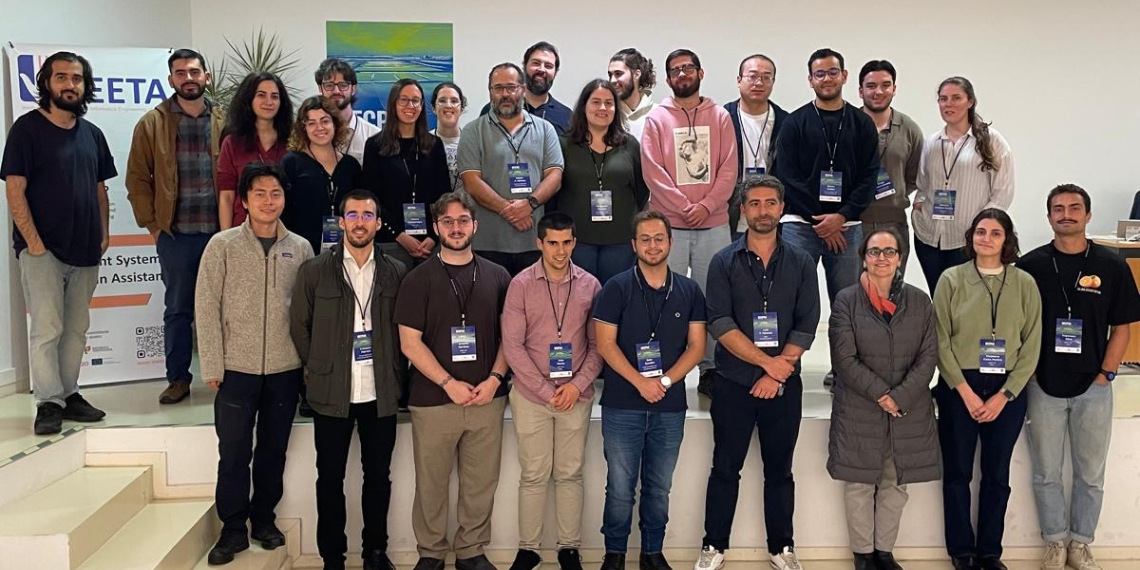
An event promoted by the Portuguese Association for Pattern Recognition featured 32 papers by INESC TEC researchers. Helena Montenegro, a researcher at the institution, won the Best Paper Award with the work Cold Diffusion Model for Decomposing Identically-Distributed Superimposed Images.
Promoting cooperation, knowledge exchange and networking were some of the main objectives of the Portuguese Conference on Pattern Recognition (RECPAD), which took place in Aveiro – with INESC TEC among the main players attending, thanks to the 32 papers authored by researchers from the institution included in the list of accepted works (out of 126). These works focused on pattern recognition, image analysis and processing, computer vision and biomedical image analysis.
According to Filipa Sequeira, a researcher at INESC TEC, the papers “focused mainly on medical imaging”. “The work developed aims to support clinical staff in the areas of breast cancer and lung cancer, by improving surgical planning and by assisting in the early diagnosis process.”
Among the accepted papers was the work developed by Helena Montenegro, under the supervision of INESC TEC researcher Jaime Cardoso; the paper Cold Diffusion Model for Decomposing Identically Distributed Superimposed Images aims to demonstrate that common anonymisation techniques based on image averaging can be reversed, revealing significant privacy risks in the context of biometric and health applications. This work received the conference’s Best Paper Award.
Moreover, INESC TEC’s work in the topics addressed at RECPAD (organised annually by the Portuguese Association for Pattern Recognition) has been – again, according to Ana Filipa Sequeira – “a fundamental pillar for the development of innovative, up-to-date and highly relevant solutions for our society”. “The various projects in which the institution is involved have enabled not only the development of scientifically relevant work across different areas of pattern recognition and computer vision, but also solutions with strong potential for real-world applications.”
The dissemination of research within the national scientific community, particularly considering the diversity of the work developed, is perceived pas something quite positive for the researcher, who mentioned that this was an opportunity to “increase the visibility and recognition of the institution”, improving access to new funding opportunities and strategic partnerships with other institutions or researchers.
The researchers mentioned in this news piece are associated with INESC TEC and the Faculty of Engineering of the University of Porto (FEUP)
 News, current topics, curiosities and so much more about INESC TEC and its community!
