


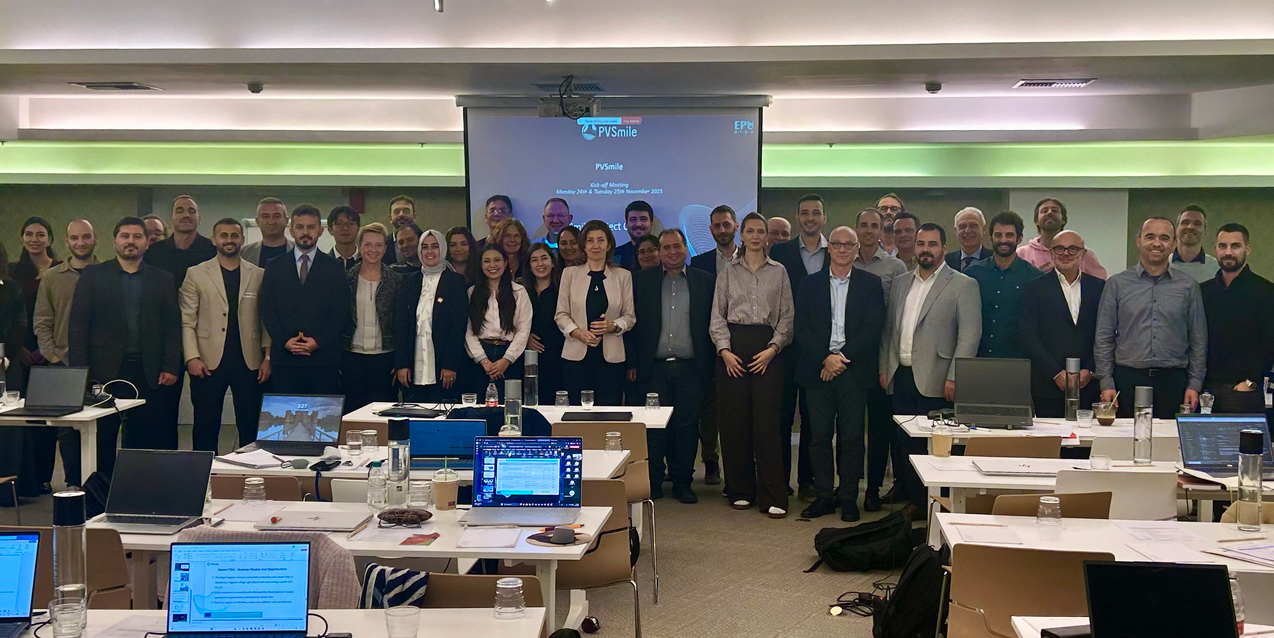
INESC TEC is taking part in a new European project called PVSmile, focusing on power & energy systems; it aims to accelerate the adoption of intelligent photovoltaic (PV) systems integrated into energy communities.
Running until 2028, the project benefits from a total budget of €6M to support the digitalisation of the life cycle of photovoltaic systems integrated into communities, serving smart, inclusive and grid-ready energy communities.
The rapid growth of photovoltaic technologies and the push towards the energy transition have sped up the deployment and integration of PV systems at local level. Today, many communities and citizens operate photovoltaic assets which, in most cases, still play a limited role in actively managing flexibility or providing services to the electricity system. These systems mainly operate as local generation units for self-consumption and/or for feeding electricity into the grid.
This is where PVSmile comes in: the project aims to transform the aggregation of multiple small- and medium-scale photovoltaic installations at local level into flexible, grid-integrated community assets, capable of supporting smart grid operation and consolidating inclusive energy communities.
To achieve this, the project will apply advanced information and communication technologies, along with decentralised, community-centred models. This approach will enable the provision of energy services, which act directly on the electricity system, and non-energy services – which do not directly involve the electricity system but create economic, social, environmental or digital value for communities and citizens. Plus, all these services will be accessible to different actors across the energy value chain.
The project is coordinated by the National Technical University of Athens (NTUA) and brings together 27 other European partners. INESC TEC is responsible for developing optimisation models for collective self-consumption and participation in energy markets, contributing to the development of a generative AI (GenAI)-based digital twin for managing energy communities, and supporting the demonstration activities in Portugal. These demonstrations aim to test community-level aggregated flexibility, energy sharing and the integration of electric vehicle charging.
Regarding the development of market-oriented optimisation models, which will enable energy communities to efficiently manage distributed photovoltaic generation, storage systems and flexible demand, INESC TEC’s contribution will take place at several levels.
“We will optimise the allocation of locally produced photovoltaic energy among community members to support collective self-consumption and energy sharing. We will also work on aggregating and valuing flexibility, allowing communities to provide services to energy markets and grid operators. In addition, we will support participation in markets and bidding strategies, enabling energy communities to interact with external markets while respecting regulatory and technical constraints,” explained Tiago Soares, an INESC TEC researcher in power & energy systems, who attended the PVSmile kick-off meeting in Athens.
INESC TEC also plays an important role in the flexibility modelling services designed within the scope of PVSmile, thus contributing with quantitative methods to assess how one can coordinate distributed assets (including batteries and electric vehicle charging infrastructures) to support grid operation and improve overall system efficiency in the community.
Regarding the development of the GenAI-based digital twin for energy communities, INESC TEC’s contributions will focus on explainable Artificial Intelligence (XAI) and user interaction.
“We will develop methods that make AI-based recommendations transparent, interpretable and trustworthy, enabling interactive explanations that help energy community managers understand why certain operational or market decisions are being suggested. This contribution aims to increase user trust and acceptance by making the logic behind optimisation and control results explicit, while allowing for human supervision in decision-making processes. This will allow informed choices in uncertain contexts, considering generation, demand and market conditions variability,” added the INESC TEC researcher.
Finally, and concerning the demonstrations planned in Portugal (which will involve testing the developed solutions in real operational environments), INESC TEC will explore community-level aggregated flexibility and coordinated control of distributed energy resources, energy sharing mechanisms adapted to real communities, and the integration of electric vehicle charging into community energy management systems. These demonstrations will be carried out in collaboration with CEVE – Cooperativa Elétrica do Vale d’Este, Coopérnico, WATT-IS and INESC-ID.
The project also aims to strengthen citizen engagement, increase cybersecurity, enable interoperable data exchange, expand local flexibility and improve life-cycle planning for photovoltaic systems. These goals will be supported by multi-level governance structures and interactive methodologies based on social sciences.
The PVSmile project is funded by the European Commission’s Horizon Europe programme, under Grant Agreement no. 101235645.
 News, current topics, curiosities and so much more about INESC TEC and its community!
