


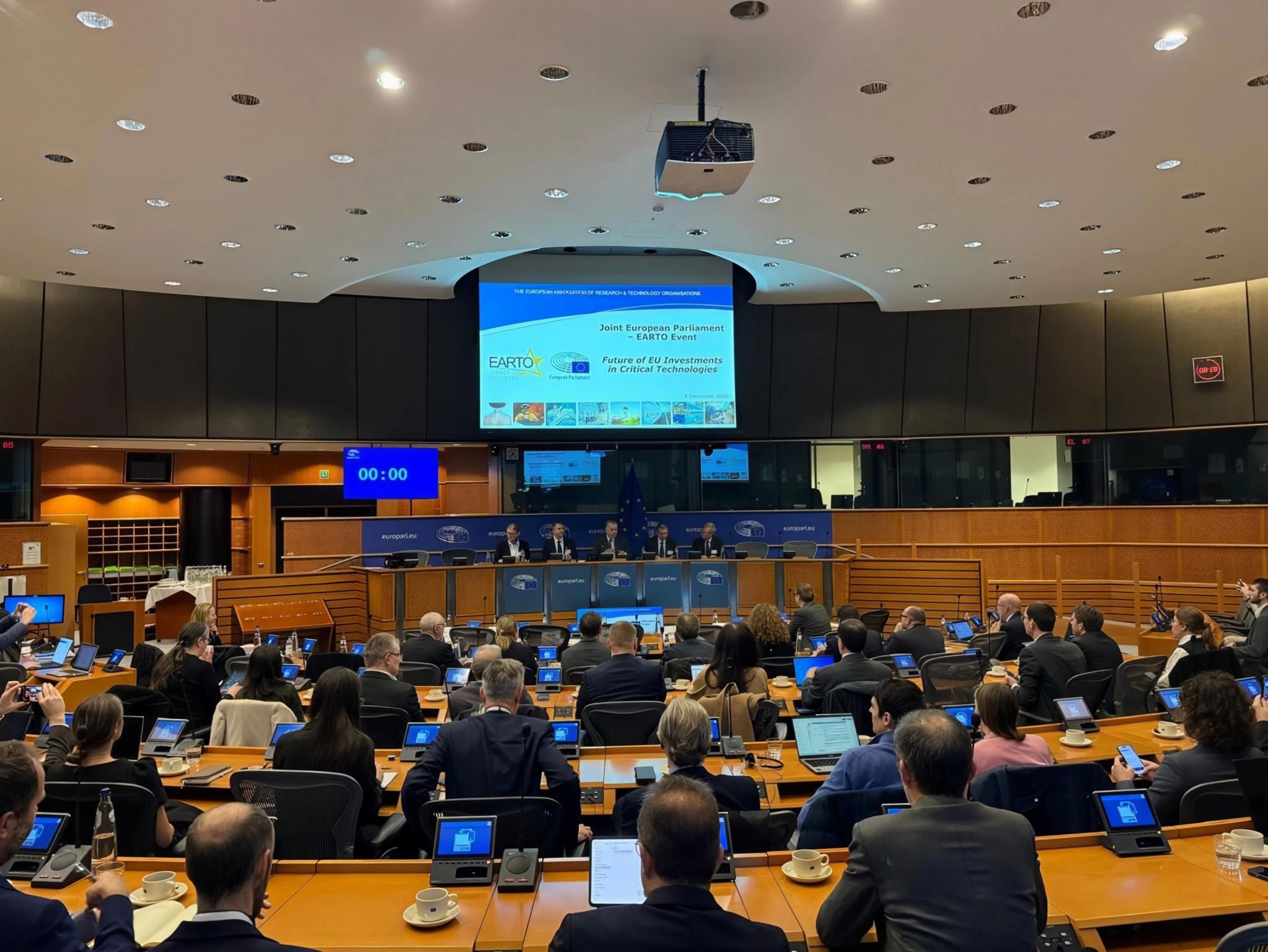
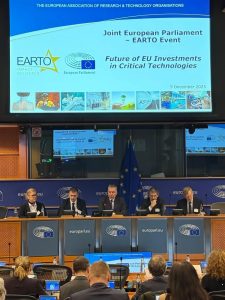
INESC TEC took part in the European Parliament (EP) in Brussels on 9 December, contributing to and co-leading the EP-EARTO Breakfast Event “Future of EU Investments in Critical Technologies”. The event brought together Members of the European Parliament, European research institutions, and industry representatives to discuss the future of European Union investment in critical technologies and the role of public–private partnerships (PPPs) in the next Framework Programme (FP10).
The meeting was organised by EARTO – European Association of Research and Technology Organisations (which features INESC TEC as a member) in collaboration with MEP Christian Ehler, who will serve as rapporteur for FP10 at the European Parliament and co-rapporteur for the European Competitiveness Fund (ECF). INESC TEC was represented by João Claro, Chairman of the Board and CEO, and Ricardo Miguéis, Head of the INESC Brussels Hub. The CEO of INESC TEC was responsible for leading part of the discussions between EARTO and MEP Christian Ehler.
European debate on strategic investment and competitiveness
The session opened with remarks by MEP Christian Ehler, who stressed the need for Europe to improve the ability to invest in critical technological areas that are essential for the Union’s competitiveness, strategic autonomy, and industrial transition. This was followed by an intervention from Jesús Valero, President of EARTO and Managing Director of Tecnalia, who highlighted the role of Research and Technology Organisations (RTOs) – a group that includes INESC TEC within the European ecosystem – as drivers of innovation, collaboration, and technological impact in Europe.
According to EARTO data, RTOs represent more than 350 organisations across 32 countries, with a workforce of around 228,000 researchers and strong participation in European programmes, securing 10% of Horizon Europe funding. The economic impact of RTOs shows a return of two euros per each government for every euro invested.
João Claro presented vision for the future of Public–Private Partnerships (PPPs)
As keynote speaker, João Claro delivered the presentation “The Future of PPPs: Governance & Selection of Critical Technologies”, where he reinforced the importance of public–private partnerships as instruments of coordination, trust, and scale – crucial for Europe to remain globally competitive in areas like Artificial Intelligence, clean energy, advanced computing, and other critical technologies.
According to the CEO of INESC TEC, there are several reasons why PPPs must be considered essential. “PPPs are vital; first of all, for long-term coordination, because they allow the balance of policies, funding, and strategic priorities across political cycles. They also provide industrial and technological sovereignty, since they mobilise joint action in areas where European competitiveness is at risk. And they act as ecosystem-delivery mechanisms: PPPs are no longer just pipelines of projects, but platforms that connect regions, companies, RTOs, and funding instruments, enabling innovation to scale,” explained João Claro.
In his intervention, he also emphasised three essential conditions for the future of PPPs: full recognition, in participation rules, of the public and non-profit mission of RTOs; clearer and more predictable contractual financial frameworks, particularly regarding funding rates, co-funding requirements, and contribution models for Joint Undertakings; and complementarity between FP10 and the ECF.
These messages followed the recommendations recently issued by EARTO regarding the future of partnerships in FP10 and the connection between the new European Competitiveness Fund and the next Framework Programme.
The need for scale and technological infrastructures
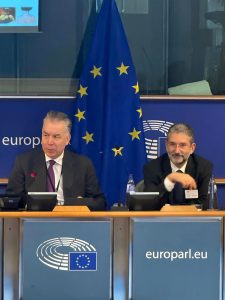
The panel also featured contributions from Bruno Feignier, Deputy CEO of CEA, and Malin Frenning, CEO of RISE. The former focused on the challenges of European scaling-up and the need to strengthen instruments supporting industrial technological development. The latter addressed the future of technological infrastructures, emphasising that European competitiveness requires simpler, faster support systems with greater accessibility for industry.
Both contributions converged on a common message: Europe must significantly reinforce investment in technological infrastructures, demonstration capabilities, industrial pilots, and mechanisms that help research transition to the market.
A strategic event at a decisive moment for FP10
The discussion among MEPs, European Commission representatives, and RTO leaders comes at a critical moment, as the architecture of FP10, the operationalisation of the new ECF, and the role of PPPs and technological infrastructures in Europe’s future investment landscape are being defined.
The session gathered around 100 participants from various European organisations, many of which maintain strong collaboration links with INESC TEC – including CEA, Fraunhofer, Tecnalia, IMEC, RISE, VTT, and SINTEF, among others.
INESC TEC was one of the institutions invited to present a strategic position, reinforcing the contribution to shaping the future of European research and innovation policies. The participation of João Claro as keynote speaker further consolidates INESC TEC’s position as a leading European organisation in the debate on the future of critical technologies and public–private partnerships.
 News, current topics, curiosities and so much more about INESC TEC and its community!
