


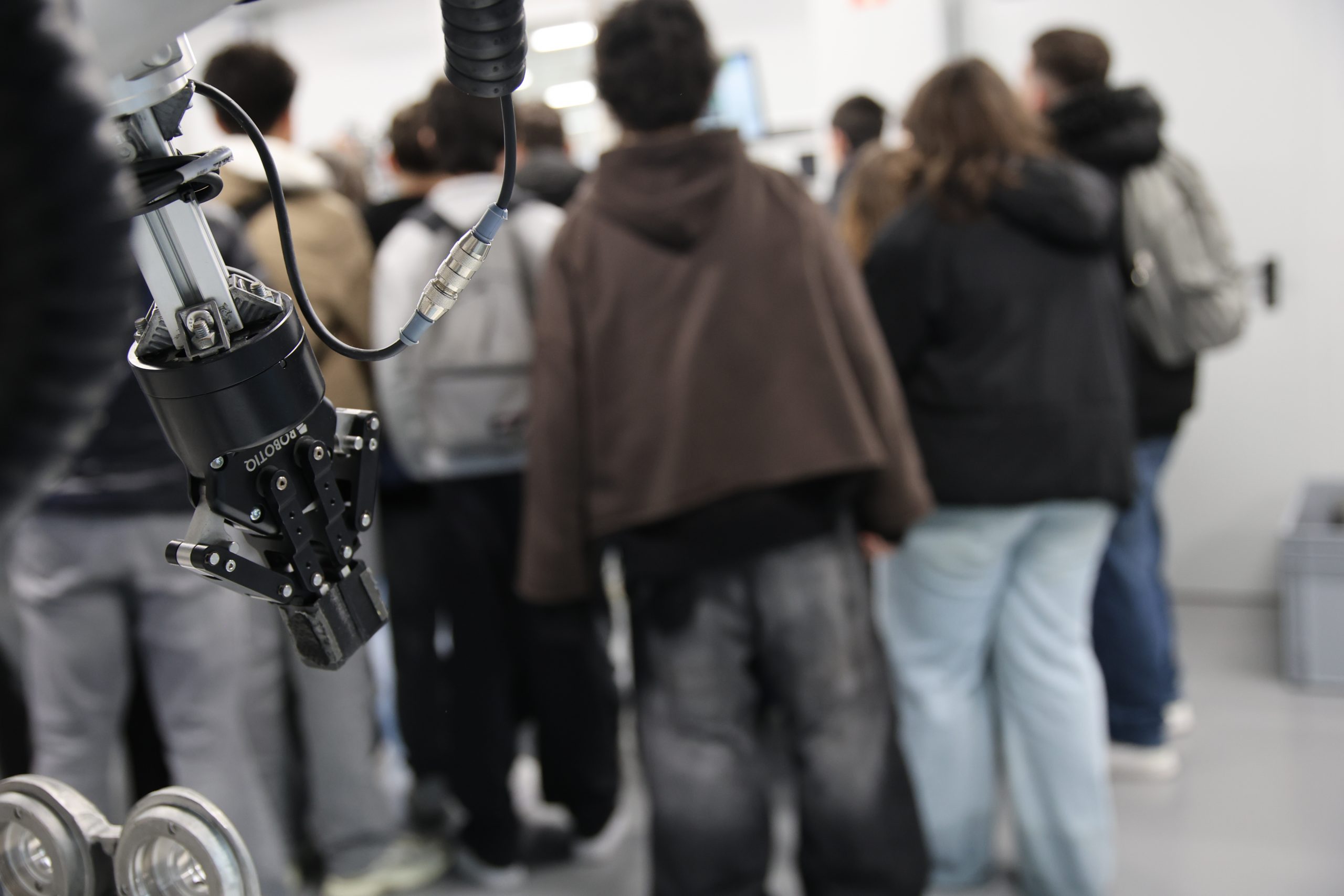
Five days. Eight laboratories. Eleven activities. Eleven schools, 241 students and 28 teachers. This is the outcome of the second edition of INESC TEC’s Open Week, an initiative aimed at showcasing the work carried out by our researchers to a younger audience.
Between 2 and 6 February, INESC TEC welcomed high school students as part of an initiative entitled “Discovering the Wonderful World of Science and Engineering”. Over the course of a week, hundreds of young people were given a close-up look at research laboratories in areas like industrial robotics, marine robotics, photonics, energy, communications and computer science. Attended by INESC TEC researchers, the students had the opportunity to learn, ask questions and experiment with developing technologies, while exploring research laboratories from the inside.
Day 1: Industrial and agricultural robotics in action
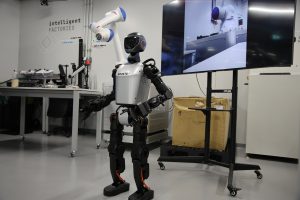
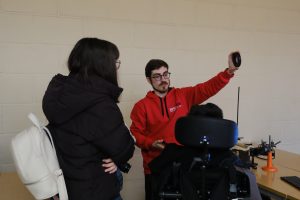
The week began at INESC TEC’s Industry and Innovation Laboratory (iiLab), where students discovered projects focused on sustainability in robotics, e.g., textile recycling using computer vision and the intelligent dismantling of electronic waste, addressing the question: “Did you know that your clothes can be easily recycled?” Pedro Dias, an INESC TEC researcher in industrial robotics, stated that “it was incredible to witness the students’ curiosity as they interacted with real-life technology and broke through the barrier of screens”, showing that “science and research are essential pillars. Who knows – perhaps some of them will be at INESC TEC in a few years’ time?” During the session, students also took part in hands-on experiments involving the teleoperation of mobile robots using virtual reality. The knowledge acquired was then tested through an interactive quiz.
As 2 February was entirely dedicated to robotics, the afternoon focused on the agricultural part through the activity “AgroTech in Action: Robotics and IoT for a Sustainable Future”. Students were introduced to INESC TEC’s TRIBE LAB, where robots and IoT technologies are developed for precision agriculture and forestry, and visited the food production greenhouse, GreenTribe. “We showed them how robotics is transforming precision agriculture and forest management, and this demonstration made it clear that robotics goes far beyond the commercial robots we all know,” explained researcher Vítor Tinoco, one of the scientists who hosted the group.
Day 2: Learning about energy and sustainability
The second day was dedicated to energy. Pedro Pascoal, one of the researchers responsible for the activities, said that “taking part in Open Week was a rewarding opportunity for the x-Energy Laboratory to step outside routine and exercise creativity, translating the complexity of our work for the next generation”. Students visited the laboratory and learned how research contributes to a more sustainable future, coming into direct contact with sustainable consumption technologies and electric vehicles. The activity, entitled “Power up! Energy for a Sustainable Future! How Can We Change the World?”, concluded with an interactive quiz. The INESC TEC energy researcher added, “It was a privilege to share our journey and inspire young students through practical activities that demonstrate the real impact of engineering.”
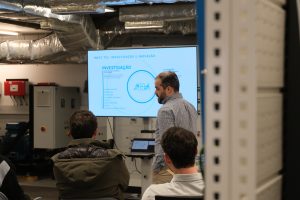
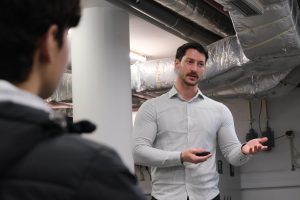
Still within the field of energy, the afternoon featured the activity “Lights, Code and Action! Control and Experiment with the Power Grid”, held in the same laboratory. Students attended a 3D printing demonstration and discovered how small changes in code can control an LED strip and affect lighting.
Day 3: Exploring communications and marine robotics
“Communicating Wirelessly and Teaching Machines to See” was Wednesday’s challenge. Students visited INESC TEC’s Communications Laboratory and took part in theme-based practical experiments. The first, “Emerging Wireless Networks – From Theory to Practice”, enabled them to configure a wireless network. The second, “Computer Vision – How Do We Teach Machines to See?”, provided a practical explanation of how image detection and recognition algorithms work, with applications in areas like medicine, security and autonomous driving. Hélder Fontes, an INESC TEC researcher in communications, said the sessions allowed students to “understand the basic concepts behind configuring and operating a Wi-Fi network”, sparking “a strong desire to go home and try to optimise the settings they had learned”.
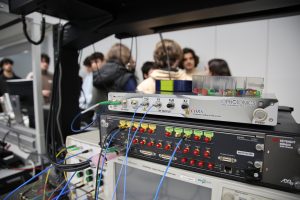
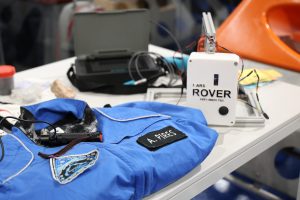
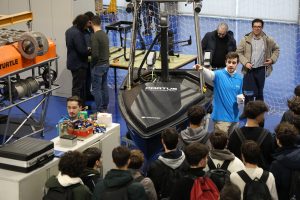
In the afternoon, students became “Land, Air and Space Explorers”, engaging with field robotics at INESC TEC’s Robotics and Autonomous Systems Laboratory. They came into direct contact with robotic dogs and ground, aerial and space drones, even simulating Mars on Earth. “It was a true adventure, where students and teachers were able to learn about the science carried out here, underwater technologies and various projects we are involved in, for example related to space exploration,” described Ana Pires, a researcher in these areas, who welcomed them to the INESC TEC laboratory facilities located at the Porto School of Engineering (ISEP).
Day 4: Designing a digital game and analysing Artificial Intelligence
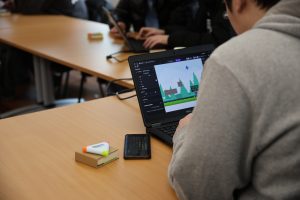
“Over just a little more than two hours, everyone was actively involved in creating a game prototype, with enthusiasm and creativity,” said Rui Rodrigues, an INESC TEC researcher in digital games and lecturer at the Faculty of Engineering of the University of Porto (FEUP), describing the students’ work on the fifth day. In the morning, participants conceived and developed a digital game, learning how to collaboratively design one; in the afternoon, they explored the world of Artificial Intelligence (AI), understood how AI models work, simulated a simple classification model, and explored ChatGPT, discussing the potential, limitations and precautions associated with the use of generative AI.
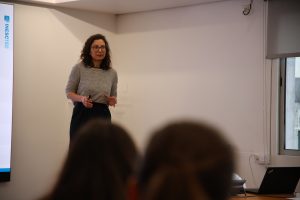
Conceição Rocha, one of the INESC TEC researchers who led the AI session, stated that “both students and teachers engaged deeply with the topic, making it possible to foster critical reflection on the functioning, limitations and impact of Artificial Intelligence”.
Day 5: Photonics and supercomputing took centre stage
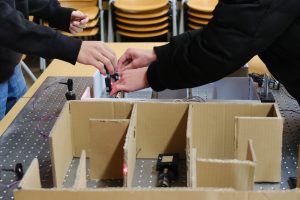
“Light in Action!” was the name of the activity that occupied student groups on the final morning. It took place in INESC TEC’s photonics laboratories, located at the Faculty of Sciences of the University of Porto, where participants explored different light sources, learned how light is guided in free space and optical fibres, and carried out simple sensing experiments.
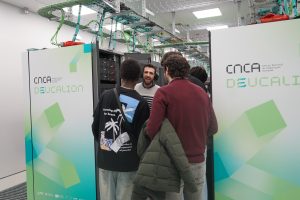
The week concluded at the facilities of the Deucalion supercomputer, at the University of Minho in Guimarães. In the activity “Supercomputing in Action: Discover Deucalion!”, students learned about the power of supercomputing and how these machines help to change the world. Rui Silva, member of the Deucalion supercomputer support team, argued that “these visits are essential to bring Deucalion closer to the community and to demonstrate the return of this public investment to citizens. The overall outcome is very positive: we showcased the infrastructure’s potential and identified daily challenges that can be overcome through automation solutions.”
Through this second edition of Open Week, aimed at students from both general and professional high school education, INESC TEC once again sought to bring younger generations closer to science and technology, demystifying research areas and sparking interest in possible career paths in these fields. The outcome was positive, with registrations and participation more than doubling compared to the previous event. A new edition is already planned for the next school year.
 News, current topics, curiosities and so much more about INESC TEC and its community!
