


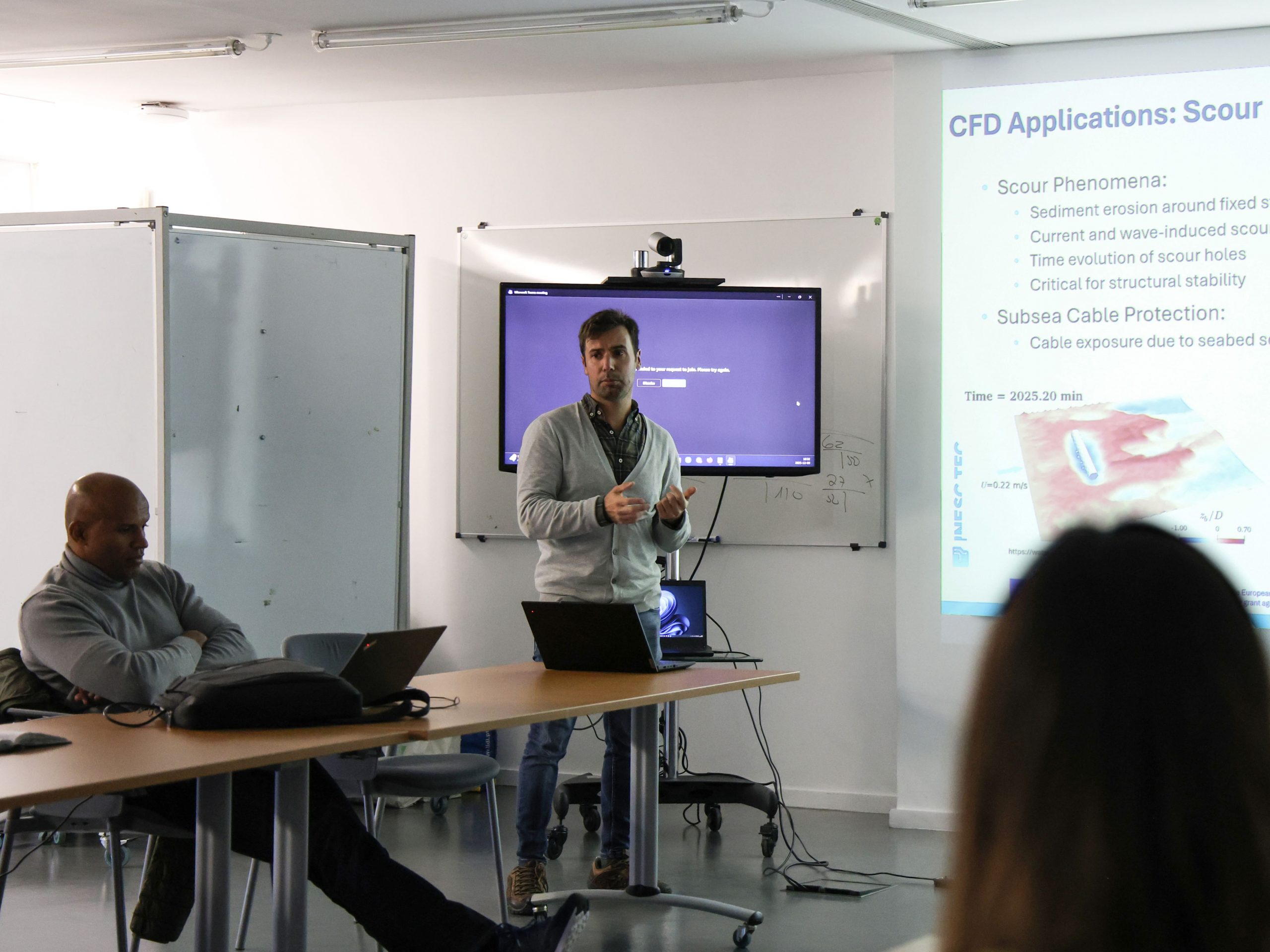
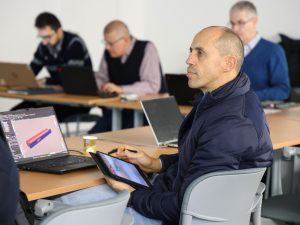
Between 9 and 11 December, the Centre of Excellence led by INESC TEC hosted a wide range of theoretical and practical sessions dedicated to one of the key topics in ocean engineering: Computational Fluid Dynamics (CFD).
They were not the “12 Days of Christmas”, but the Short Course on Numerical Modelling and CFD for Maritime Applications provided several learning moments focused on fluid simulation for offshore structures and applications. Over the course of three days, theory was combined with practice through challenges using CFD software like OpenFOAM and DualSPHysics.
The intensive course was led by three people: Diogo Neves, INESC TEC researcher; Moisés Brito, Assistant Professor at the Department of Mechanical and Industrial Engineering of the NOVA School of Science and Technology (FCT NOVA); and Andrea Califano, Senior Research Scientist at SINTEF Ocean.
“Numerical modelling using CFD tools is currently crucial for analysing the behaviour and optimising offshore systems and structures, directly contributing to innovation and sustainability,” highlighted Diogo Neves.
The exercises carried out “focused on the complexity of solving CFD problems, particularly in the correct generation of computational meshes, the definition of boundary conditions and the interpretation of results, requiring strong commitment in practical application,” the researcher explained.
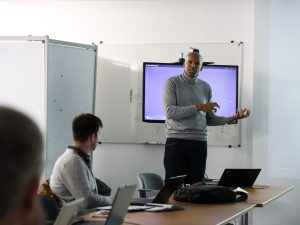
According to Moisés Brito, the course “was designed to have a strong practical CFD component”. “This practical dimension allowed trainees to become familiar with CFD software (sometimes without a graphical user interface – to critically interpret the results obtained and to identify potential numerical modelling issues,” explained the NOVA University professor.
From Northern Europe, SINTEF Ocean also contributed with “examples from both research and industry”, directly connected to the experience of the Norwegian R&D centre. “It was possible to illustrate how Computational Fluid Dynamics can complement other activities, aiding both physical laboratories and the in-house software developed at SINTEF Ocean,” explained Andrea Califano.

In the end, “the conclusions are very positive,” mentioned Diogo Neves. “The feedback from the trainees and their commitment highlighted the relevance and applicability of the knowledge acquired, overcoming challenges and enriching the professional training in numerical modelling and CFD,” emphasised the INESC TEC researcher.
According to Diogo Neves, this was another initiative aimed at “strengthening capacity-building and reinforcing the position of INESCTEC.OCEAN at the forefront of ocean technology and best practices in ocean engineering processes”.
 News, current topics, curiosities and so much more about INESC TEC and its community!
