


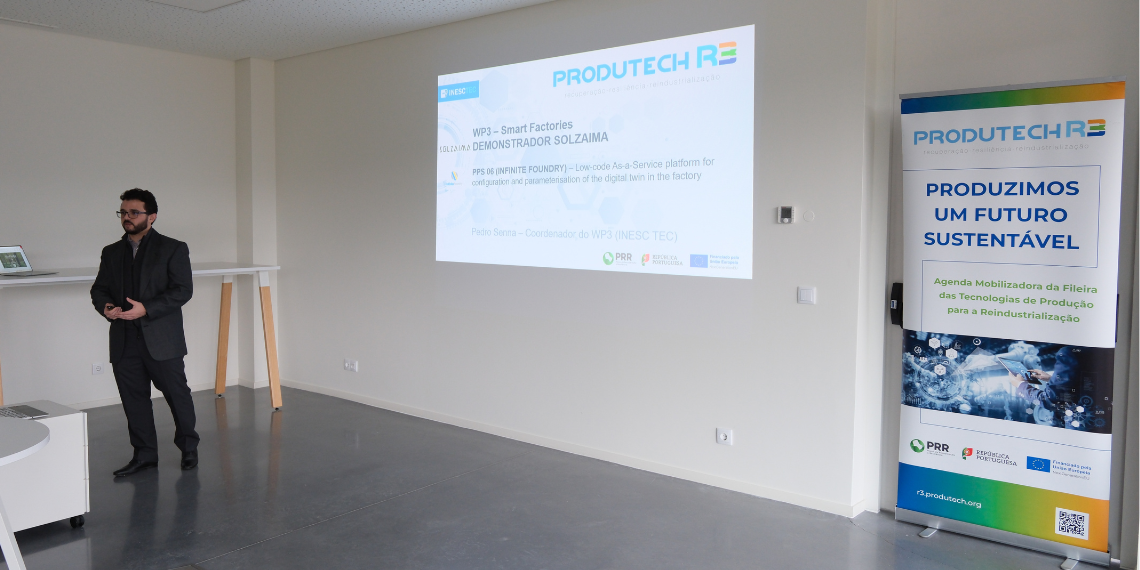
INESC TEC’s contributions to digital transformation were showcased at a demonstration event held within the framework of the PRODUTECH R3 mobilising agenda of the Recovery and Resilience Plan (PRR).
The facilities of Solzaima, a Portuguese company dedicated to producing heating solutions, hosted the presentation of the work carried out – focused on the design, implementation and development of industrial digitalisation and digital twin solutions. The goal? To modernise production processes, integrate information systems and equip factories with mechanisms capable of supporting strategic and operational decision-making.
Specifically, INESC TEC’s role in the project involves providing scientific and technological support in the creation of a three-dimensional, real-time virtual replica of factory operations (also known as a digital twin). This tool will enable companies to faithfully reproduce the operation of their factories in a safe environment where scenarios can be simulated, changes tested and knowledge generated without disrupting production.
“It is a solution that allows us to optimise processes within the factory in a very visual way. Very quickly, we can look at it and understand what is working well and what is not,” explained Nuno Sequeira, CEO of Solzaima. He watched the demonstration with great “enjoyment”, having followed the team’s work over the course of a year; a year of work which now leads to changes in the structure of the factory where Solzaima’s operations take place. “This factory was built only recently, but if I were building it today, the time we would spend designing and reflecting on the processes would be much shorter – and far more effective.”
However, the Institute’s contributions to modernisation go beyond this; in addition to changes in manufacturing through the introduction of cutting-edge techniques, Solzaima also moved forward with the integration of digital systems, a process likewise supported by INESC TEC. During the demonstration, the Manufacturing Execution System (MES) took centre stage: a system dedicated to the digitalisation of the shop floor, enabling the recording and measurement of parameters like raw material consumption, production time and operator tracking.
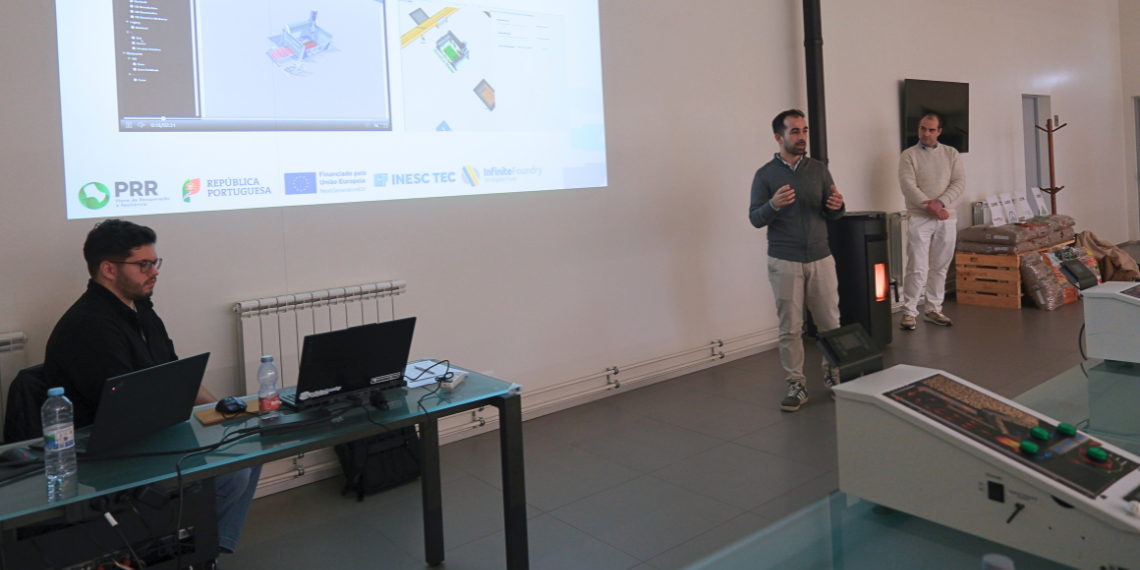
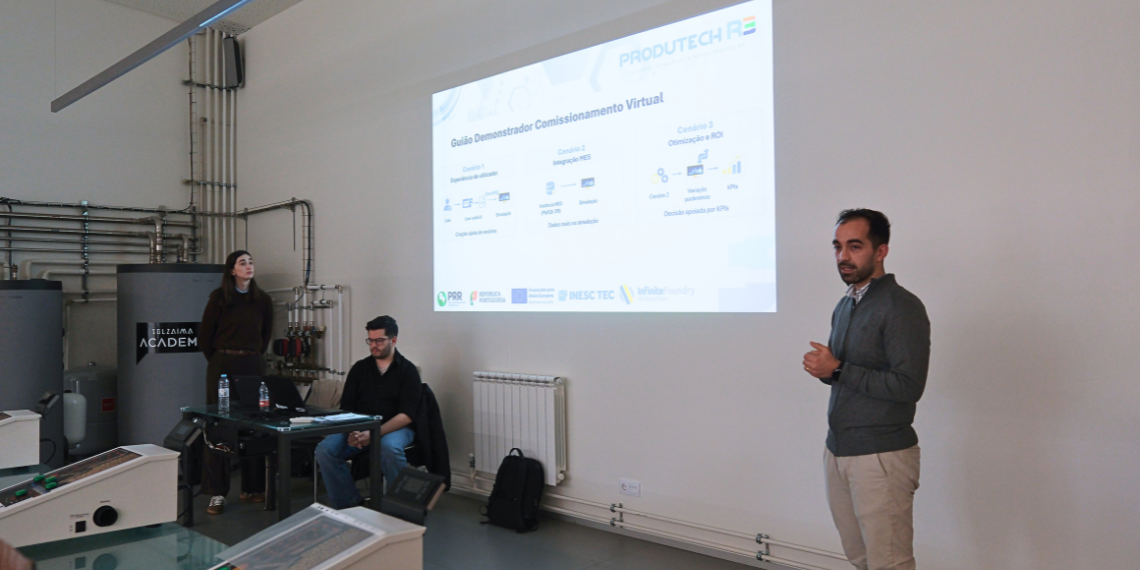
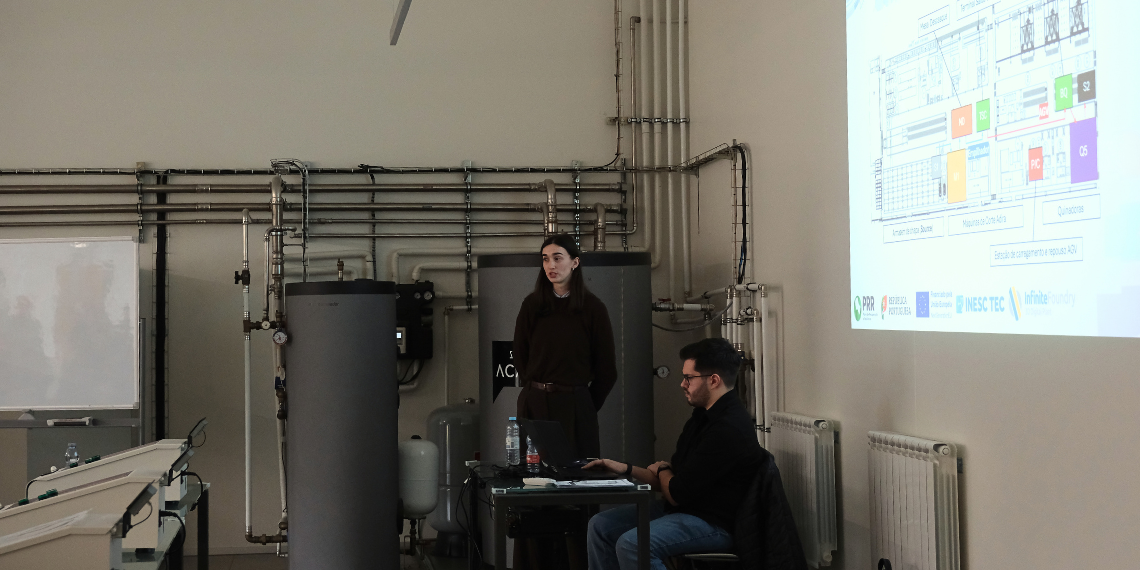
Based on this restructuring process and the resulting data, the INESC TEC team was able to lay the foundations for the operation of the digital twin, making simulation models, APIs and automatic scenario-generation mechanisms viable. This will allow the company to assess the introduction of new tools, the redistribution of resources or the acquisition of new equipment without resorting to costly real-world testing.
Promoted by INESC TEC, the concept of simulation on demand allows simulation to become part of companies’ daily routines, supporting fast and informed decision-making – even when those involved do not have specific expertise in this area. Hence, it’s crucial that the specific objectives of each business are reflected in every factory, operation and strategy.
António Almeida, INESC TEC researcher and one of those responsible for the Systems Engineering and Industrial Management area, believes that the demonstration achieved three objectives – fully complying with the targets set out in the PRR agenda. The first concerns capacity building, as INESC TEC is transferring knowledge to the market and to industry. “We equip technology companies to implement digital twin tools in the best possible way, in line with the needs of Portuguese industry,” he explained.
Secondly, there was a “strengthening of the value chain”, resulting from the joint work carried out by the various entities involved. In an initial phase, companies developed 100% Portuguese technology; subsequently, the designed machines that can integrate low-code digital twin libraries (thereby accelerating the use of these technologies in an industrial context).
Finally, the third objective relates to technological sovereignty, since what is at stake is “100% Portuguese technology”. “Everything being developed is built on technology created in Portugal, with the goal of developing a democrat low-code platform that is accessible not only to large companies but also to SMEs, which will gain access to technology that is still expensive, still difficult to access and to customise/adapt. The goal of this technology is to accelerate the adoption of digital twin technologies in the industrial context and within the Portuguese business fabric.”
The researcher mentioned in this news piece is associated with INESC TEC
 News, current topics, curiosities and so much more about INESC TEC and its community!
