


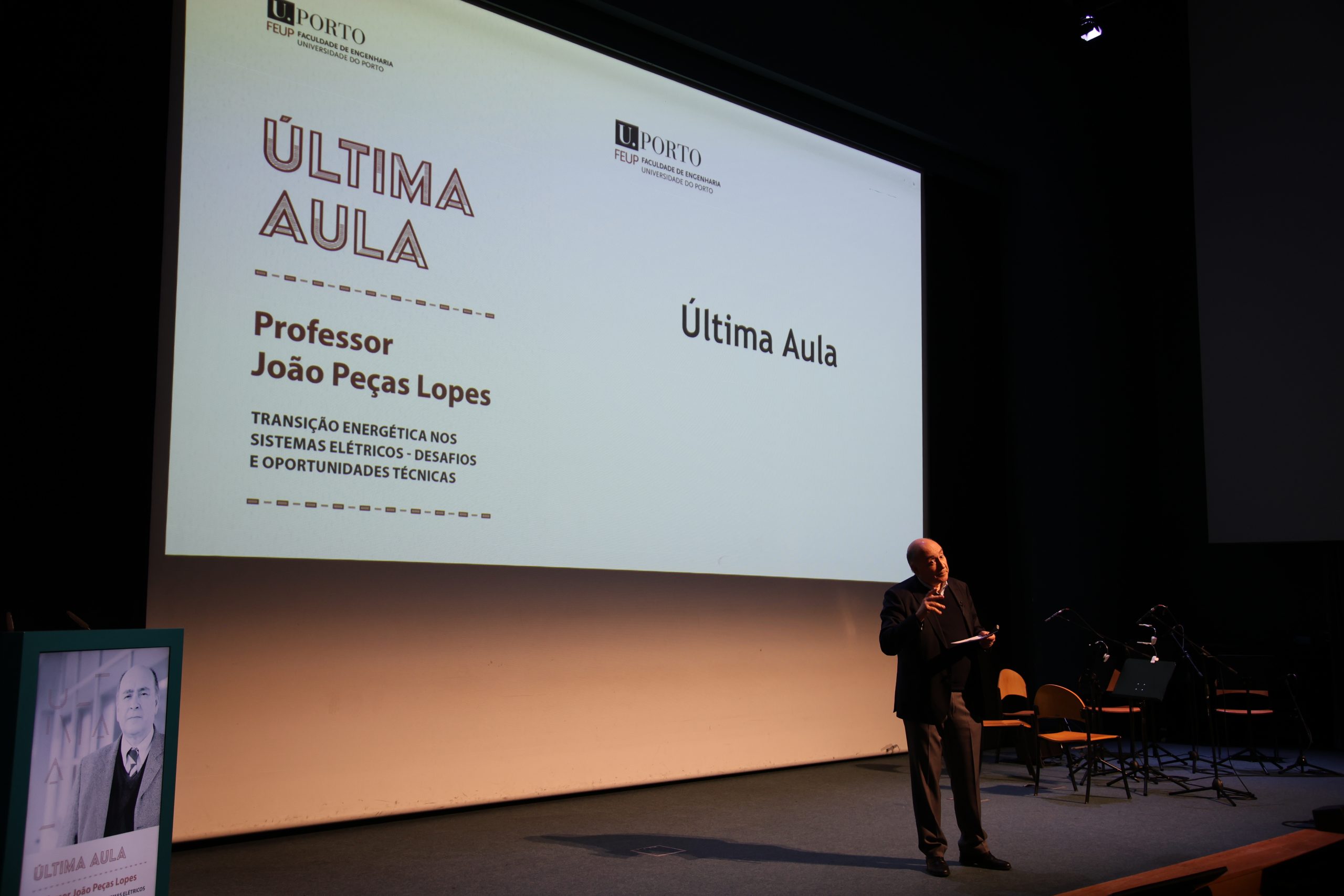
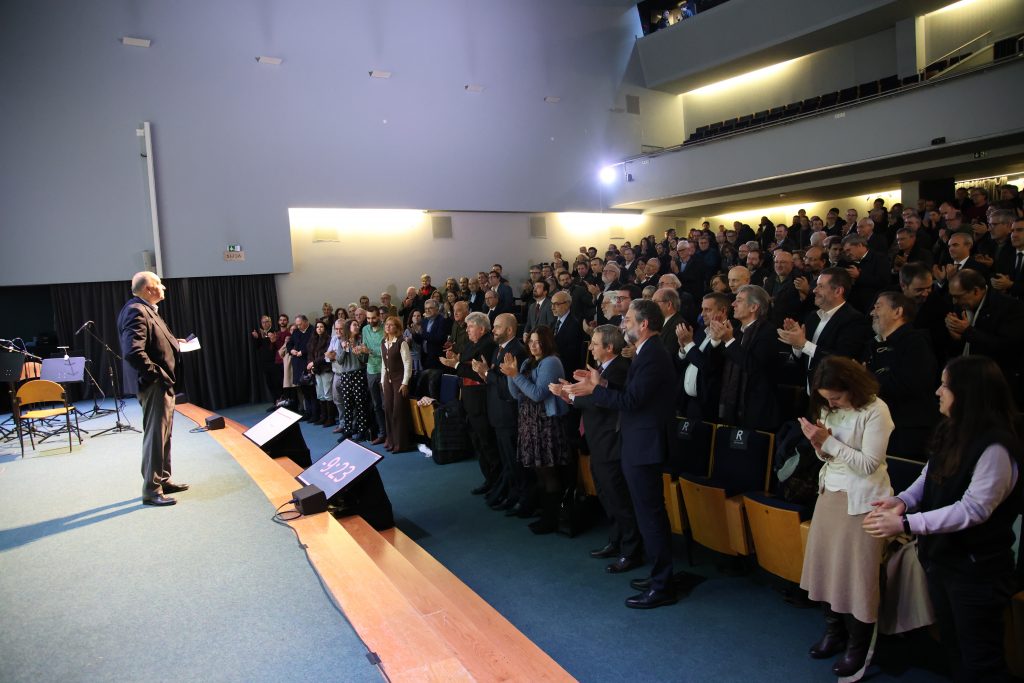
How can 44 years of teaching and research fit into a single afternoon? João Peças Lopes, Director of INESC TEC and a lecturer at the Faculty of Engineering of the University of Porto (FEUP) for more than 40 years, showed an audience of almost 500 people why he is known as the “wind power pope”.
“Energy transition in electrical systems – technical challenges and opportunities” was the title João Peças Lopes chose for his final lecture, delivered on 23 January in the main auditorium of FEUP.
Stepping into the room, one could understand that a full auditorium could only mean one thing: the audience was in the presence of someone who had deeply shaped an entire generation of students, fellow academics and researchers, as well as many people from industry and even politics. Any remaining doubts disappeared as soon as the opening speeches began.
Throughout his career, João Peças Lopes was responsible for hundreds of scientific publications, led numerous national and international projects, supervised dozens of master’s theses and more than 40 PhD theses in Portugal and abroad; he became a IEEE Fellow and was an active member of many leading national and international technical committees in his field. He also taught many of those who now hold prominent positions in the power & energy systems sector, both nationally and internationally. Yet, he himself insisted that he had the privilege of working with “giants” and that “science is done as a team”.
The opening remarks were delivered by five speakers: Rui Calçada, Director of FEUP; Jean Barroca, Secretary of State for Energy; Manuel Ricardo, Director of the Department of Electrical and Computer Engineering at FEUP and Director of INESC TEC; João Claro, Chairman of INESC TEC and FEUP lecturer; and Bernardo Silva, INESC TEC researcher, FEUP lecturer and master of ceremonies for João Peças Lopes’ final lecture.
Rui Calçada opened the session by making it clear that the audience was before “an intellectual leading figure, a bridge-builder between science, engineering, public policy and society”. The Secretary of State for Energy thanked João Peças Lopes, on behalf of the Portuguese Government, for everything he had contributed over the years to national public policy, stressing: “we keep counting on you”, and highlighting him as “not only a central academia figure, but of the national electrical system”.
Manuel Ricardo followed, reminding the audience that long before many of the issues now considered standard in the electrical system became widely accepted, João Peças Lopes was already placing them “at the centre of teaching and decision-making”. He concluded by announcing that the department he leads had proposed João Peças Lopes for the title of Emeritus Professor of the University of Porto, acknowledging a life dedicated to science, the university and public service – a proposal that has already been approved.
João Claro, Chairman of INESC TEC, described him as “an indisputable reference in power & energy systems” and thanked him for everything he has contributed (and still contributes) to INESC TEC.
Before the testimonies began, Bernardo Silva, as master of ceremonies, shared further details about the life of João Peças Lopes as a scientist and academic.
Born in 1958, João Peças Lopes joined the Electrical Engineering programme at FEUP in 1976. He completed his degree in 1981 and joined the industry sector in October of that year – working at EFACEC for six months. In November 1981, he was invited to become an assistant lecturer at FEUP; he completed his PhD in 1988 and passed his habilitation exams in 1986. In May 2000, he became an Associate Professor at FEUP, and eight years later was promoted to Full Professor. Along the way, he coordinated the Centre for Power & Energy Systems at INESC TEC.
One year after becoming a Full Professor, he had an opportunity “from across the street”: in 2009, he became a member of the Board of Directors of INESC TEC, a position he held until 2018. In 2016, he was named a Fellow of the IEEE. Since 2018, he has served as Director of INESC TEC, where he took on the challenge of coordinating one of the main sectoral innovation areas: power & energy. His full CV is far more extensive than this summary; but the stories shared during the testimonies completed the picture of his life and career.
The session also included eight testimonies: Aurélio Tavares; Nikos Hatziargyriou, Professor at the National Technical University of Athens; João Paulo Rosado Correia, legal adviser to the wind power tender in which Peças Lopes served as chair of the jury; Jorge Vasconcelos, former President of the Energy Services Regulatory Authority (ERSE); João Torres, former President of EDP Distribuição; João Conceição, CTO of REN (where Peças Lopes has chaired the REN Award) jury for 12 years; José Manuel Mendonça, Emeritus President of INESC TEC and Emeritus Professor at the University of Porto; and Ricardo Bessa, coordinator of one of INESC TEC’s research centres, in power & energy systems.
The expression “wind power pope” was introduced by João Paulo Rosado Correia, who explained that this was how João Peças Lopes was known. He joked that he had not yet had the chance to meet “His Eminence” when he was told that this academic would chair the jury – and highlighted his “calm and firm leadership”.
Jorge Vasconcelos, former President of ERSE, described João Peças Lopes as “a singular figure in the academic world”. He stated that he was “an active part of the academic generation that knew how – and wanted – to transform and improve the prestige of the Faculty of Engineering of the University of Porto and the University of Porto itself”. He went further, saying that “without any doubt, in the final quarter of the last century and the first quarter of this century, he was the leading figure in placing Portugal on the world map of energy systems”. He concluded with a suggestion: “Next time I come to FEUP, I would like to see a very simple plaque with the name ‘João Peças Lopes’ (…) because in a world where those who shout loudest and deny science now dominate, it is important to honour those who elevate it.”
One of the most recent stories highlighting João Peças Lopes’ impact was shared by REN’s CTO, João Conceição, regarding the Iberian Peninsula blackout. He called him “the blackstart of knowledge for technical issues” and said that whenever REN faces doubts or difficulties, he is the person they turn to for help.
José Manuel Mendonça shared several stories, emphasising that he worked for 20 years “with João Abel in building a truly exceptional institution”. Among many achievements, they secured approval to build a smart grids and electric vehicles laboratory, now known as the INESC TEC x-energy lab (a name that, according to Mendonça, “is closer to Generation Z”, but which was “João Abel’s pride and joy back in 2011”).
Ricardo Bessa referred to João Peças Lopes’ scientific publications, some with more than 3,000 citations, but said this mattered little compared to the legacy of lecturers he left at FEUP and the scientists he helped to train at INESC TEC. He also shared a concept taught to him by João Peças Lopes – “footprint” – which he now understands (or at least thinks he does) as knowledge combined with thoroughness and international reach. He joked that every meeting with João Peças Lopes begins with “yes, but that’s already been done”, and added that “everything inspiring contains a touch of irrationality” and that “thanks to him, we managed to go beyond the dream”.
Visibly moved, João Peças Lopes finally took the stage to deliver his last lecture on the energy transition in electrical systems. He began by stating that climate change is no longer a threat, but a fact. Over the course of an hour, he addressed many topics, from what happened to the Portuguese and Spanish electrical systems during the blackout, to issues related to renewable energy. He spoke about the need to electrify the economy and society, new ways of charging electric vehicles, the future electricity demand of data centres and cryptocurrency mining, and the operation of large-scale electrolysers for hydrogen production. He concluded by stressing the need to promote electrification supported by electricity generated from renewable sources, as this is the only way to decarbonise the economy while creating major opportunities for industrial and economic development and for the creation of highly skilled jobs.
Before the musical moment and tribute, João Peças Lopes – true to his principles – did not leave the stage without, once again, stating that “science is done as a team” and thanking INESC TEC “for giving me all the conditions to develop this work”. He concluded with a firm conviction: “the work done in academia only makes sense if it is carried out together with the economy and industry”.
 News, current topics, curiosities and so much more about INESC TEC and its community!
