


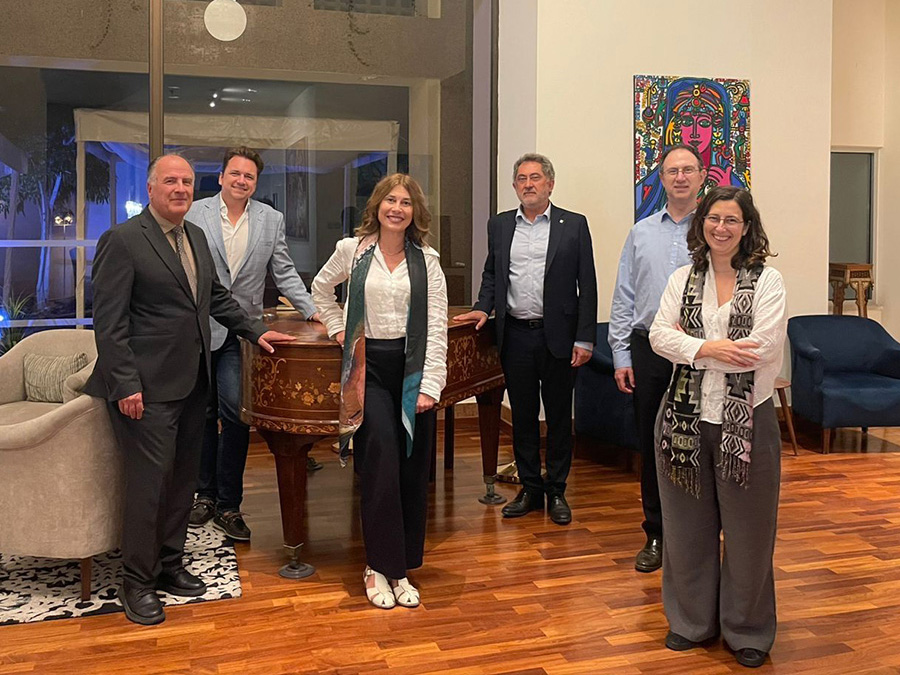
The Centre of Excellence led by INESC TEC – INESCTEC.OCEAN -, the Cyprus Marine and Maritime Institute (CMMI) and MARBLE (Centre of Excellence in Marine Robotics and Maritime Technologies) have formalised an agreement for multilateral collaboration in ocean-related innovation. In the Cypriot city of Limassol, the INESC TEC research team also took part in the Breaking the Surface workshop, securing the second place in an underwater acoustic detection challenge.
Collaboration between INESCTEC.OCEAN and the Centres of Excellence of Cyprus and Croatia will focus on establishing R&D programmes and projects of mutual interest in marine science and technology. Key areas include robotics and autonomous systems, data and cybersecurity, structures and testing, environmental monitoring sensors, modelling and mapping, digitalisation, marine energy and seabed resources, and the design and performance of research platforms.
The agreement between the three Centres of Excellence also covers cooperation in organising a range of activities like training courses, seminars, workshops, conferences and other events related to marine and maritime technological innovation.
“This Memorandum of Understanding is an important step in strengthening the framework for cooperation in marine research and innovation,” said Marta Barbas, Executive Advisor to the INESC TEC Board. She emphasised that the signed document “symbolises a mutual commitment to working together on critical research areas related to ocean technologies,” noting that these are “essential for the development and sustainability of the marine and maritime sectors.”
“We expect an even closer balance between academic research and industry needs, the development of new green technologies, and advanced training for engineers and professionals supporting the Blue Economy,” added Marta Barbas.


According to Nikola Mišković, Director of the MARBLE Centre of Excellence, the signing of the Memorandum “represents a joint commitment to bridging advanced research and industry challenges related to autonomous maritime systems.” Zacharias Siokouros, CEO of CMMI, described it as “an achievement for Cyprus,” adding that “a new chapter of long-term collaboration in marine and maritime innovation is unfolding with two leading Centres of Excellence.”
MARBLE, founded by the Faculty of Electrical Engineering and Computing at the University of Zagreb (UNIZG-FER), is a Centre of Excellence dedicated to maritime robotics and innovation for a sustainable Blue Economy. Their research and solutions build on areas such as robotics, the Internet of Things (IoT) and digital twinning.
CMMI – the Cyprus Marine and Maritime Institute – is an independent Centre of Excellence dedicated to research, innovation and technologies that support solutions for the various sectors of the marine industry. CMMI operates with a multidisciplinary perspective on innovation and research in support of a sustainable Blue Economy.
The signing ceremony was attended by the Croatian Ambassador and the Portuguese Ambassador, Vanda Sequeira.
INESC TEC team secured the second place in the Breaking the Surface challenge
The visit to Cyprus was not solely motivated by the signing of the Memorandum of Understanding between the three ocean-focused Centres of Excellence. From 9 to 16 November, an INESC TEC research team participated in the 17th edition of Breaking the Surface, an international workshop dedicated to underwater robotics and technology and potential applications.
Alongside lectures and demonstrations, the event featured the traditional aquatic technology competition. “This year, the task involved detecting underwater acoustic signals in a real environment,” explained Nuno Cruz, INESC TEC researcher and one of the organisers of the challenge.
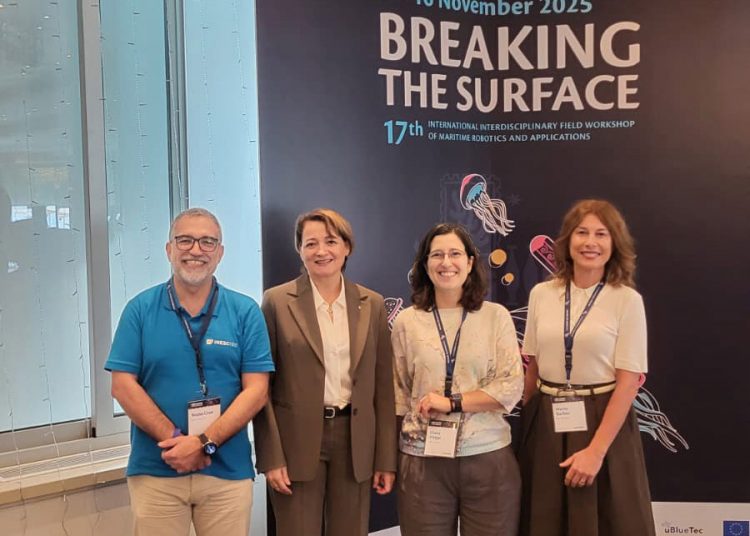

“We used two boats off the coast of Limassol: one carried an acoustic signal emitter, while the other, located several hundred metres away, had a recorder capturing all ambient sound,” he described.
The researcher mentioned that “the challenges of underwater acoustic detection are considerable,” as “signals are strongly attenuated and experience major propagation distortions, particularly due to surface and seabed reflections in coastal waters.” He added that during the challenge “there was significant wind and wave activity, with several boats passing by – all of which create acoustic noise that complicates signal detection.”
Regarding the evaluation of the teams’ performance, several criteria were considered, said Nuno Cruz: “Number of correctly detected signals, accuracy in calculating emission times, and identification of characteristics of the emitted signals.” “None of the teams excelled in every aspect, so the comparative assessment was particularly challenging,” noted the researcher, who coordinates INESC TEC’s robotics and autonomous systems area.
Paula Graça, researcher and member of the INESC TEC team, highlighted two moments in the competition. In the first challenge, “where the characteristics of the signal were known, the goal was to determine the number of receptions and their respective arrival times.”
“To do this, we used Matched Filter techniques with refinement through an STA-LTA (Short-Term Average over Long-Term Average), making the whole process automatic and free of human intervention – one of the aspects that set our team apart. Of the 12 emissions, we detected nine receptions with time precision on the order of milliseconds,” she explained.
In the second challenge, “where the signal was unknown, the goal was to determine its frequency and emission period.” For this, the INESC TEC team used a method “combining spectral analysis of the signal with intensity filtering, followed by statistical calculations to reduce measurement error.” The team achieved the best result in this task.
Ultimately, the team’s overall performance earned INESC TEC second place in the competition. According to Paula Graça, key takeaways from the challenges relate to how “the variability and unpredictability of the underwater environment heavily impact acoustic transmission, affecting the quality and integrity of received signals.” “This observation reinforces the need for adaptive and cooperative systems and methods to operate effectively in real environments,” she said.
Following Nuno Cruz’s remarks, the INESC TEC researcher stressed that the greatest difficulty “arose precisely from the dynamics of the environment, which resulted in a non-constant signal-to-noise ratio, heavily influenced by ambient noise, including both biological and anthropogenic sources.” “Despite knowing the signal in the first challenge, three occurrences were not automatically detected due to irregular signal degradation,” concluded Paula Graça.
The researcher Nuno Cruz is associated with INESC TEC, Faculty of Engineering of the University of Porto (FEUP) and the researcher Paula Graça is associated with INESC TEC via FCT.
 News, current topics, curiosities and so much more about INESC TEC and its community!
