


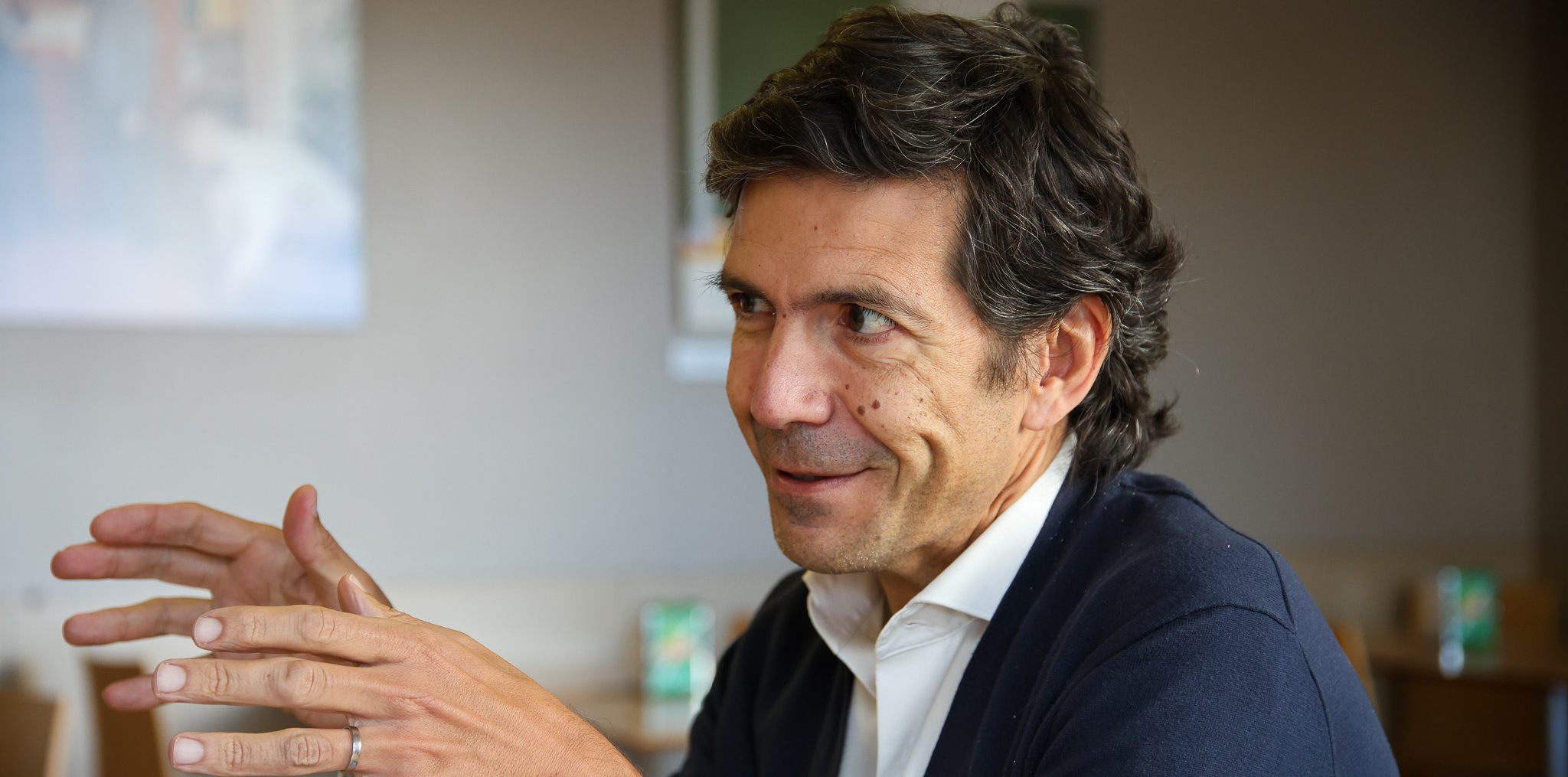
He keeps a Spectrum 48K at home. The hours Hugo Paredes spent in front of that small computer marked the beginning of a career devoted to understanding how technology can change people’s lives. More than two decades of research later, from virtual gyms and intelligent assistants to accessibility solutions, he continues to explore how technology can better meet human needs.
What if people could go to the gym without leaving their living room, exercising alongside training partners who live hundreds of kilometres away? Or have a virtual assistant to help them recover from an illness? What if technology could adapt to the needs of blind or deaf people? These questions have guided more than two decades of research by Hugo Paredes – who has been working at the intersection of Artificial Intelligence (AI), human-computer interaction, accessibility and digital health across the Braga-Porto-Vila Real triangle since the turn of the century.
This is also very familiar territory for INESC TEC, which has gradually expanded northwards from Porto over the years. This story does not begin in Porto, however. Hugo Paredes was born in Vila Real and studied in Braga; he has a long-standing connection with the University of Trás-os-Montes and Alto Douro (UTAD), where he is now a Full Professor. INESC TEC entered the picture in 2012, when closer ties with UTAD began to take shape through a cooperation agreement.
But before all that, there was a Spectrum. The hours he spent using the 48K, which he still has at home, set him on what he describes as the “natural progression” towards choosing what he wanted to do with his future: “When I applied to university, I only chose one degree… Informatics Systems Engineering at the University of Minho. Just that one, nothing else.” His single choice paid off. And it was in Braga, towards the end of his degree, that he began to realise how technology designed to be accessible and responsive to human needs could genuinely transform lives.
He took part in the development of the first accessible web browser for blind people. “That sparked a great deal of curiosity in me about how technology can actually make an impact and change people’s lives,” said Hugo Paredes. But it was not just a prototype browser for blind users. “We went beyond that.”
It was the year 2000, and pocket PCs were beginning to emerge – devices about the size of a mobile phone, but without connectivity. “One of the things we realised was that specialised devices for blind people were prohibitively expensive. If we could develop solutions using consumer electronics and software, we could overcome those cost barriers much more easily,” explained the researcher.
Bringing the lab into the classroom
Between that browser and the present day, an ever-growing portfolio of projects has emerged, spanning gamification in education, collaborative tools, AI, human-computer interaction, accessibility and digital health. And all that experience makes the way into the classroom.
“The classroom should be where we educate new generations using the knowledge we acquire in the lab. If, as teachers, we simply go into the classroom, read a book and repeat what is in the literature, we can very easily be replaced by any AI. We become almost unnecessary,” he pointed out.
He brings more than laboratory experience to his teaching. After completing his degree at the University of Minho, and before returning home to begin his career at UTAD with the support of an FCT grant, he gained experience outside academia. During one of these spells, at SIBS, he took part in developing projects that were innovative at the time, including the business-to-business component of MBnet, an electronic payment solution.
A research grant at UTAD would ultimately determine his path. “I had several options, but I felt that was where I could make the biggest difference.” The university’s Informatics degree was still in its early stages, and new teaching staff were being recruited. He moved to Vila Real, securing a position at the university while completing his PhD at the University of Minho.
But his decision was not simply about returning home. “The university already had a track record in electronic accessibility, and I was fortunate to get involved in projects through the colleagues I met at the time.” The projects kept coming. More than 10 years ago, he began contributing to research on active ageing. One of the first initiatives was Online Gym – a virtual gym where people could exercise together in groups from their own homes.
The impact was immediately clear; as Hugo explained, when the WalkingPAD project (designed to help people with peripheral artery disease regain mobility and improve their quality of life through a personalised exercise programme monitored remotely) was covered in the news, someone travelled all the way from Faro to Porto to try out the technology.
“That makes you more aware of the impact these solutions can have. You realise that what you are doing really does make a difference,” he stresses. “Sometimes, though,” he continues, “we simply don’t manage to gain the traction we would like to turn what we develop into commercial solutions,” says the researcher.
Running alongside
When Hugo Paredes joined INESC TEC in 2012, the Institute was also beginning to expand the geographical reach. “INESC TEC is increasingly establishing itself as Portugal’s leading research institution in our field,” he said. This confidence is based above all on people. “We have outstanding human resources,” he emphasised.
But growth also comes from bringing people closer together. Splitting his time between Vila Real and Porto, Hugo Paredes now feels more closely connected to the INESC TEC community, despite the distance. He recalled the early years, when opportunities for researchers to meet and share ideas were few and far between. “There weren’t the initiatives we have today,” he remembered, highlighting the value of opportunities that bring together people whose work is spread across different locations.
There is one thing Hugo Paredes never leaves behind when travelling between Trás-os-Montes and INESC TEC: his running shoes, shorts and a T-shirt. “The day always has to start with a run.” Interestingly, this “healthy addiction” began in the same year that INESC TEC became part of his daily routine.
And it is a serious addiction. He ran his first half-marathon in 2012 and, the following year, made his debut over the full 42 kilometres in Madrid, just one week after the Boston Marathon bombing. Races in Lisbon, Porto, Hamburg and Paris followed. In 2016, he set his personal best in Lisbon: three hours and 56 seconds – “those 56 seconds were just a little too much,” he joked.
Marathons are no longer a goal, but running remains an essential part of his routine. “Running is one of those addictions that stays with me wherever I go.” Neither cold weather nor work trips get in the way. During a visit to Oulu, Finland, with temperatures below freezing and streets covered in ice, his priority was to find a sports shop where he could get the gear he needed to run on icy surfaces.
Today, the ambition of completing a marathon in under three hours is behind him. But the curiosity that first took hold during the final years of his degree in Braga has not faded. Working across accessibility, digital health and AI, Hugo Paredes will continue to seek answers at INESC TEC to a question that has stayed with him since the turn of the century: how can technology make people’s lives better?

 News, current topics, curiosities and so much more about INESC TEC and its community!

