


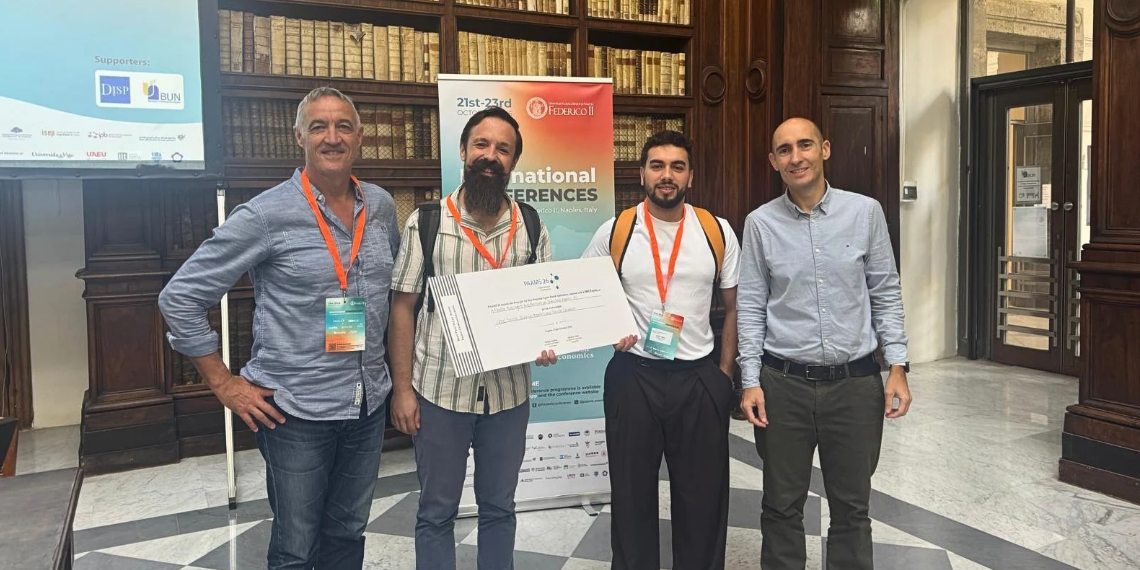
The demonstration was developed as part of the FCT-funded S2GAIIA project and received the Best Practical Agent-Based Application award.
A multi-agent system designed to support decision-making in industry, developed by INESC TEC researchers, won the Best Practical Agent-Based Application award at PAAMS 2026 (International Conference on Practical Applications of Agents and Multi-Agent Systems), held in Naples. The innovation addresses the need to develop “agents/models that perform well in complex, high-value industrial tasks”. Examples include the dynamic generation of dashboards, the creation of and interaction with simulation models, and interface with organisational information sources (documents, Asset Administration Shells and historical databases). These capabilities offer an alternative to more generic commercial solutions, which often cannot perform such tasks with the same level of quality or specificity.
Reducing dependence on commercial providers was another key requirement addressed by the research. The goal is to ensure that organisations can integrate these tools without relinquishing control of their data or becoming dependent on external services that could be discontinued without warning, become more expensive or simply change.
The solution’s deciding feature lies in a fully “flexible and dynamic” architecture. Regarding said flexibility, INESC TEC researcher Davide Carneiro explained that it allows organisations to “add and remove agents in real time, according to their needs and characteristics”. As for the dynamic nature, this means that there are no predefined workflows. “Depending on the prompt, the available agents are planned and coordinated, with re-planning and new attempts made in the event of failures, incomplete responses, and so on. This enables the system to answer a wide range of questions and adapt without requiring manual configuration.”
Beyond these two features, the researcher believes that the industrial task-specific agents included in the solution also played a decisive role in securing the award. “They include agents for interacting with Asset Administration Shells, creating and running simulation models in FlexSim, generating dashboards, querying databases, and so on.” This made it possible to demonstrate both the architecture’s potential and the wide range of questions it can address.
“The award-winning demonstration took place in three sessions over the three days of the conference,” recalled Davide Carneiro: one online and two in person. The award was particularly significant because it was decided by a vote among conference participants, some of whom have been working in this field for “decades”. “It is the community’s validation of an idea that was initially exploratory, but which we managed to turn into something concrete and functional,” stated the researcher, who worked on the system alongside José Sousa and Rodrigo Ribeiro.
This recognition is consistent with the feedback gathered throughout the conference, which focused mainly on the architecture’s dynamic nature and on how new behaviours and problems that the system can solve emerge as more agents are added. At the same time, “the models/agents designed for specific tasks – particularly interaction with AAS and the generation of simulation models – also attracted considerable attention because of their innovative nature, specificity and high value for industry”.
 News, current topics, curiosities and so much more about INESC TEC and its community!

