


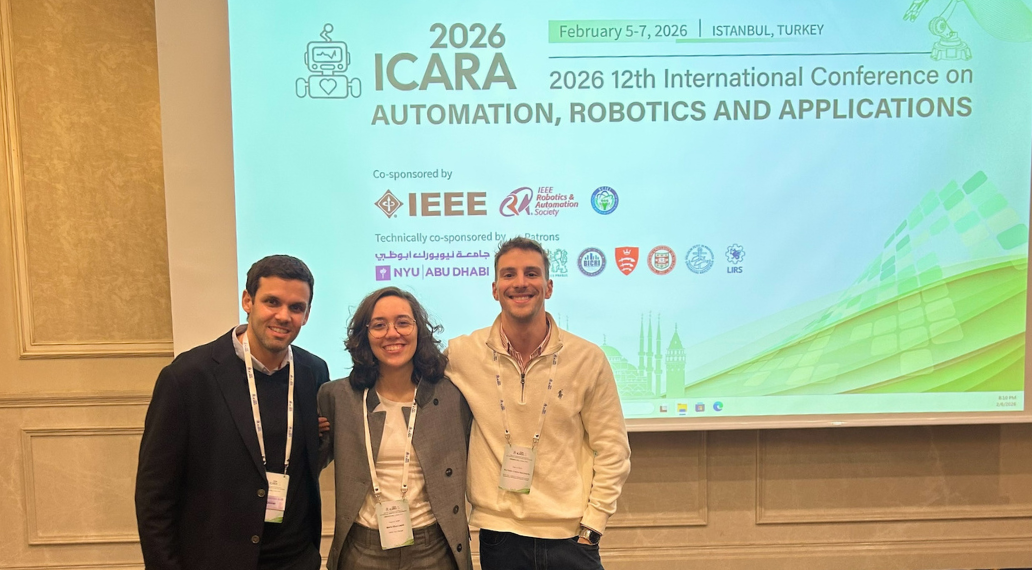
The twelfth edition of the International Conference on Automation, Robotics and Applications (ICARA 2026) provided the stage for the presentation of innovative robotic solutions developed at INESC TEC. Maria Lopes, Rui Nascimento and Accacio Neto travelled to Istanbul, in Turkey, to present their work – with the researcher winning the Best Presentation award in the session “Intelligent Medical Devices and Assistive Robots & Engineering Robot Design”.
Maria Lopes, robotics for container unloading and the award
Maria Lopes presented the paper “CARGO (A Mobile Manipulator Solution for Container Unloading)”, developed within the scope of the Produtech R3 project. The study proposes a flexible container unloading solution, based on a modular structure adaptable to common mobile manipulators, eliminating the need for specialised hardware – with this approach achieving a 97% success rate. “This work addresses the labour shortage for this task, as it is physically demanding and carried out in extreme conditions,” explained the award-winning researcher; thanks to her work, Maria Lopes received the Best Presentation.
Rui Nascimento and inspection using augmented reality
Rui Nascimento presented the paper “Augmented-Reality-Based and Deep Learning Framework for Defect Detection in Reflective Parts”, which focuses on quality inspection of reflective metal components. The solution uses augmented reality and deep learning methods to collect flexible, multi-perspective images, enabling real-time feedback during the inspection process. “This work contributes to advancing assisted inspection systems, following a human-in-the-loop approach. At the same time, the solution reduces cognitive load and human error, promoting safer, more efficient inspection processes that can be easily applied in real industrial contexts,” the researcher explained.
Accacio Neto and smarter agricultural robots
Accacio Neto presented two papers exploring robotics solutions for precision agriculture. In the first, “Linear Parameter-Varying Dynamic Modeling of Agricultural Robots on Variable-Friction Soils”, he developed a dynamic model of agricultural robots that automatically adapts to different soil types, using Linear Parameter-Varying (LPV) models to represent the impact of friction on behaviour. The second paper, “Bounding Box-Based 3D Mapping with UGV–UAV Collaboration for Precision Agriculture”, proposes a 3D mapping method for agricultural environments based on collaboration between ground and aerial vehicles and simple geometric representations – enabling the creation of simpler and more lightweight agricultural maps. “These works make it possible to develop safer, more efficient and more adaptable agricultural robots, supporting precision agriculture, reducing failures and increasing the autonomy of these resources,” said the researcher.
Associated with the IEEE Robotics and Automation Society, ICARA is a renowned international scientific conference that aims to promote the advancement of knowledge in the fields of robotics and automation, bringing together researchers, professionals and industry leaders from several continents. The twelfth edition, held between 5 and 7 February 2026, became a global forum for presenting research work and discussing key topics in the field, e.g., autonomous systems, advanced control, cognitive robotics, computer vision and human–robot interaction, while also fostering international collaboration and partnerships between academia and industry.
Researchers Maria Lopes and Rui Nascimento are associated with INESC TEC, and researcher Accacio Neto is associated with CEFET-MG.
 News, current topics, curiosities and so much more about INESC TEC and its community!
