


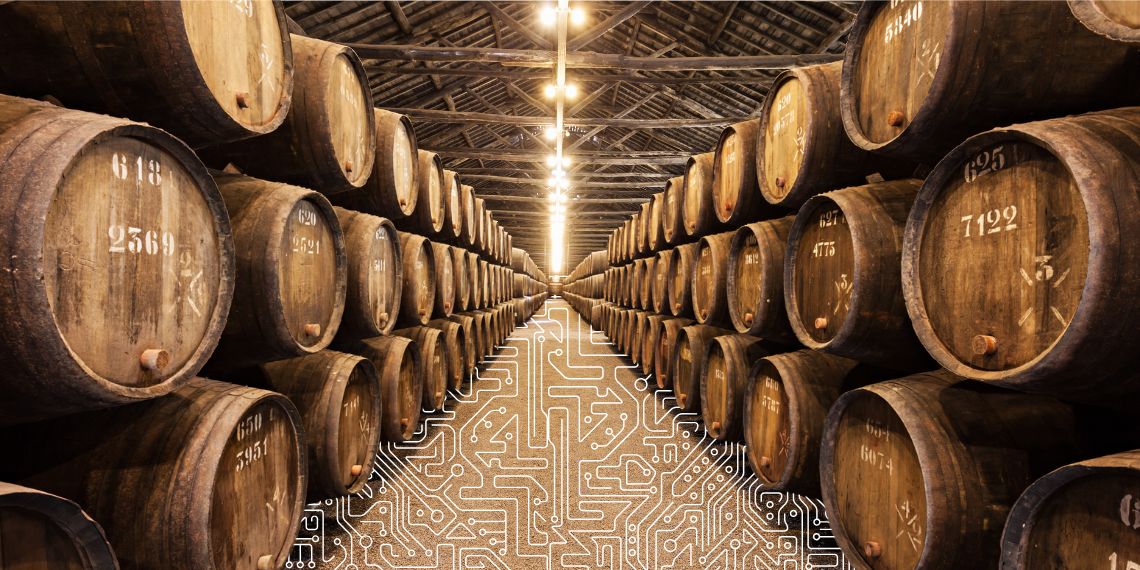
Every year, Port wine producers must decide whether to sell their wine for immediate revenue or store it to age – and, in theory, sell it later at a higher price. To support this decision, INESC TEC has developed a model that seeks to anticipate what may happen over time, considering factors like uncertainty and the interaction between different categories of wine.
Port wine has a unique attribute: it improves with age, increasing both quality and commercial value. At first glance, the producers’ decision may seem straightforward, but there are many other factors to consider. Selling wine earlier allows producers to maximise immediate profit, but it may compromise their ability to meet future demand for older, more valuable wines in the long term. On the other hand, maintaining large quantities in ageing involves operational costs, natural losses and missed sales opportunities. The complexity is further compounded by variability in the available raw material and uncertainty in demand over time.
The study Aged products spillover effect and the value of holding inventory under stochastic demand: the case of Port wine, published in the International Journal of Production Economics, stems from an international collaboration between INESC TEC researchers Miguel Lunet, Fábio Neves Moreira and Pedro Amorim, and Professor Marjolein Buisman from the Technical University of Munich. It analyses inventory management in this sector and presents a new approach to decision-making.
“A particularly relevant element explored in this study is the spillover effect, meaning that an increase in sales of aged wine has a positive impact on the sales of younger wine from the same brand. This occurs because the commercialisation of older wine strengthens the perception of the brand as premium, encouraging demand in entry-level segments. Although this phenomenon is well known in marketing, it had never been formally integrated into operational decision-making models,” explained Miguel Lunet.
The INESC TEC researchers developed models that simultaneously consider the sequential nature of decisions (as the decision is repeated every year) and market uncertainty. Among the proposed approaches are a long-term optimisation model and a solution based on Deep Reinforcement Learning, “in which an agent, by interacting with the Port wine market, learns optimised allocation and ageing policies capable of maximising a company’s long-term profitability”, as the researcher mentioned.
In the case of 20-year-old wines, for example, the decisions that determine their availability must be made two decades in advance, making it impossible to quickly correct strategic deviations. By integrating the spillover effect and the time-based dynamics of the problem, INESC TEC’s research enables significant economic gains.
“A short-sighted decision policy, in the long term, results in much lower profits compared to policies that net the sequential nature and uncertainty inherent in the problem. Furthermore, the study demonstrates that present decisions – namely regarding how much demand to meet and how much inventory to leave ageing – have a future impact through a spillover effect that cannot be overlooked. Ignoring this effect leads to substantial financial consequences, with cumulative profit losses of up to €9 million over a 25-year horizon, based on the empirical data analysed,” the author added.
Although focused on Port wine, the model developed can be applied to other products whose value increases over time, such as spirits or aged cheeses.
“To address problems of this nature, it is essential to: first, formulate the problem using appropriate conceptual frameworks, such as a Markov Decision Process; second, develop decision-making policies that explicitly consider the future impact of present actions; and third, validate models in simulation environments that adequately replicate real-world uncertainty,” he concluded.
Managing Port wine is not just a matter of production or marketing. With the right tools, it is possible to make more informed decisions with real impact on the performance of producing companies. Shall we raise a glass to this innovation?
 News, current topics, curiosities and so much more about INESC TEC and its community!
