



Two INESC TEC experts took part in a webinar series on open data to demonstrate how, in Portugal, data is prepared “throughout the lifecycle” to enable new applications and generate knowledge.
Open data, framed by European open science policies, only generates real value when supplemented by consistent data management practices complying with the FAIR principles – meaning that data must be findable, accessible, interoperable and reusable. This was one of the key messages that INESC TEC brought to the webinar series Data Management and Open Data, an initiative promoted by REPLAN – Network of Planning and Foresight Services of Public Administration.
INESC TEC, one of the National Centres for Research Data Management – where numerous projects generate large volumes of data with potential for public policy -, played a leading role in the second webinar of the series. Joana Almodovar, Head of INESC TEC’s Foresight and Public Policy Office, and João Aguiar Castro, member of INESC TEC’s Management Support Service, highlighted the role of open data in scientific research as an increasingly important dimension in how science is shared and evaluated, and emphasised INESC TEC’s position within European open data policies.
To illustrate this, they presented a range of examples showcasing good practices in the management and sharing of research data. The two experts began by highlighting INESC TEC’s Research Data Repository, which serves as an infrastructure supporting the availability of open data, as well as “the role of the data steward in supporting researchers in adopting practices that meet FAIR principles throughout the data lifecycle”.
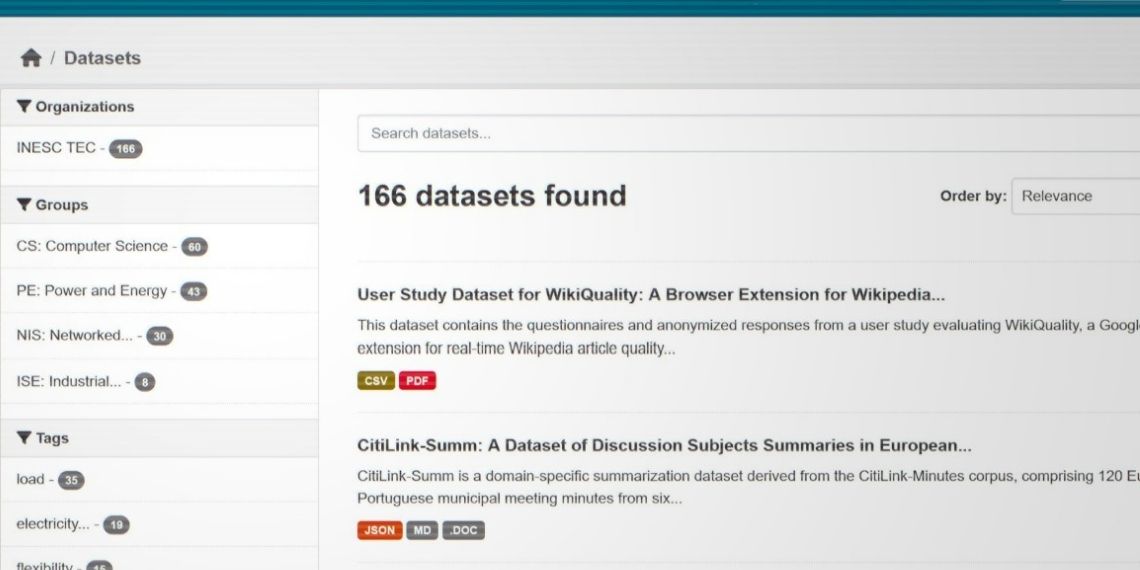
“We also outlined the contribution of the FAIRway project in capacity-building, defining guidelines and promoting best practices in research data management, as well as INESC TEC’s participation in the POLEN Blueprint pilot service, promoted by FCT, within the framework of developing Data Management Plans (DMPs),” explained João Aguiar Castro and Joana Almodovar.
Data supporting public policy
Speaking to an engaged audience – with each session attracting, on average, more than 250 participants and strong participation from public administration bodies and the scientific research community – the experts highlighted the reach of INESC TEC’s research and the impact that easily accessible data from said repository can have on sectoral public policies, both at central government level (directorates-general, public institutes, regulators and state-owned enterprises) and at local level. They also pointed to a recent project led by the institute – CitiLink.
As a concrete example of the application of FAIR principles, the CitiLink-Minutes dataset was presented. It uses Artificial Intelligence models to transform municipal meeting minutes, written in natural language, into structured information ready for analysis. This process produces interoperable and reusable data that can be applied across multiple contexts. “This case illustrates that the impact of open data depends not only on availability, but on how it is prepared throughout the lifecycle to support new uses and generate knowledge,” they emphasised.
The CitiLink case highlights the potential of data produced at INESC TEC to complement “other sources of evidence such as statistics and administrative data related to policy implementation”. It also demonstrates how this combination can create opportunities for collaboration between research and innovation ecosystem stakeholders and policymakers.
The webinar series, consisting of three sessions, revisited topics like data quality, accessibility, format and scope, towards emphasising their value both for improving research within science policy and for informing public policy.
 News, current topics, curiosities and so much more about INESC TEC and its community!
