

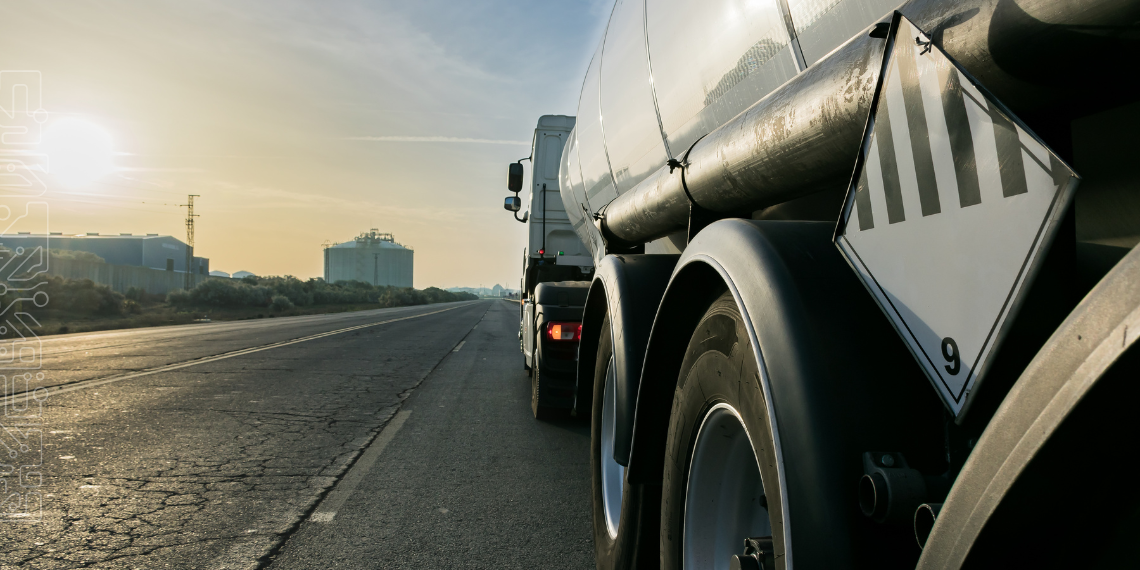
Have you ever wondered how a fuel tanker truck works? How efficient is the loading process? How is vehicle stability ensured during transport? What happens in cases of overloading or poor axle weight distribution? What is the likelihood of rollover? And what are the risks associated with failing to comply with safety regulations?
A group of researchers from INESC TEC has published a paper proposing a mathematical model designed to ensure the safety of fuel tanker trucks throughout their delivery routes by imposing constraints on load distribution. The study demonstrates that, without such constraints, most loading plans violate safety regulations.
The paper, Multi-compartment tank-truck loading problem with load balance constraints: A mixed integer linear programming model, by Roberto Paixão, Ângelo Soares, António Galrão Ramos and Elsa Silva, emerged from the need to make existing models more closely aligned with the realities of fuel transportation.
Ângelo Soares explained that “although the study was not motivated by a specific case, it seeks to address a widespread challenge faced by distribution companies: ensuring not only delivery efficiency, but also strict compliance with safety requirements related to vehicle stability.”
Until now, research in this field had focused mainly on maximising loading and routing efficiency while overlooking a critical aspect: the physical stability of the vehicle during transportation. According to the researcher, the paper’s main innovation is “the formulation of a new paradigm that integrates fuel distribution with vehicle safety and stability requirements throughout the entire route.” More specifically, “the proposed mathematical model not only distributes fuel across different compartments, but also ensures that, at every stage of the journey, the positioning of the load complies with axle weight distribution regulations.”
In practical terms, the study shows that around 78% of traditional solutions may be unsafe because they fail to account for vehicle stability. “This research could have a direct impact on how fuel distribution companies plan their operations,” said Ângelo Soares.
The model also enables companies to adjust loading strategies according to their priorities (whether speed, delivery volume or stability), helping to balance objectives that often conflict with one another. All of this is achieved through a practical and fast tool capable of generating solutions in seconds, making it suitable for everyday operational use while ensuring safer, more efficient and regulation-compliant transport operations.
Looking ahead, the researcher hopes the work will evolve towards full integration between load optimisation and route optimisation. “Instead of relying on a route predefined by the company, the system could eventually recommend the best route to follow,” he concluded.
 News, current topics, curiosities and so much more about INESC TEC and its community!
