


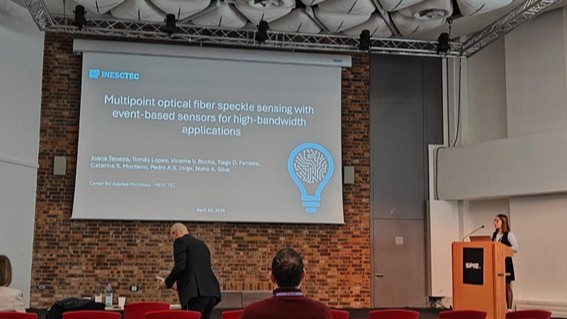
Joana Teixeira, a researcher at INESC TEC, received the Best Student Paper Award at the SPIE Photonics Europe conference for her research work, which paves the way for the development of real-time multipoint optical sensing solutions, that is, systems capable of monitoring multiple points simultaneously and in real time.
The award-winning presentation is entitled “Multipoint optical fiber speckle sensing with event-based sensors for high-bandwidth applications”. The work was developed by Joana Teixeira, in collaboration with Tomás Lopes and under the supervision of researchers Nuno Silva and Pedro Jorge. The distinction was awarded within the scope of the sub-conference Optical Sensing and Detection IX, considering the quality of the presentation and the relevance of the work to the field.
The research explores a new way of using optical fibres as sensors. Rather than relying on conventional cameras to observe changes in the light at the fibre’s output, it employs event-based sensors, asynchronous sensors, that are faster and generate less data. This makes it possible to detect vibrations and other disturbances along the fibre at high speed and with minimal delay, enabling real-time monitoring of multiple points along the fibre.
More specifically, the work investigates the use of event-based sensors for optical fibre sensing. These sensors only transmit data when changes occur in the fibre, meaning that if nothing changes, no data is sent, making information transfer faster. The aim is to address applications requiring high bandwidth, with the capacity to track fast phenomena such as acoustic signals, high processing efficiency, since the sensor only sends information when changes occur, meaning the computer does not need to process full images but only the points that have changed; and low latency, whereby the shorter the time between a change in the fibre, its detection by the sensor, and the transmission of that information, the lower the latency, and asynchronous sensors help reduce these delays.
This approach enables the analysis of speckle dynamics in optical fibres, contributing to the development of real-time multipoint optical sensing solutions. Speckle is a random pattern of light and dark spots that appears at the output of the fibre and changes when the fibre vibrates. In multimode fibres, light can propagate through many different modes, akin to different pathways, which interfere with one another and create the speckle pattern.
In such cases, small disturbances in the fibre cause highly visible changes in the pattern, making the fibre extremely sensitive. By detecting these changes at high speed and with low latency, it becomes possible to analyse in real time signals originating from different points along the fibre, thereby contributing to the development of more advanced sensing systems.
The research has already yielded a published scientific article related to this line of work, which can be found here.
SPIE Photonics Europe 2026 took place in Strasbourg, France, from 12 to 16 April. It is one of Europe’s leading conferences in the field of optics and photonics, bringing together researchers, professionals, and specialists on topics such as optical technologies, imaging, sensing, metrology, and applied photonics.
Disclaimer: this news piece was translated by Claude.ai
 News, current topics, curiosities and so much more about INESC TEC and its community!
