


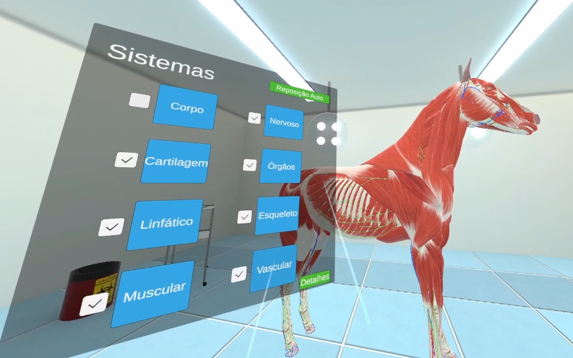
Imagine using virtual reality to increase student engagement while making it easier to learn course content. That is the goal of the VR-EDU 3D project, developed by researchers at INESC TEC in collaboration with the University of Trás-os-Montes and Alto Douro (UTAD) at MASSIVE, the shared Virtual Reality Laboratory run by the two institutions.
The project aims to use virtual reality tools to improve the teaching of concepts that require strong spatial awareness by enabling 3-D visualisation, instead of relying solely on two-dimensional platforms like books, computer screens or classroom projections.
Guilherme Gonçalves, a researcher at INESC TEC and UTAD, explained: “We cannot use virtual reality for every topic, but this approach will help us identify the areas where it can genuinely add value.” The virtual reality tools will be tested in immersive classrooms specially designed and adapted for this purpose, as well as through real-world case studies. The project will also assess whether students are able to learn the course content, whether they learn it more effectively, and how the technology affects their motivation. “Ultimately, we seek to understand whether this approach has any impact compared with traditional teaching methods,” he said.
In this project, the technology will support teaching in the Computer Engineering and Veterinary Medicine degree programmes, specifically in the Graphic Computing and Veterinary Anatomy courses, respectively.
The project – VR-EDU 3D: Aprendizagem Imersiva e Compreensão Espacial de Conceitos 3D em Engenharia e Medicina Veterinária, is part of UTAD’s Projetos de Inovação Pedagógica initiative. The approach encourages academic staff to develop innovative teaching ideas within one or more course units, promoting creativity and the exploration of new approaches to teaching and learning. Three projects were selected for funding, each receiving €2K to support implementation and validation in real teaching environments by July 2027.
Alongside Guilherme Gonçalves, the INESC TEC team includes researchers Maximino Bessa, Miguel Melo, Bruno Peixoto and Luciana Cabral Bessa. The project also benefits from the collaboration of Bruno Colaço and Maria Sofia Pimenta from the Department of Animal Science at UTAD’s School of Agricultural and Veterinary Sciences.
 News, current topics, curiosities and so much more about INESC TEC and its community!
