


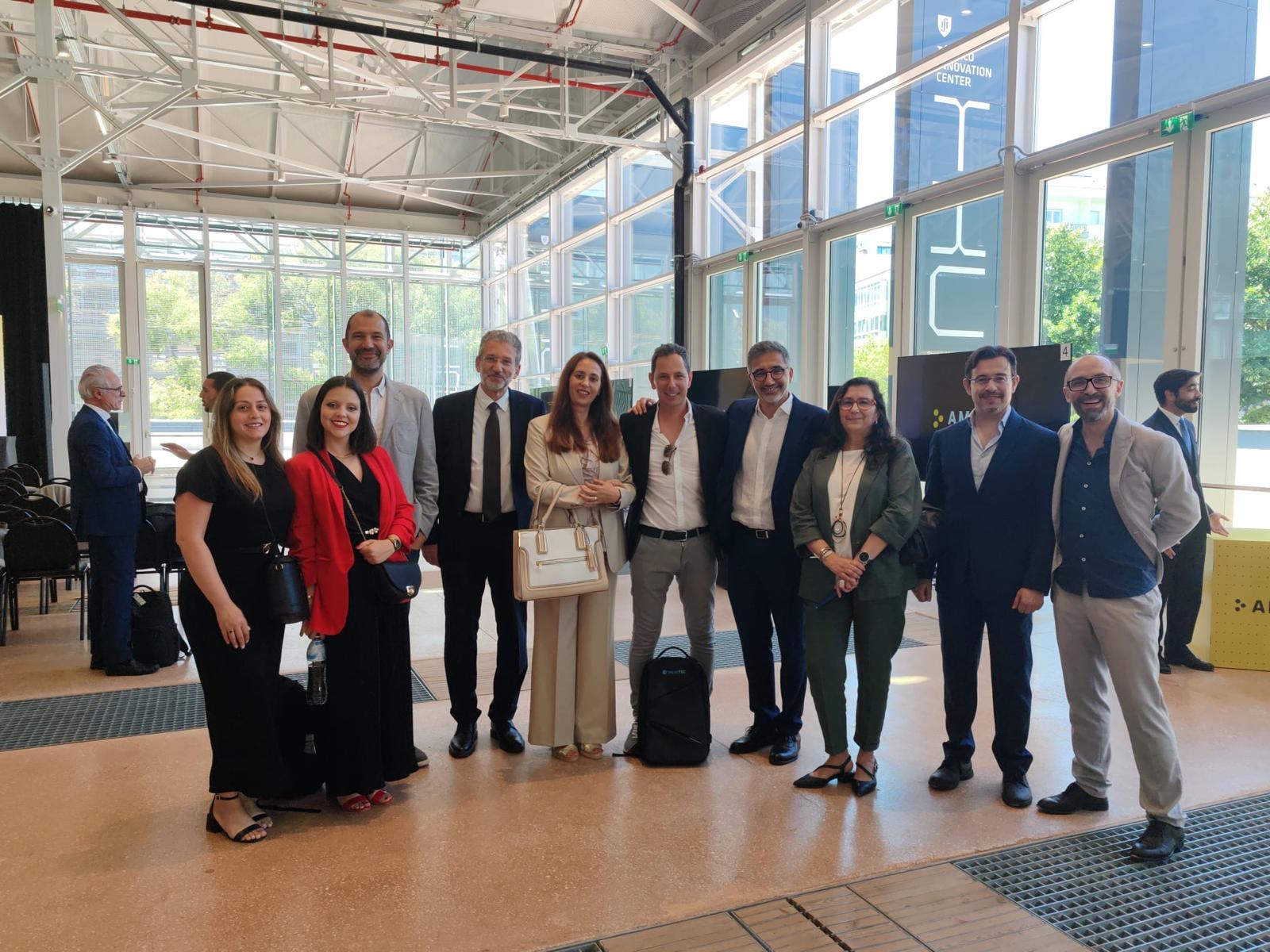
AMALIA is the name of Portugal’s newest large language model (LLM), and INESC TEC was one of the partners behind the project, which was officially unveiled on 1 July at the Innovation Centre of Instituto Superior Técnico, University of Lisbon.
Designed from the ground up to reflect Portugal’s linguistic and cultural context, AMALIA has been available as an open-source model on the Hugging Face platform since yesterday.
Developers created the Portuguese LLM in just 18 months with an investment of €5.5M. Although anyone can access the model’s code, the public will not be able to use it directly. As an open-source foundation model, AMALIA seeks to support the development of domain-specific applications powered by dedicated datasets, rather than operate as a general-purpose chatbot such as ChatGPT or Claude.
At INESC TEC, the team working on AMALIA led the media domain; their work covered tasks including abstractive summarisation of multiple sources, identification of dominant narratives, detection of persuasion techniques, automatic generation of news and information texts, and image captioning.
“INESC TEC’s contribution to AMALIA shows how sustained investment in science, technological capability and institutional partnerships can deliver practical tools that support national autonomy. The project reflects a commitment to digital sovereignty, the Portuguese language and the development of applications with significant public value. The team from the University of Porto, the University of Beira Interior (UBI) and INESC TEC made a particularly important contribution to the media domain, which plays a vital role in processing complex public information with greater accuracy, context and clarity. We are fully committed to supporting the next stages of the project and taking it even further,” said João Claro, Chairman and CEO of INESC TEC, who attended the public kick-off event of AMALIA.
The INESC TEC researchers involved in developing the Portuguese LLM were Alípio Jorge, now vice-rector of the University of Porto and lecturer at the Faculty of Sciences of University of Porto (FCUP); Ricardo Campos, INESC TEC researcher and lecturer at the University of Beira Interior (UBI); Sérgio Nunes, INESC TEC researcher and lecturer at the Faculty of Engineering of the University of Porto (FEUP); Nuno Guimarães, INESC TEC researcher; and Purificação Silvano, INESC TEC collaborator and lecturer at the Faculty of Arts and Humanities of the University of Porto (FLUP). In total, around 20 researchers took part in the project, including undergraduate and postgraduate students from the University of Porto and the University of Beira Interior.
Instituto Superior Técnico and NOVA University Lisbon’s School of Science and Technology (NOVA FCT) coordinated the project. João Magalhães, one of the project coordinators, explained that AMALIA will support a range of public administration applications. One of the first planned uses is on Gov.pt, the Portuguese Government’s public services portal, where it will act as a virtual assistant for citizens.
Prime Minister Luís Montenegro attended the public launch alongside several other speakers, including the Minister for Education, Science and Innovation and the Minister for State Reform. During the event, he said that AMALIA gives Portugal a new national capability, enabling the country to face the coming years with greater autonomy, sovereignty and independence.
AMALIA has a dedicated website, where visitors can find comprehensive information about the project and explore the domains it can be used. Alongside public administration, planned application areas include education, culture and museums, media, and science.
Researchers from NOVA FCT, Instituto Superior Técnico, INESC TEC, the University of Porto, the University of Minho, the University of Coimbra, the University of Beira Interior and the University of Évora contributed to the development of AMALIA. The Foundation for Science and Technology (FCT) also took part, with notable contributions from Arquivo.pt and the Agency for State Technological Reform.
 News, current topics, curiosities and so much more about INESC TEC and its community!
