


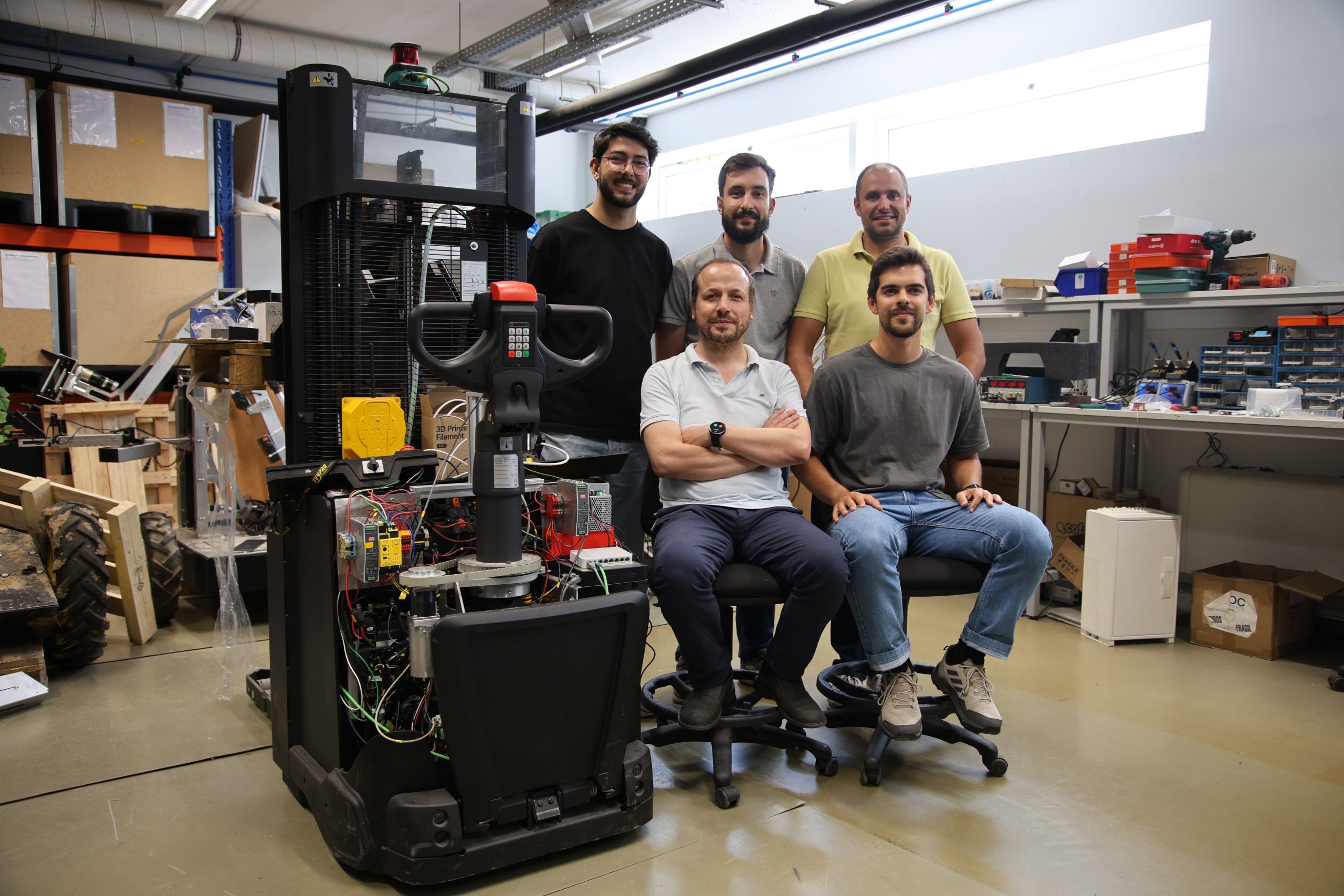
ViField is a new Portuguese spin-off focused on bringing to market a robotic platform developed at INESC TEC: ORIOOS. Designed to operate in complex real-world environments across agriculture and industry, this modular, autonomous robot is powered by Artificial Intelligence (AI) algorithms. As ViField’s first commercial product, ORIOOS will provide high-value data to farmers and security professionals, making decision-making faster and more informed.
Imagine a farm covering around 30 hectares, where the producer needs to monitor the entire area every day: counting the number of fruits on each tree, detecting disease in specific parts of the orchard, identifying issues such as water leaks, and much more. Now consider this: today, on large-scale agricultural holdings, only around 10% of the total cultivated area is typically monitored.
Or imagine a security company, where a guard is required to patrol vast areas, often alone, covering long distances during lengthy rounds. This inevitably leaves some areas unprotected and, in many cases, puts the guard’s own safety at risk.
Whether in agriculture or security, managing large areas usually means an increasing need for continuous monitoring, at a time when organisations are facing labour shortages, rising operating costs and limited digitalisation.
In agriculture, manual monitoring is slow and only covers a small proportion of each holding, meaning decisions are often based on incomplete information. In security, reliance on human patrols results in limited coverage and high costs. Existing technologies, including drones, satellites and fixed sensors, are unable to combine monitoring frequency, level of detail and scalability.
These are some of the key challenges that ORIOOS, the first product developed by ViField, is designed to address. The development of this modular, sensor-equipped robot, created to meet clear market needs, began in 2022.
“When we identified this need in 2022, we started thinking about a solution. That solution was a robotic platform capable of carrying out monitoring completely autonomously across the entire cultivated area. Instead of manually monitoring only 10% of a vineyard or orchard, the whole site can be monitored 24/7, through a fully autonomous process,” explained André Aguiar, a researcher at INESC TEC.
Four years later, ORIOOS has become a fully electric, autonomous and modular robotic platform. Lightweight and quick to deploy, it has been designed to operate in complex real-world environments such as vineyards, orchards and other large outdoor spaces. The system combines autonomous navigation with advanced perception capabilities, enabling it to collect and process data continuously in the field.
For precision agriculture, ORIOOS can estimate yields by counting fruit, detect early signs of disease, identify irrigation anomalies and monitor crop growth, among many other applications. By providing accurate, continuous field data, it supports better-informed decisions, reduces waste and improves resource management.
But can’t drones perform this type of monitoring? While drones are one of the technologies competing with ORIOOS, the robot stands apart in one important element. Drones can survey crops much more quickly, but the information they capture is not as detailed as the data collected by ORIOOS. In addition, drone battery life is limited, and regulations often require operators to obtain authorisation before flying.
“As a ground-based robot, ORIOOS can monitor crops from much closer range and build a detailed profile of each individual tree. That means the information provided to decision-support systems, or directly to growers, delivers much greater added value than what drones can currently offer,” said André Aguiar.
This brings several advantages; firstly, it significantly reduces monitoring costs, increases operational speed compared with traditional methods and improves overall efficiency. Secondly, thanks to a non-invasive approach, high-quality cameras and sensors, ability to generate detailed close-range data, simple modular design and robustness in unstructured environments, ORIOOS can adapt to a wide range of challenging outdoor scenarios. This enables users to identify problems earlier, improve resource management and prevent damage before it occurs.
The same platform can also be deployed in security applications, carrying out autonomous perimeter patrols, detecting intrusions and monitoring agricultural or industrial infrastructure. Rather than replacing human security staff, it complements their work and reduces the need for continuous manual patrols.
In these settings, the focus shifts from agronomic monitoring to site surveillance, intrusion detection and infrastructure protection.
According to André Aguiar, the sector is under increasing pressure to reduce costs, but ORIOOS is not intended to replace human patrols. “We could, for example, be talking about reducing one shift. The robot will always remain connected to a human operator, just as today’s security operations centres already work. If an alert is triggered, the security company responds in the most appropriate way.”
He also highlighted the importance of improving the safety of security personnel. “Very often, operators have to juggle multiple responsibilities, from carrying out patrols on the ground or managing the operations centre. ORIOOS is designed as a complementary solution: a low-cost robotic platform that improves the quality of security while helping to prevent incidents.” And there is another important aspect to this solution: “If a robot is damaged, it can be repaired. If something happens to a human operator, the consequences can be far more serious. When a robot carries out a patrol on its own, there is no risk of losing a human life,” he concluded.
 News, current topics, curiosities and so much more about INESC TEC and its community!
