


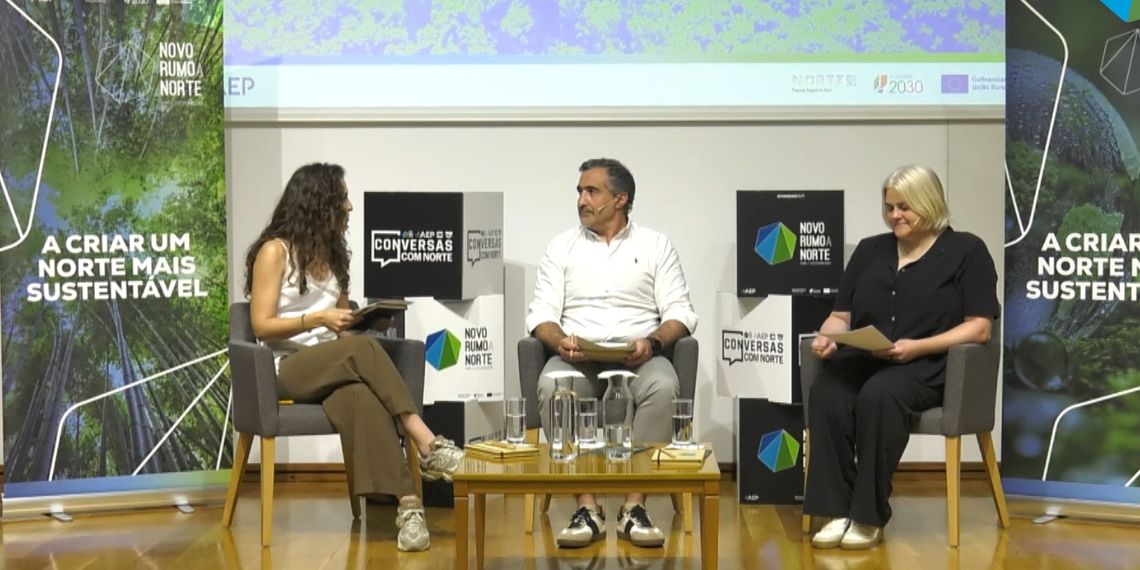
Did you know that, in many subsectors of manufacturing, more than 90% of companies are micro, small and medium-sized enterprises (SMEs), and that they can account for up to 70% of the sector’s total energy consumption? Despite progress in energy efficiency and the adoption of renewable energy, decarbonising industry remains one of the biggest challenges in meeting Europe’s target of carbon neutrality by 2050. This was the alert issued by Zenaida Mourão, a researcher at INESC TEC, during the third session of the Conversas com Norte series, organised by the Portuguese Business Association (AEP).
But are we prepared to meet these targets? The food and beverage, ceramics, glass production, metalworking and electromechanical, chemical, and textile industries alone account collectively for 52% of greenhouse gas (GHG) emissions associated with energy use and around 44% of final energy consumption in Portugal’s manufacturing industry. The INESC TEC researcher portrayed the current situation in Portugal, pointing out that the deadline for achieving carbon neutrality is fast approaching and that action needs to be accelerated. To achieve this, she argued, “more than isolated measures, what is needed are long-term strategies that are defined, monitored and continuously updated”.
According to Zenaida Mourão, following the progress made in energy efficiency and renewable electricity generation for self-consumption, the focus should now shift towards decarbonising the heat used in industrial processes, particularly in sectors such as textiles, chemicals and agro-food. In these sectors, process heat is the largest end use of energy, accounting for more than 2/3 of total final energy consumption in some cases.
“The use of heat remains heavily dependent on fossil fuels. This is currently the biggest challenge facing Portuguese companies,” she highlighted.
The researcher explains that mature technological solutions already exist for many low- and medium-temperature applications, and that the main obstacle is not always technological. Investment in energy efficiency can deliver significant economic benefits. “Doing nothing ultimately proves to be much more costly,” she pointed out.
But the challenge is not just about technology. Access to information, skills development and funding are still identified as barriers to implementing decarbonisation measures. During the debate, it was also announced that AEP and INESC TEC will launch a set of roadmaps for SMEs in September, aimed at supporting companies in defining decarbonisation strategies by identifying investment priorities, technological opportunities and available funding mechanisms.
Zenaida Mourão stressed that “meeting climate targets will depend on companies’ ability to see decarbonisation as an ongoing process”, while at the same time boosting the competitiveness, resilience and sustainability of economic activity.
INESC TEC’s commitment to decarbonisation goes far beyond this initiative. In recent years, the Institute has developed projects and tools to support companies and decision-makers in defining energy transition strategies, from developing roadmaps for industrial sectors to optimising energy systems, integrating renewable energy sources, electrifying industrial processes and using green hydrogen. The involvement in national and European initiatives further reinforces the Institute’s role as one of the leading players in applied research focused on decarbonising and improving the competitiveness of Portuguese industry.
 News, current topics, curiosities and so much more about INESC TEC and its community!
