


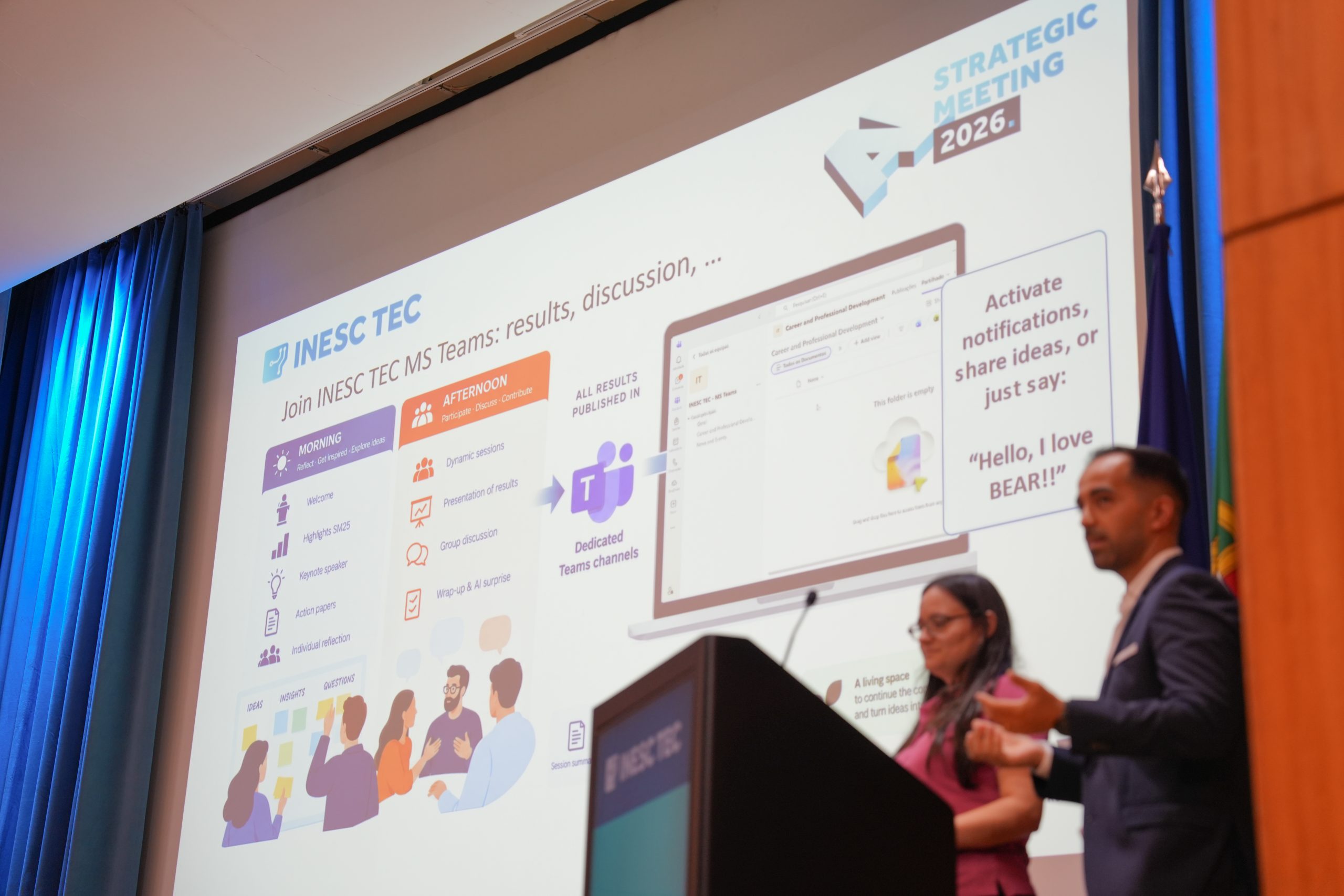
How can a science and technology institution prepare of the future in a world increasingly shaped by Artificial Intelligence (AI)? For BEAR – Boosting EArly-stage Researchers – the answer was to start with those who experience the institution’s challenges every day: the community.
With this premise, BEAR (the internal network dedicated to early-career researchers at INESC TEC) took on, for the first time, the organisation of the Institution’s Strategic Meeting – an annual internal event that, this year, brought together around 200 people. For the first time, the event moved from the city of Porto to one of INESC TEC’s northernmost locations, namely the University of Trás-os-Montes e Alto Douro (UTAD), in Vila Real. More than just organising the event, BEAR wanted to set a challenge: to give the community a voice and turn ideas for the institution’s future into concrete actions.
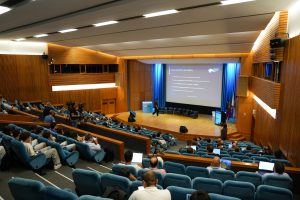
The goal was simple: to involve the community in reflecting on INESC TEC’s future and turn different perspectives into contributions that could help define institutional priorities and possible actions. To this end, the morning was dedicated to inspiration, reflection and gathering ideas through the keynote, action papers and different opportunities for individual participation. In the afternoon, these contributions provided the basis for a more structured discussion in working groups, where participants were challenged to develop proposals further, identify priorities and formulate concrete recommendations around two themes: “Career and Professional Development” and “Artificial Intelligence”.
According to João Claro, Chairman and CEO of INESC TEC, moving the event to UTAD was important because “we are an institution with an open geographical presence, and that is one of our distinctive sources of value. It is important that our moments of reflection and strategic discussion also reflect this reality”.
Regarding the organisation of the event, João Claro said that placing BEAR in charge recognised “the important role that members of our community at early stages of their careers play in shaping the institution’s future”, while also highlighting the two topics under discussion, “which are becoming increasingly interconnected, because the technological transformation of our work also raises new and critical questions about skills, career paths and the conditions needed to develop excellent science and generate impact”.
From ideas to discussion
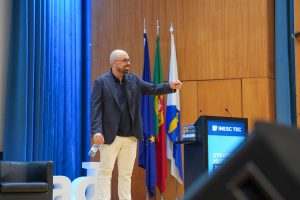
The reflection began with an unavoidable question for any institution working in science and technology: how will Artificial Intelligence transform the way we work? João Costa Ribeiro, software engineer and Open Innovation Intelligence Lead at GALP, and the event’s keynote speaker, addressed the topic “Designing our future with AI – between agentic autonomy and human Agency”, exploring the hybrid management of infrastructures by AI tools and humans, and where this path may lead.
Then, it was time for the members of our community to present their action papers; by identifying challenges and concrete, practical ideas for INESC TEC, it was possible to gather nine proposals for institutional initiatives with potential for future implementation. The ideas presented brought a wide range of issues into the discussion, including the responsible use of AI in research, new approaches to business development, R&D priorities, research careers, institutional mobility, support for parenthood and connection with industry.
“The most interesting aspect was seeing that the community’s participation brought not only opinions, but also very concrete information about what people feel, value and would like to see evolve at INESC TEC. This type of contribution is difficult to understand in any other way and showed how a more open and participatory approach can help reveal opportunities and initiatives with genuine institutional potential,” said Romão Santos and Carla Gonçalves, BEAR researchers responsible for organising the event.
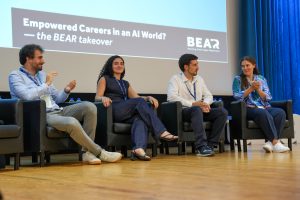
Although distinct from one another, the proposals shared a common direction: addressing the ability to develop talent while keeping pace with technological change, and strengthening INESC TEC’s capacity to generate scientific, technological and social impact in these new scenarios.
Together, these themes provided the starting point for the reflection and discussion that took place in the afternoon, divided into two parallel working groups focusing respectively on Career and AI.
When the future starts at home
Because thinking about the future also means experimenting with new ways of working, the meeting also provided the ideal setting to present a new internal tool: TECA – INESC TEC institutional assistant. With the simple goal of making access to INESC TEC’s institutional information easier and faster, the tool is based on a conversational interface through which the community can ask questions in natural language and receive answers based on the institutional information made available to the tool. [Presentation video]
At an initial stage, TECA focuses primarily on information related to Human Resources, Projects and Funding Opportunities, with plans to progressively expand it to other institutional areas and content.
TECA was developed as part of the initiatives carried out by the INESC TEC Digital Transformation Working Group, which identified the definition of guidelines for the use of AI in research at INESC TEC as a priority. As part of this work, the team explored the possibility of developing a useful solution for the institution that would facilitate access to internal information and help address institutional knowledge management needs.
A meeting for everyone, by everyone
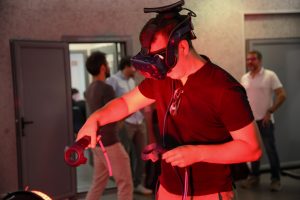
Before the event began, several participants also had the opportunity to visit MASSIVE – Virtual Reality Laboratory – one of INESC TEC’s research infrastructures. INESC TEC’s virtual reality laboratory is located at UTAD and focuses primarily on researching and developing multisensory virtual reality solutions and immersive experiences.
The 10th edition of the Strategic Meeting sought to do more than look towards the future: it aimed to involve the community in shaping it. And by placing early-career researchers at the heart of the meeting’s organisation, BEAR also delivered a clear message: thinking about an institution’s future means making space for the people who will build it.
About BEAR
Towards creating a dynamic space for sharing, collaboration and professional development at INESC TEC, BEAR was established following INESC TEC’s 2025 membership of YEAR – Young European Associated Researchers, a European network that brings together research and technology centres from across Europe to empower and connect their early-career research members. At INESC TEC, BEAR focuses specifically on young researchers, promoting the development of transversal and strategic skills and the exchange of experiences and good practices.
The community is constantly growing, and all young researchers at INESC TEC are invited to join BEAR and take part in its initiatives. Find out more and learn how to join here.
 News, current topics, curiosities and so much more about INESC TEC and its community!
