


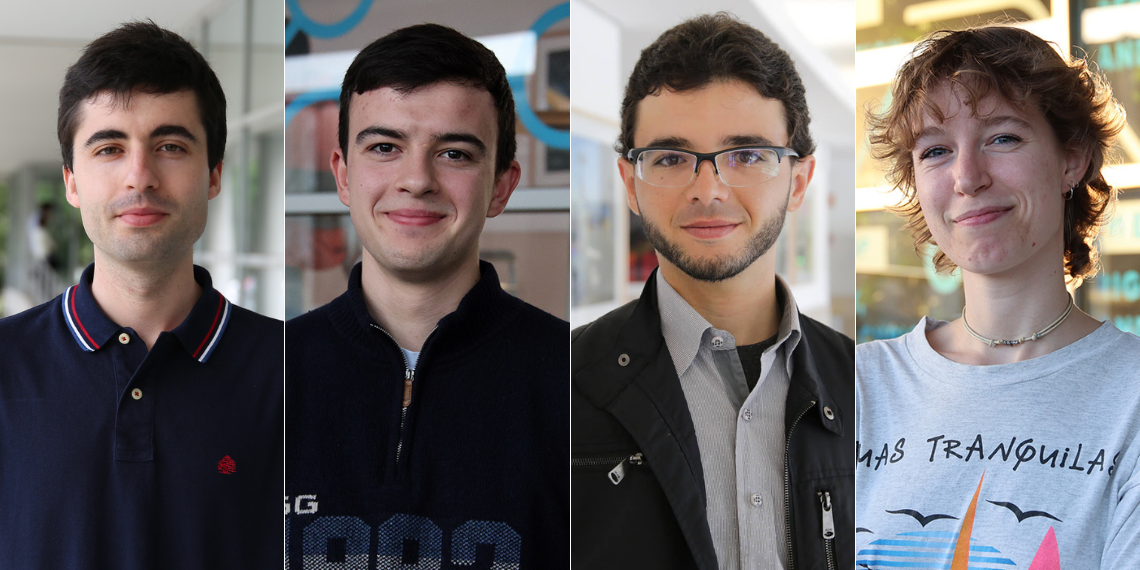
André Filipe Coelho
The CTM coordinators would like to nominate researcher André Filipe Coelho. This nomination stems from André’s exemplary work within the PRODUTECH R3 and NEXUS projects. We’d like to highlight his contribution in leading the tasks related to the design and implementation of private 5G network solutions based on Open Radio Access Network (O-RAN) for both projects. In PRODUTECH R3, this solution complemented the commercial private 5G network provided by NOS and already deployed at iiLab and the 5G Lab (at FEUP), making it possible to test innovative network configurations (i.e. with a lower TRL) for industrial use cases without compromising the stability of the production NOS network. Concerning NEXUS, the private 5G network solution took the form of a Mobile 5G Cell installed in a fire service vehicle belonging to the Port Authority of Sines, strengthening the coverage of the Altice Labs private 5G network wherever it was most needed. The reliable operation of every element of these 5G solutions, together with the careful integration work carried out with the partners in both projects, was essential to the success of the final demonstrations: NEXUS at the Port of Sines, and PRODUTECH R3 at The Navigator Company’s facilities in Aveiro and Setúbal. The outstanding quality of André’s work, recognised by the coordinators of both project PPSs, the Centre Coordination Board, external partners and the other INESC TEC centres involved, made a decisive contribution to achieving the projects’ objectives. This work further strengthened INESC TEC’s position as a leading organisation in the development and integration of innovative 5G network solutions and helped build even closer relationships with key national partners, with whom we will continue to collaborate actively.”
– CTM coordinators
What were the main technical challenges in designing and implementing the O-RAN-based private 5G network solutions in the PRODUTECH R3 and NEXUS projects, and how did you overcome them?
Although they had different objectives, the PRODUTECH R3 and NEXUS projects shared a common challenge for INESC TEC in the field of communications: demonstrating 5G solutions based on open implementations in real-world environments while meeting specific functional and performance requirements.
In PRODUTECH R3, we developed an open-source 5G communications solution and set up a communications laboratory that complements the commercial private network, which was also deployed as part of the project in collaboration with the telecommunications operator NOS. This 5G experimental infrastructure made it possible to validate new configurations, components and features for industrial use cases without affecting the operation of the commercial network.
Regarding NEXUS, INESC TEC’s work in communications focused on the design, development and validation of a Mobile 5G Cell capable of extending the coverage of the Port of Sines’ private network, meeting the needs of temporary operations while integrating with the fixed 5G network infrastructure developed within the project by Altice Labs.
In both projects, the development and integration phases were particularly demanding. We had to integrate different components and make sure they could all work together. The work was organised in stages, starting with laboratory testing and then moving on to validation in real operating environments. Defining a modular architecture and carrying out several rounds of testing allowed us to validate the solutions under controlled conditions before the final demonstrations.
What was the most significant contribution of your work to the success of the final demonstrations and the achievement of the objectives of both projects?
My main contribution was leading the tasks related to the design, implementation and integration of the private 5G network solutions developed by INESC TEC in both projects, as well as coordinating the work between the internal teams and external partners.
In practice, this involved defining the architecture of the solutions, integrating the different components and validating that they met the requirements of the use cases and the objectives set for each project.
In projects of this scale, the main challenge is not just the performance of each individual component, but how well all the different elements work together. That is why my main contribution focused on planning the integration and validation stages, helping to bring together the different developments and ensure they worked seamlessly alongside the other solutions.
What impact do you think this work has had on INESC TEC’s positioning and on creating opportunities for future projects?
These projects reinforced INESC TEC’s expertise in the development of private network solutions, covering every stage from architectural design to integration and validation in real-world environments.
Working in operational settings gave us first-hand experience of requirements and challenges that are difficult to encounter in a laboratory alone, including issues related to interoperability between solutions, coverage, network performance and operation. This experience is particularly valuable in preparing future research activities, especially in the areas of private networks based on open implementations and next-generation wireless networks.
Beyond the results achieved, the projects also translated into prototypes, testing infrastructures and know-how that can provide a strong foundation for future projects while further consolidating INESC TEC’s position in this field.
Which aspects of your job do you enjoy the most?
What motivates me most is seeing an idea evolve into a real solution; I particularly enjoy projects where it’s possible to combine research, engineering and an understanding of the application context, including working closely with end users such as the Port of Sines and The Navigator Company, as was the case with these projects. Very often, it is through that interaction that the most interesting solutions with the greatest potential impact emerge.
It is also very rewarding to witness the work carried out by the teams translated into solutions and demonstrations that perform successfully under real operating conditions while opening new opportunities for research and innovation.
How do you comment on this nomination?
I’m very happy for this nomination and would like to thank the CTM coordinators for recognising the work carried out – not only by me but also by the many colleagues who were also involved.
These were demanding projects, from development through to the integration, validation and demonstration phases, and the results were only possible thanks to the commitment of many people, each bringing their own expertise and contribution.
It is especially rewarding to know that this work, which helped strengthen INESC TEC’s capabilities in the development, integration and validation of private network solutions in collaboration with leading partners, is highly acknowledged.
Daniele Caldana
“Daniele Caldana first joined CRIIS while still in the third year of his degree at ISEP, when he completed his final-year project/internship in Electrical and Computer Engineering with us. At the time, we were launching the PRODUTECH R3 Recovery and Resilience Plan (PRR) Agenda, and his work focused on exploring a SICK sensor for pallet and pallet-pocket detection. The quality of his work was so impressive that we invited him to continue working with us as a research grant holder. In this role, he began developing our entire pipeline for pallet and pallet-pocket detection, which was later adapted for detecting the metal transport containers used in the automotive industry and deployed as part of the GreenAuto PRR Agenda. Following the completion of these PRR Agendas, Daniele’s work was successfully validated across a range of demonstrators (CTT, The Navigator Company, SONAE and Stellantis) and with autonomous mobile robots (AMRs) developed by JPM and Flowbotic, consistently delivering excellent results and receiving high praise from the project partners. Finally, this work also led to the filing of a patent application.”
– CRIIS coordinators
When you started your final-year project at CRIIS, did you ever imagine that your work would evolve to the point of being used in several industrial demonstrators and even lead to a patent application? What surprised you most along the way?
Looking back on everything that has happened since I joined CRIIS to carry out my final-year project, it’s incredibly rewarding to see how far the work has come. At the time, I never imagined that the pallet detection technology I started working on would eventually be developed and deployed by me in several industrial demonstrators. The patent application was also a surprise and represents recognition of the innovative nature of the solution we developed.
What surprised me most was how much I grew, both technically and professionally. The knowledge I gained over the years allowed me to turn an initial idea into a solution with practical applications and real impact. Working alongside my colleagues at CRIIS and with the project partners was equally important, giving me valuable experiences and challenges that played a key role in my development.
Throughout the development of the pallet detection pipeline and its adaptation for the automotive industry, what were the biggest technical challenges, and how did you overcome them?
One of the main challenges was developing a solution that was flexible enough to work across different industrial environments. From the outset, our goal was to create a pipeline compatible with low-cost RGB-D cameras, making the solution more accessible. Naturally, this type of sensor has limitations in terms of data quality, so we had to develop mechanisms that allowed us to adjust various pipeline parameters to optimise performance depending on the camera being used.
Another major challenge was adapting the pallet detection solution to identify the metal transport containers used in the automotive industry. Although the initial detection is carried out using Artificial Intelligence models, all the subsequent point cloud processing was designed to be object-agnostic, relying primarily on geometric characteristics. This approach allowed us to reuse the same core technology across different industrial applications.
Seeing your solution validated by partners such as CTT, The Navigator Company, SONAE and Stellantis must have been a milestone. What does it mean to you to know that work you started during your degree has had such a significant impact on industry?
Without a doubt: it has been one of the most rewarding moments of this journey. Knowing that a project I began while still at university has been validated by leading companies shows that research really can address the genuine needs of industry. It’s also hugely motivating to see that the solutions we’ve developed have the potential to create value and support the adoption of new technologies in industrial environments.
Which aspects of your job do you enjoy the most?
What motivates me most is the opportunity to solve real-world challenges through science and technology. I particularly enjoy working on practical industrial problems and following an idea all the way from research through to real-world application. I also value the collaboration with industrial partners, as it allows us to validate the solutions we’ve developed in real operating environments and understand the impact they can have once integrated into production processes.
How do you comment on this nomination?
I’m delighted, and I perceive it as recognition of the work I’ve carried out over the past few years. I’d like to thank the CRIIS coordinators for the nomination, as well as all the colleagues and supervisors I’ve had the opportunity to work with. Their support and willingness to share their knowledge have been essential throughout this journey.
Pedro Senna
“Over the past few months, Pedro has delivered an outstanding performance in managing the various work packages (PPSs) and their associated documentation within the PRODUTECH R3 project, overseeing more than 20 processes simultaneously with exceptional rigour, organisation and responsiveness. His work has been instrumental in ensuring deadlines were met, documentation remained of the highest quality, and communication between the different project partners was smooth and effective. Alongside these responsibilities, Pedro also provided essential support to several Recovery and Resilience Plan (PRR) Mobilising Agendas, consistently demonstrating a strong collaborative spirit, availability and sense of responsibility. His ability to handle multiple complex processes in parallel while supporting teams during critical stages made a significant contribution to the success of the initiatives in which he was involved. As a key member of the PMO team, Pedro embraced the challenge of extending the work he had been doing within the PRODUTECH Agenda to the other Agendas in which INESC TEC plays a major role. In doing so, he made a valuable contribution to many colleagues by clarifying questions and helping to establish procedures. This support was essential to the successful completion of the various work packages across the Mobilising Agendas in which we are involved, and for that reason he fully deserves this recognition.”
– SYSTEM coordinators and Luís Seca
Over the past few months, you’ve managed more than 20 processes simultaneously within PRODUTECH R3 while also supporting several PRR Mobilising Agendas. How do you stay organised and respond effectively to so many different demands at once?
Before talking about any process or the way I personally approach my work, I have to acknowledge and thank the outstanding technical and operational teams I’ve had the privilege of working with. Everything was made much easier because the teams from the Centres involved in both PRODUTECH R3 and the other Mobilising Agendas are highly professional and have an unquestionable sense of ownership and commitment to delivering quality.
On a more personal level, I rely on two approaches that complement each other. The first is monitoring response times for every new request while following a 50–5 Pomodoro routine: 50 minutes of focused work on specific tasks, followed by five minutes to read and reply to emails. The second is keeping in mind the saying, “Train hard, fight easy.” That means staying optimistic while identifying, planning and, whenever necessary, putting measures in place to deal with more challenging scenarios before they arise.
None of this would work, however, without constant communication with Centre coordinators, team leaders and all the colleagues who are directly responsible for delivering the work and achieving the results.
You took on the challenge of extending your support to other Mobilising Agendas, helping colleagues, answering questions and establishing procedures. What did this role mean to you, and what did you earn from the experience?
It was an opportunity to step outside my comfort zone and broaden my horizons by placing a stronger focus on management activities, something I discovered could add real value to the many developments taking place at INESC TEC.
For me, it marked a turning point, making me realise that I could contribute to the organisation’s success through skills that are less technical, while still allowing my colleagues to focus on what they do best by taking some of the bureaucratic and administrative burden of these projects off their shoulders. Those tasks can often be mentally exhausting and have a negative impact on operational performance.
I’m grateful to the Executive Board, the PMO and CESE/SYSTEM for making this gradual transition possible, always with the same goal of moving towards programme and project management.
Along the way, I learned a great deal about emotional balance, adapting communication styles to different internal and external stakeholders, being decisive while always taking responsibility for my decisions and standing up for the teams whenever necessary, and developing a genuine sense of belonging within a group of colleagues who drive positive disruption – that I like to call “creative destruction” – through cutting-edge scientific and technological development.
Much of your work happens behind the scenes, yet it’s essential to the success of these projects. What motivates you most about this type of role, and what kind of impact do you hope to have on the teams you support?
Often, my motivation comes from watching my colleagues with the freedom to do their best work and deliver results that go beyond what was originally expected, exceeding the expectations of our key stakeholders – whether they’re internal teams, technology partners or leading companies in Portuguese industry.
It’s the classic example of behind-the-scenes work: the less visible it is, the better it’s usually working, because it gives those who transform plans, tasks and objectives into tangible results the freedom to focus on creating value for our partners.
Being part of this quiet but essential mechanism, working in close collaboration with other internal services to free up our technical and operational teams so they can focus on research and development instead of management, administrative or bureaucratic matters, is what gives me the greatest sense of pride and belonging.
Every piece of the puzzle contributes in its own way and under the right conditions to ensure that the outcome doesn’t simply meet expectations but significantly exceeds them. That internal synergy often surprises our partners and encourages them to continue working with us over the long term through lasting, productive and mutually beneficial collaborations.
Which aspects of your job do you enjoy the most?
I enjoy being part of a high-performance environment built on technical excellence and scientific thoroughness. More importantly, it’s a place that remains deeply human and always strives to deliver sustainable results that genuinely meet the needs of our partners.
It’s incredibly rewarding to receive recognition from our partners, especially when it’s based on the results we’ve achieved together. That work doesn’t just generate financial and scientific or technological gains for INESC TEC – it also creates knowledge and increases our reputation.
Those are our greatest assets and reflect exactly what we aim for when tackling innovation programmes and projects that demand the level of complexity and multidisciplinary collaboration needed to meet such ambitious challenges.
How do you comment on this nomination?
It’s especially rewarding; I’m very grateful to Luís Seca and the SYSTEM coordinators for this nomination, which means a great deal to me and further strengthens my sense of belonging to such a diverse and valuable organisation as INESC TEC.
I’d also like to thank António Almeida, who first presented me with this challenge more than three years ago and with whom I had the opportunity to work on coordinating the PRODUTECH R3 PRR solutions.
That said, as I mentioned before, this nomination is really a reflection of the collective effort of the more than one hundred colleagues I work with every day – coordinators, team leaders, researchers, technical staff and many others – who are the true driving force behind innovation at this institution.
For that reason, I’d also like to express my appreciation to all the colleagues who have walked, and continue to walk, this challenging and innovative path of developing disruptive solutions with INESC TEC’s DNA.
Sofia Varotto
“Sofia Varotto has demonstrated outstanding work within the STOR-HY project, showing a high level of thoroughness, commitment and initiative. She was responsible for preparing two reports, making a significant contribution to the project’s technical progress, and represented INESC TEC at the project’s mid-term review meeting, where she presented the work carried out as well as the next planned steps. Her presentation was very well received by the reviewers. At the same time, she has been pursuing her PhD research to a high scientific standard, demonstrating the ability to achieve significant advances in her field of research, with the potential to lead to further publications in international journals.”
– CPES coordinators
You represented INESC TEC at the STOR-HY project’s mid-term review meeting; what was it like to present your work to the reviewers, and what feedback did you receive?
This was my first experience at a European project review meeting, and I must say it all went smoothly. The STOR-HY project focuses on reducing operation costs of pumped-storage hydropower plants, while increasing their durability and their contribution to power system stability. I presented our work progress in two important work packages: one focused on scoring the capability of each demonstrator to contribute to power systems’ flexibility together with their societal and environmental impact, and the other focused on optimising the operation of a hybrid pumped-storage hydropower plant with photovoltaic and battery in electricity market and frequency support services. We have been on track with our tasks thus far, and even though the reviewers seemed at first a bit intimidating (their job is to give constructive critiques after all!), they had no objections on our work, just a few curiosities on future developments.
Throughout the project, you were responsible for several key technical deliverables. What do you consider to have been the biggest challenge, and what was the most rewarding aspect of that work?
When I first joined STOR-HY in February last year, I soon realized that the work package I was assigned to was a bit out of my area of expertise: it required knowledge of power systems dynamics and control that I didn’t have in my background as energy engineer. I was lucky enough to work alongside a colleague that had the knowledge I was missing, Fernando Ribeiro – who just recently left INESC TEC. Fernando is a great team player, our roles in the WP were complementary and our collaboration was fruitful: we produced one of the first project technical deliverables (Identification of new hydropower requirements) and he supported me before leaving in the preparation of a second deliverable regarding one of the demonstrators, our very own Alqueva pumped-storage plant, in Alentejo. So, I would say the biggest challenge was facing a low familiarity with the topic of the assigned work, but the most rewarding parts of this experience so far were expanding my knowledge in a previously unknown domain and carrying out successful teamwork with a valuable colleague.
You are balancing your work on the STOR-HY project with your PhD research; how do these two activities complement each other, and how do they contribute to your development as a researcher?
As often happens when pursuing a PhD while working in a research centre, the topic of your thesis might not completely overlap with the domains you have to explore while working for other projects. Luckily, there is a relevant underlying area between STOR-HY and my thesis: energy storage integration with renewables, a topic I am passionate about. While STOR-HY is focused on hydropower, even in hybrid configurations with floating photovoltaic and batteries, my thesis addresses offshore renewables and storage systems. However, the understanding of energy storage operation and ancillary services markets is something I developed in parallel while working in STOR-HY and on my own publications. Plus, I am happy to be learning to work in a European project, to bring tasks to completion and write deliverables, while interfacing with other Portuguese and international partners from different backgrounds – academia and industry.
Which aspects of your job do you enjoy the most?
It is always very rewarding to understand new things that before looked completely incomprehensible, as I said. For our work package on flexibility, we are inheriting methodologies for scoring the capability of each demonstrator to provide ancillary services from the concluded project XFLEX Hydro, in which INESC TEC was a key partner. However, the technological solutions developed in STOR-HY are inherently different, and we must adapt the methodology to the cases and data we have now, which is another aspect of this work that I enjoy: looking for alternative and creative solutions.
Speaking of my experience in CPES overall, I find that this is a very good work environment, where I interface with peers from different backgrounds and senior researchers with a vast expertise, and I can learn something from each one of them. There is a lot of mutual support between colleagues, even when not working in the same projects, and I also had the luck to create important friendships here in the office.
How do you comment on this nomination?
It was – most honestly – unexpected! I have been working in INESC and in research for almost three years now, but I still feel like I am at the very beginning of my path and I have a lot to learn. Anyway, it feels good to know that my work and my efforts are noticed and appreciated, for this I am very thankful!
 News, current topics, curiosities and so much more about INESC TEC and its community!
