


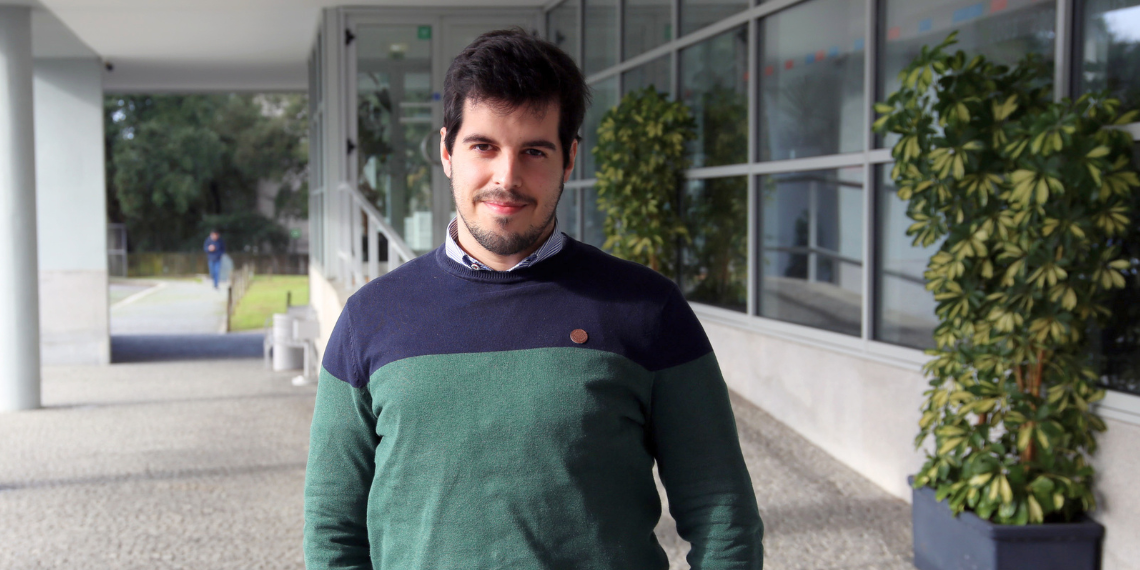
Rúben Queirós
“The CTM coordinators would like to nominate researcher Rúben Queirós. This nomination stems from the exemplary work Rúben carried out within the European project OVERWATCH, alongside his PhD research in wireless networks. It’s worth highlighting his contributions to the development of the fallback communications system, focusing on the communication components aboard a tethered drone, as well as the integration of software with the cloud backend led by project partners. This system, based on low-Earth-orbit satellite internet connectivity combined with a tethered drone, successfully created a tactical communications ‘bubble’ to support operations in emergency scenarios, even in cases of degraded or unavailable local coverage. The outstanding quality of the work, recognised by the INESC TEC team, external partners and project evaluators, was instrumental in achieving the project’s objectives successfully.”
You’re involved in the OVERWATCH project. Could you tell us a little more about this initiative (main objectives, differentiating features, challenges, activities, etc.)?
The OVERWATCH project focused on developing an integrated and autonomous system for managing emergencies and natural disasters, e.g., wildfires and floods. One of the main differentiating aspects was the tactical backup communications system designed for situations where mobile network coverage is unavailable or severely degraded. My work focused on developing this system, specifically the components deployed aboard a tethered drone – a drone connected via cable that provides both power and fibre-optic connectivity. The main challenge was ensuring seamless integration between the drone hardware, low-Earth-orbit (LEO) satellite internet connectivity (via LEO, Starlink), and the cloud backend developed by our project partners. We successfully created a resilient infrastructure capable of providing critical connectivity for first responders operating in extreme scenarios.
Having taken part in a European project, how do you think this experience will influence your future career as a researcher? Are there other areas you would like to explore?
Participating in European projects has allowed me to work directly with international partners, which has been fundamental to my development as a researcher. These experiences have supported my ability to bridge more theoretical research with the demands of applied research and real-world challenges, something I have always enjoyed exploring.
How would you describe balancing your PhD work with the technical responsibilities of the OVERWATCH project? What stands out most from this experience?
Personally, I believe that PhD research should be complemented by opportunities to contribute to European projects, despite the considerable time commitment they require. With careful planning, it is certainly possible to manage both. What stands out most to me is the practical validation of the work. Seeing a complex system that integrates drones and satellites operate successfully in real-world conditions – and receiving recognition from external evaluators – is extremely rewarding and gives additional purpose to academic research.
Which aspects of your job do you enjoy the most?
I enjoy learning and being surrounded by people and challenges that allow me to learn something new.
How do you comment on this nomination?
I am delighted with this nomination. It is a gratifying recognition of the effort dedicated to the OVERWATCH project. At the same time, this achievement is far from an individual accomplishment, and I would like to thank all the INESC TEC team involved in the project – not only from CTM, but also from CRAS. In particular: Filipe Teixeira, Sérgio Silva, Hélder Fontes, João Pires, André Moura, Ricardo Morais, António Matos, João Pinto, Sara Freitas and Hugo Silva.
 News, current topics, curiosities and so much more about INESC TEC and its community!
