


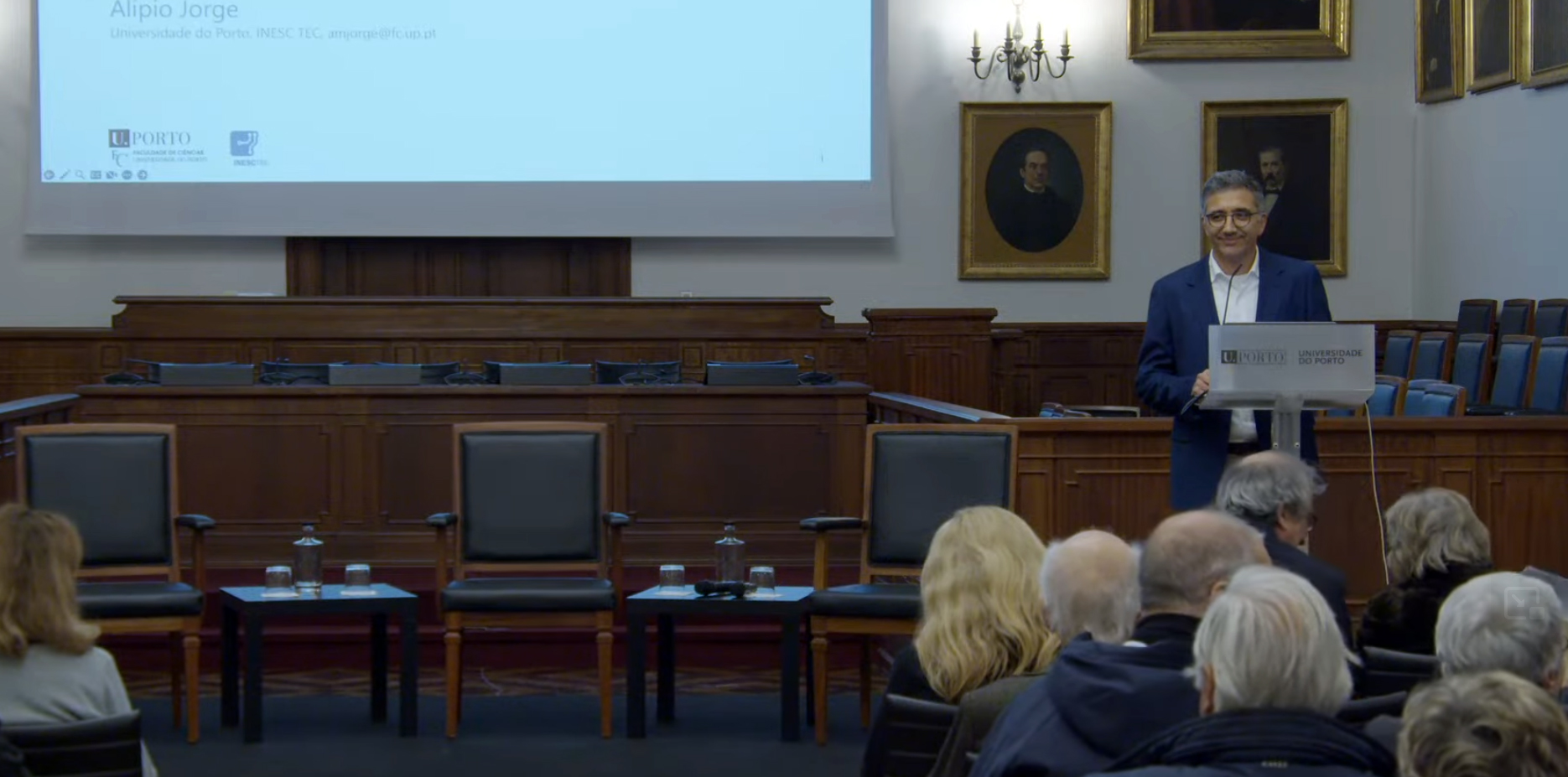
What is Artificial Intelligence and why is it taking centre stage? How do the language models we use on a daily basis work? What role can AI play in Portugal, and how far can it go? These questions were addressed at the Salão Nobre of the University of Porto Rectory (U.Porto), where INESC TEC researcher Alípio Jorge led the session Inteligência Artificial: onde estamos em 2025?
To answer this question, Alípio Jorge embarked on a journey through the past 70 years. From the Turing Test as a starting point for the “springs and winters” of Artificial Intelligence development, through the “data explosion” brought about by the advent of Web 2.0, and finally to the arrival of the now well-known LLM (Large Language Models) systems.
“Artificial Intelligence is a subject with many decades – 70 years – but we are talking about AI now because it has an impact on the economy, and it influences society,” explained the INESC TEC researcher and one of Portugal’s leading experts in AI and data science.
During the third session organised by the U.Porto Conference Centre – which aims to be a “privileged space for dialogue and critical reflection on the major challenges of today” – Alípio Jorge also highlighted environmental and social challenges that are already on the agenda: from increased energy and water consumption to the impact of AI on the production of disinformation, “which can be difficult to control,” the researcher noted.
Turning to Portugal and the strategies being adopted in this field, Alípio Jorge highlighted the recently created National Artificial Intelligence Agenda, Amália (the Portuguese LLM) and a project aimed at increasing transparency in public administration. Led by INESC TEC, CitiLink developed AI algorithms focused on Natural Language Processing (NLP) to interpret and summarise minutes from municipal council meetings.
Considering this context, moving towards a future with more uncertainties than certainties, the question remains: “what is the future of AI?” According to Alípio Jorge, “there is still a long way to go and many things to be done”, and the future will be shaped by improved collaboration between humans and machines, the development of ethical and moral frameworks, and by “new computing paradigms, such as quantum computing, neuromorphic computing, or even biologically based computing, which may solve the energy-related problems of today’s silicon-based AI.”
In short: “we all want Artificial Intelligence to do the boring things so that we can do the fun ones. Let’s hope it’s not the other way round, and that it’s not us doing the laundry while Artificial Intelligence writes poems and paints pictures.”
The researcher mentioned in this news piece is associated with INESC TEC and the Faculty of Sciences of the University of Porto
 News, current topics, curiosities and so much more about INESC TEC and its community!
