


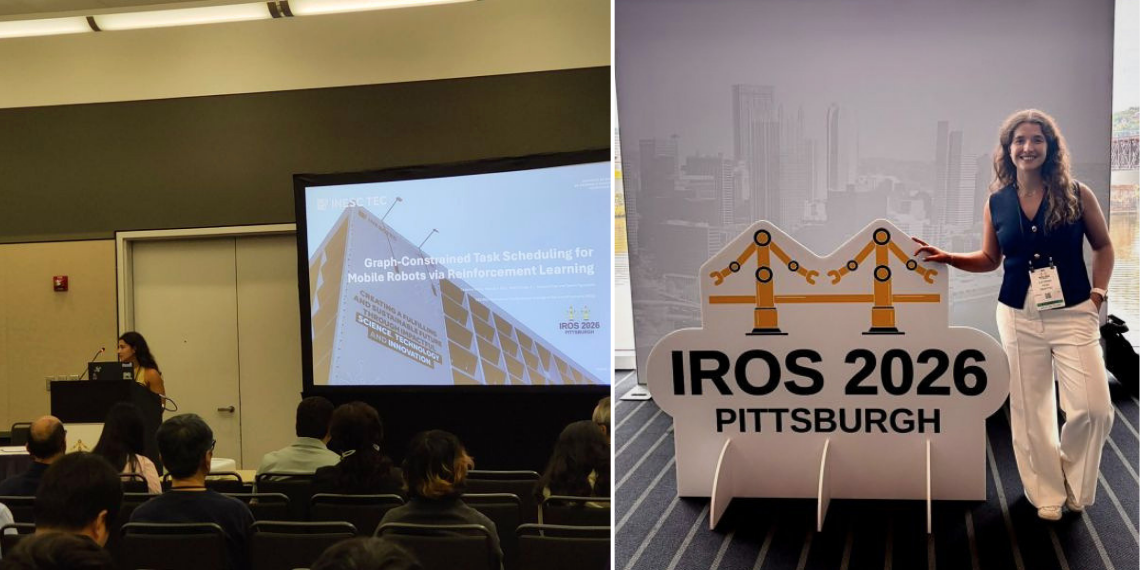
The research presented is one of the first approaches to use a methodology based entirely on Artificial Intelligence (AI) for mobile robotics applications. It also marks the first time in several years that INESC TEC has published at one of the world’s leading robotics conferences, reinforcing the Institute’s position at the forefront of research in this field.
Robots are increasingly being deployed in environments where they must operate alongside people, vehicles or machines. This requires constraints to be placed on their movements (and routes to be defined in advance), as well as tasks to be scheduled at the most suitable times. However, despite the increasing relevance of this scenario, it remains relatively underexplored in the scientific literature. INESC TEC researcher Catarina Rema identified an opportunity to address this gap, leading to the study Graph-Constrained Task Scheduling for Mobile Robots via Reinforcement Learning – recently presented at the 2026 IEEE/RSJ International Conference on Intelligent Robots and Systems (IROS).
Beyond the routes used by INESC TEC’s own robots, another motivation behind the work was the potential to scale the results to larger robot fleets – a scenario in which traditional methods begin to struggle, “both because of the computing time required and the difficulty of coordinating several machines simultaneously”, the researcher explained.
Using AI the research (co-authored by Manuel Silva, Pedro Costa, Eduardo Pires and Daniel Figueiredo) demonstrated that these new technologies can be as competitive as, or even outperform, traditional methods. Another key finding concerned speed, specifically how quickly tasks can be planned for robots.
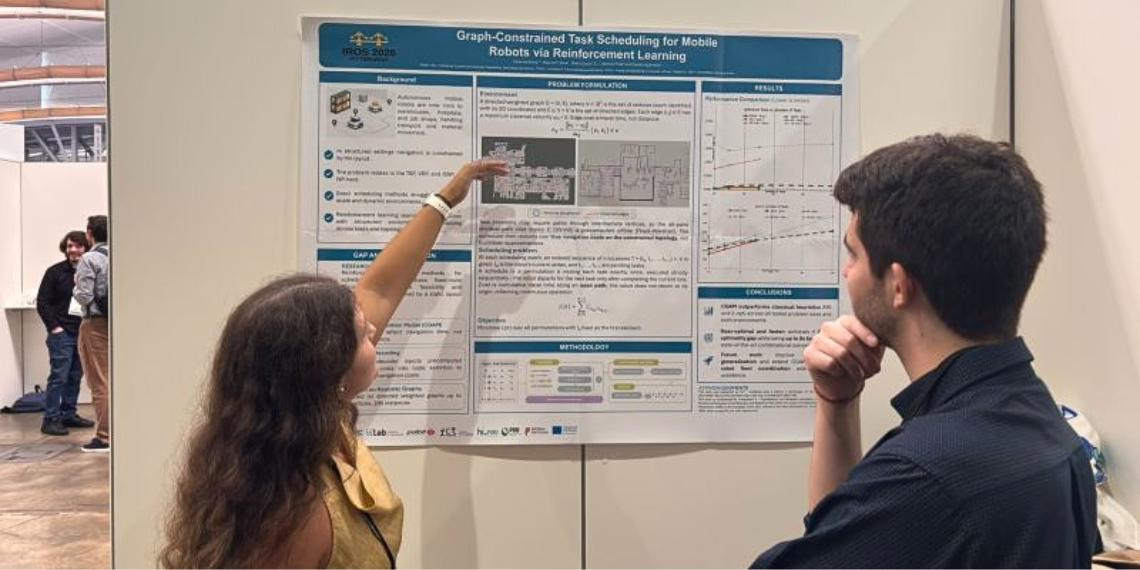
According to Catarina Rema, “the models make decisions in a fraction of the time required by classical methods, making industrial processes more agile and increasing efficiency and productivity”. These findings are already informing follow-up research, in which the same approach is being applied to fleets involving “multiple robots operating simultaneously”.
The approach explored in the study meets INESC TEC’s ongoing efforts to move away from traditional systems – typically based on heuristics or classical optimisation methods -towards new methodologies better suited to dynamic environments, where conditions are constantly changing.
Taking part in the IEEE/RSJ International Conference on Intelligent Robots and Systems 2026, one of the world’s largest robotics conferences, gave Catarina Rema the opportunity to address questions “both about the model’s architecture and the technical choices behind it, and about possible future applications of this work beyond mobile robotics, such as logistics and process optimisation more generally”. During the poster session following her presentation, she also faced considerable interest from researchers working with other types of systems, particularly drones. “They saw the proposed architecture as an interesting starting point for their own applications,” she recalled.
The opportunity to attend IROS – which she described as a “privilege”, allowing her to represent INESC TEC on the other side of the Atlantic and help put Portugal on the global robotics map – also gave the researcher first-hand insight into the rapid pace of progress in the field. “AI-based approaches are becoming increasingly widespread and were the conference’s ‘hot topic’. Humanoid robots are attracting considerable attention, and there is also very interesting research in space robotics, industrial applications and soft robotics, including robots with unconventional shapes,” she said.
 News, current topics, curiosities and so much more about INESC TEC and its community!

