


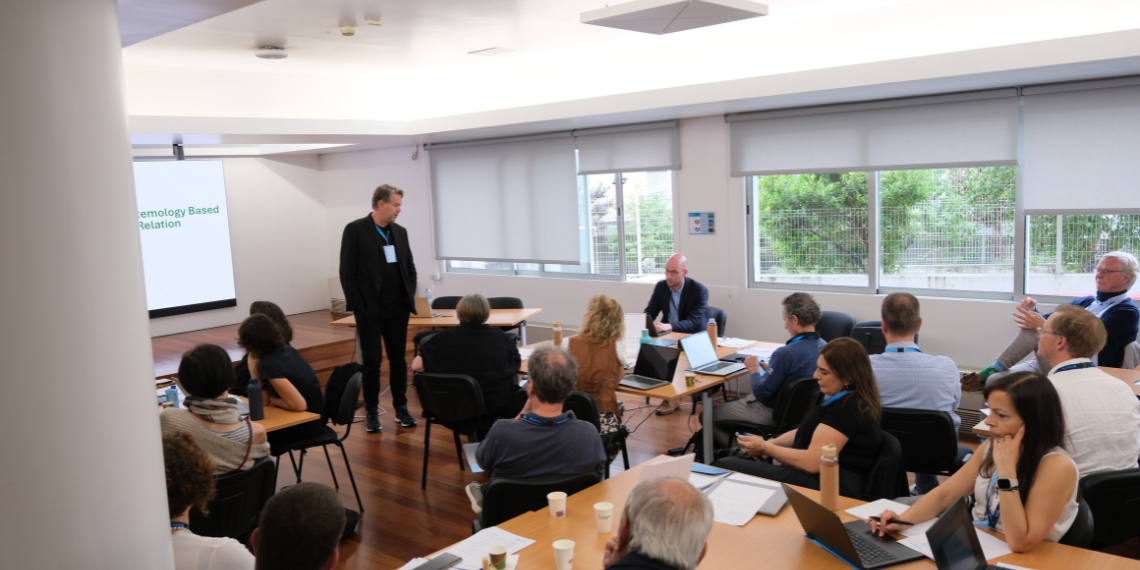
What do a mobility app, an energy community and a platform like a national health registry have in common? In all three, value is not something that a company simply produces and delivers to customers. Instead, it is co-created through interactions between people, organisations and, increasingly, intelligent technologies within what are known as service ecosystems. This was the central premise of the Forum on Markets and Marketing (FMM 2026), which brought together 38 of the world’s leading service researchers at INESC TEC over four days.
FMM is a biennial conference with a distinctive format; rather than following the traditional scientific conference model of presentations and parallel sessions, it prioritises collaborative, side-by-side teamwork. Participants come not only to share their research findings, but also to debate ideas, develop new perspectives and leave with fresh outcomes.
At the heart of the discussions was service-dominant logic, an approach that challenges the traditional view that companies create value and deliver it to customers. Instead, it argues that value is always co-created through interactions between multiple actors – including customers, businesses, institutions, communities and technologies – that exchange resources and capabilities within service ecosystems. This way of thinking has had far-reaching practical implications: it has been instrumental in the emergence of service science, the design of tech-enabled service systems, and the transformation of industrial companies that now offer solutions and outcomes through as-a-service business models, rather than simply selling products.
For business leaders, this represents a significant shift in perspective. Rather than asking only, “How can we produce and sell more effectively?”, organisations are increasingly asking, “How can we create value together with customers, partners and communities, and how can we ensure that this ecosystem remains healthy over time?” It was precisely these questions – how service ecosystems emerge, evolve and remain viable – that the Forum explored, reflecting the growing importance of service research and service science for engineering.
According to Lia Patrício, member of INESC TEC’s Board of Directors and the Forum’s Organising Committee, “these discussions focus on the theoretical foundations of Service Science, but they inform very real decisions. Whenever a company designs a new service, digitalises customer relationships or rethinks a business model, it is intervening in an ecosystem. Understanding how these ecosystems operate, and how they remain viable, is essential for delivering innovation with impact.”
The opening session was delivered by Steve Vargo, one of the founders of service-dominant logic, who presented the field’s latest theoretical developments, particularly the shift towards so-called relational ontologies, some of which are inspired by quantum theory. While the concept may seem abstract, it can be summarised simply: just as particles in quantum physics are not isolated entities but are defined by the relationships they establish, people, resources and value do not exist independently or in predetermined forms – they are mutually constituted through interaction. In practice, this means that markets, services and technologies cannot be understood or managed in isolation from the ecosystems in which they operate.
Participants also discussed topics including cognitive biases in market formation, the resilience and viability of service ecosystems, path dependence and temporal alignment in innovation processes, drawing on contributions from researchers such as Anu Helkkula, Eric Arnould, Heiko Wieland, Kaisa Koskela-Huotari and Jaakko Siltaloppi, among others.
Over the following days, the discussions expanded to themes with direct relevance for society and organisations, including AI and human–machine collaboration, the distribution of agency within service ecosystems, the role of different actors in driving socially impactful transformation, and sustainability and resilience in ecosystems such as tourism and healthcare.
The final two days were dedicated to a more collaborative format, with team-based working sessions focused on jointly developing new ideas, followed by presentations and a concluding discussion that brought FMM 2026 to a close.
 News, current topics, curiosities and so much more about INESC TEC and its community!
