


At the Port of Leixões Cruise Terminal, INESC TEC placed ocean research firmly on the Business2Sea agenda; throughout the event, researchers and representatives from the Institute participated in panels, round tables and presentations, sharing experiences and future perspectives on ocean innovation.
On 24 and 25 November, the Cruise Terminal in Matosinhos hosted the 13th edition of Business2Sea; organised by Fórum Oceano, the event aimed to promote interaction among the various players in the Blue Economy, from science and research to industry.
Under the theme “Global Partnerships for a Sustainable Blue Future”, the latest edition of Business2Sea welcomed not only local and national organisations, but also participants from Brazil, Canada, Japan and Norway. The Nordic delegation included SINTEF, mentor of the INESCTEC.OCEAN Centre of Excellence.
On the first day of the event, INESC TEC inaugurated the Blue Room with a round table dedicated to aquaculture. The session, co-organised with the Portuguese Aquaculture Association (APA), addressed the theme “Advancing Sustainable Aquaculture: Innovation and Collaboration across the Atlantic”.
Before the discussion, the parallel event began with two presentations; Diana Viegas, Coordinator of INESCTEC.OCEAN, presented the Centre of Excellence in Ocean Research and Engineering led by INESC TEC. Hagbart Alsos, Research Coordinator at SINTEF Ocean, outlined the technologies and breakthroughs applied to aquaculture at the Norwegian centre.
The round table was moderated by Vasco Teles, Business Developer at INESCTEC.OCEAN, and Rui Azevedo, Business Adviser at INESCTEC.OCEAN, and brought together key figures from the Portuguese aquaculture sector: David Lima, Production Manager at Stolt Sea Farm; António Castel-Branco, member of the Board of Directors at Naturafish; Pedro Encarnação, Director at Seaculture; and Isidro Blanquet, Secretary-General of the Portuguese Aquaculture Association.
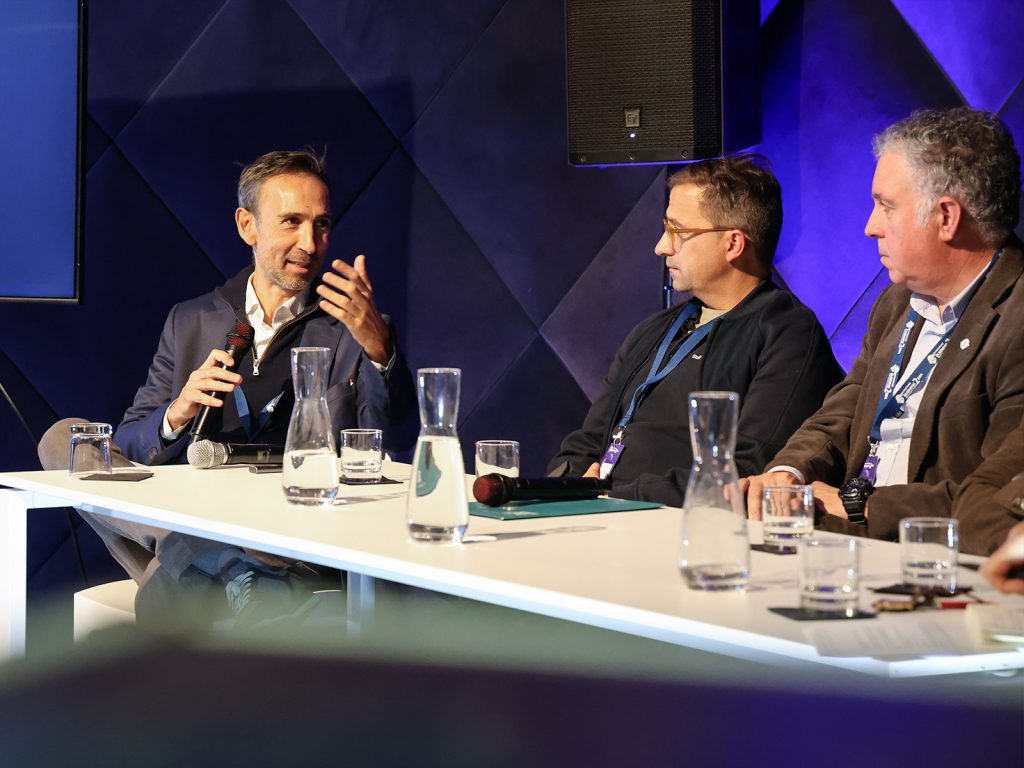
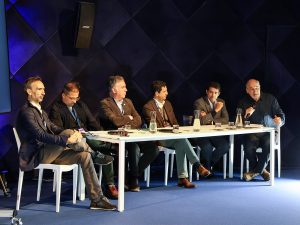
“The participants discussed the needs related to the demanding offshore sector, namely adapting existing technologies and materials to the extremely harsh environments of the Atlantic,” explained Rui Azevedo.
The INESC TEC moderator also highlighted that one of the main concerns raised during the discussion was the integration of technologies in offshore aquaculture applications. “The issue is not so much the availability of technology, but rather the ability to integrate different technologies into different contexts. This requires broad and in-depth collaboration between researchers in engineering and biology,” he explained.
One of the clearest ideas shared among participants was the importance of finding efficient technological solutions. According to Rui Azevedo, the discussion pointed towards a path focused on automation and process efficiency, such as the use of ROVs (Remotely Operated Vehicles) for feeding, monitoring and maintenance operations.
“The need for technology capable of accurately measuring available biomass in tanks was also address; this question influences feeding efficiency, systems and automation. Fish feeding is the main cost factor in production and one of the parameters that most needs to be controlled from an economic efficiency perspective,” summarised the INESC TEC moderator.
Boosting the Atlantic Blue Economy through the UPWELLING project
In another parallel session in the Blue Room, the spotlight turned to the UPWELLING project. Under the theme “Boosting Innovation and Skills to Drive the Blue Economy”, the session was led by INESC TEC, S2AQUAcoLAB and the Portuguese Institute for Sea and Atmosphere (IPMA) – partners in this European project aimed at promoting cooperation between companies and innovation centres to advance the Atlantic Blue Economy.
According to Paula Lima, INESC TEC researcher, UPWELLING aims to “address gaps in the Blue Economy” through three main actions: the creation of the UPWELLING Network, “with partners from Portugal, Spain, France and Ireland, providing access to support infrastructures”; the development of the UPWELLING Academy, “where partners will develop training materials”; and the promotion of hackathons, “whose winners will be supported by the project partners”.
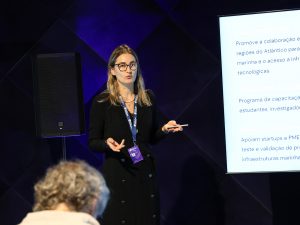
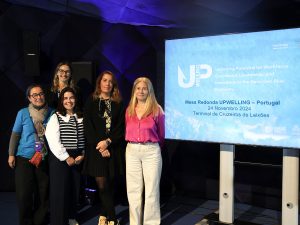
The session sought to identify emerging technologies, skills needs and collaboration opportunities for the Blue Economy in Portugal – with key interventions by Eduardo Silva, INESC TEC researcher and Scientific Coordinator of INESCTEC.OCEAN; Cátia Marques, Scientific Coordinator of S2AQUAcoLAB; and Florbela Soares, researcher at IPMA.
INESCTEC.OCEAN as a leader in ocean engineering innovation
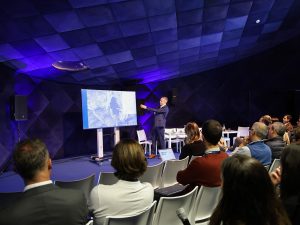
To start the second day of Business2Sea, INESCTEC.OCEAN took the main stage as an example of cooperation between Portugal and Norway within the Blue Economy. The panel “INESCTEC.OCEAN as a Driver of Business Innovation in Ocean Engineering” focused on the Centre of Excellence led by INESC TEC and on how both countries can collaborate in the research and development of marine technologies.
“When addressing real-world problems, no expert can solve them alone; we need to bring people together to face these complex challenges, especially those related to the oceans. But to do that, we also need infrastructures, laboratories and talent,” explained José Manuel Mendonça, President Emeritus of INESC TEC.
Also acting as Coordinator of INESCTEC.OCEAN, he presented the centre in detail, stressing that it is a natural outcome of “more than 30 years of INESC TEC’s experience in Marine Robotics”. “That is why – in cooperation with SINTEF in Norway – we decided to be bold and create INESCTEC.OCEAN, Portugal’s first Centre of Excellence in Ocean Research and Engineering,” he added.
SINTEF was represented by Trond Johnsen, Director of Market Development; moderated by Carlos Pinho, leader of the Portugal Blue Digital Hub (PBDH) and President of Companhia de Energia Oceânica (CEO), the discussion also featured Owe Hagesæther, CEO of the GCE Ocean Tech Cluster; David Afonso, Vice-President of Nortech.AI; and Admiral Ramalho Marreiros, Director-General of the Portuguese Navy’s Hydrographic Institute. The session was preceded by an address from the Norwegian Ambassador to Portugal, Hanne Brusletto.

A Canadian “supercluster” for Atlantic cooperation
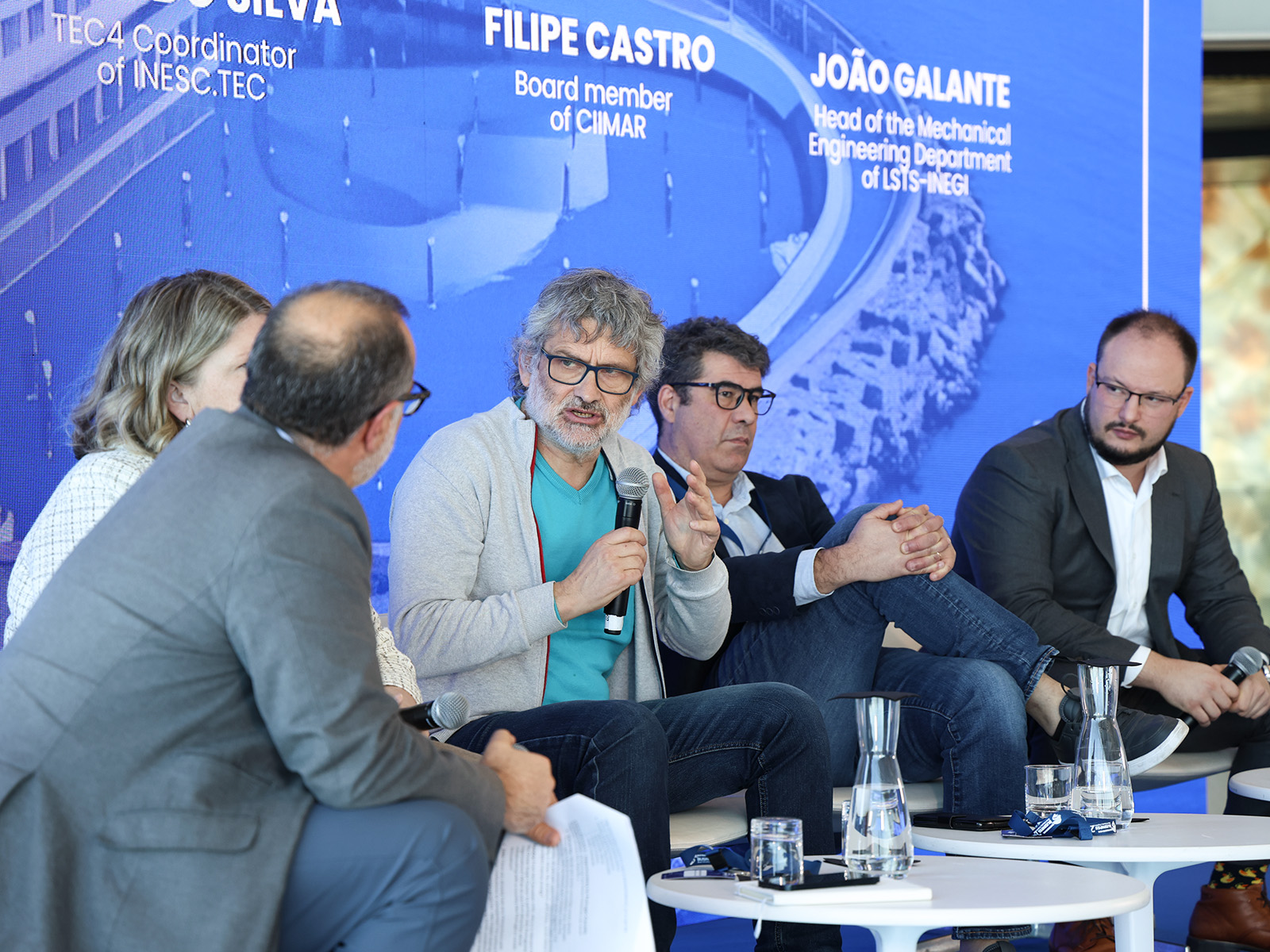
Cooperation within the Blue Economy goes beyond Europe; collaboration with Norway through INESCTEC.OCEAN should serve as an “example” for “a world that needs to be more connected”, said Eduardo Silva. In a panel on “Connecting the Leixões Blue Hub to Canada’s Ocean Supercluster”, the INESC TEC researcher turned attention to the other side of the Atlantic, where he identified clear advantages in establishing a strong partnership with Canada.
“Canada’s Ocean Supercluster has impressive figures in terms of members, companies and economic impact. Canada is a strong presence in the Western Atlantic and is exploring the Arctic Ocean, which has a significant influence on our waters, our fish and our coastline,” explained the Scientific Coordinator of INESCTEC.OCEAN.
The Hub Azul Leixões, an infrastructure coordinated by INESC TEC and future home to one of Europe’s largest ocean test tanks for marine technology – could play a role in this cooperation. “But above all, it is a governance issue, associated to how Portugal cooperates with interested Canadian companies,” mentioned Eduardo Silva.
At a time of strong global growth in the Blue Economy, the INESC TEC researcher stressed that “a small country like Portugal needs to focus on the continuous development of a solid portfolio of ocean tech solutions”. “Not just for next year, but looking 20 or 30 years ahead, to strengthen our ability to collaborate with the rest of the world,” he emphasised.
Moderated by Gonçalo Faria, leader of Hub Azul Portugal, the panel included the Canadian perspective of Kendra MacDonald, CEO of Canada’s Ocean Supercluster. The discussion was completed by Filipe Castro, member of the Board of Directors of CIIMAR – Interdisciplinary Centre of Marine and Environmental Research – and João Galante, Head of the Mechanical Engineering Department at INEGI’s Underwater Systems and Technology Laboratory. The session opened with a speech by Elise Racicot, Ambassador of Canada to Portugal.
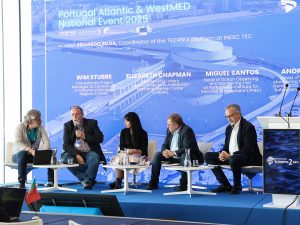
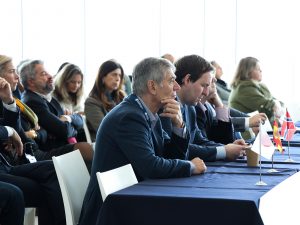
Eduardo Silva then returned to the main stage as moderator of a discussion promoted by Fórum Oceano, with the support of the Directorate-General for Maritime Policy and the EU Sea Basin Assistance Mechanism.
As Coordinator of Pillar IV of the EU Atlantic Strategy, the INESC TEC researcher led a panel entitled “From the Atlantic to the Mediterranean: Coastal Resilience and a Healthy Ocean”. The discussion explored convergence between WestMED and the Atlantic Strategy, the Ocean Pact and European Blue Economy priorities, focusing on inter-regional cooperation and collaboration between maritime basins.
Introduced by Marisa Lameiras da Silva, Director-General for Maritime Policy, the panel included Wim Stubbe, Transatlantic Project Manager at the Conference of Peripheral Maritime Regions (CPMR); Elizabeth Chapman, Director for International Projects at the Andalusian Maritime Cluster (CMMA); Miguel Santos, Head of the Ocean Monitoring and Observation Unit at IPMA; and André Couto, Head of the Environmental Monitoring Unit at the Directorate-General for Natural Resources, Safety and Maritime Services. The session closed with remarks by Rúben Eiras, Secretary-General of Fórum Oceano.
What if the future of offshore renewables involved virtual reality?
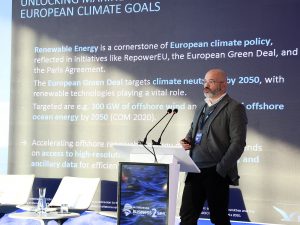
With an eye on the future of the Blue Economy, ocean renewable energy took centre stage. In line with Europe’s decarbonisation and energy efficiency targets for 2050, one possible path involves “consolidating the offshore renewable energy installation process”, explained Marco Amaro Oliveira.
The INESC TEC researcher presented the BLUE-X platform on the main stage of Business2Sea. This European project – with INESC TEC as partner – is described as an “innovative ocean observation solution to optimise processes associated with renewable energy”. From installation to decommissioning, BLUE-X “covers the entire life cycle of offshore renewable energy projects”.
Using satellite observation systems, the project provides accurate marine data through a multi-purpose extended reality (XR) tool, designed to support planning, visualisation and monitoring at different stages of offshore renewable energy projects.
This immersive technology also allows the monitoring of wave and tidal energy corridors, as well as the simulation of disaster scenarios. “We have a platform that improves efficiency through data-driven decision-making,” concluded Marco Amaro Oliveira.
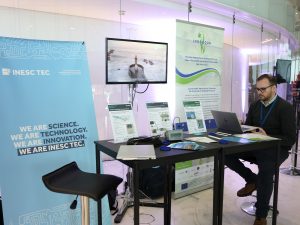

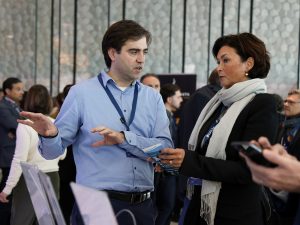
Throughout the two days of Business2Sea, INESC TEC’s latest developments for the ocean were also showcased in the exhibition area. Researchers Luís Coelho and João Mendes represented the Institute with demonstrations related to the Energy Transition Alliance and the INNOAQUA project, which focuses on developing an innovative approach to the integrated use of algae in sustainable aquaculture practices and high-value food applications.
The researcher mentioned in this news piece, Eduardo Silva, is associated with INESC TEC and IPP-ISEP
 News, current topics, curiosities and so much more about INESC TEC and its community!
