


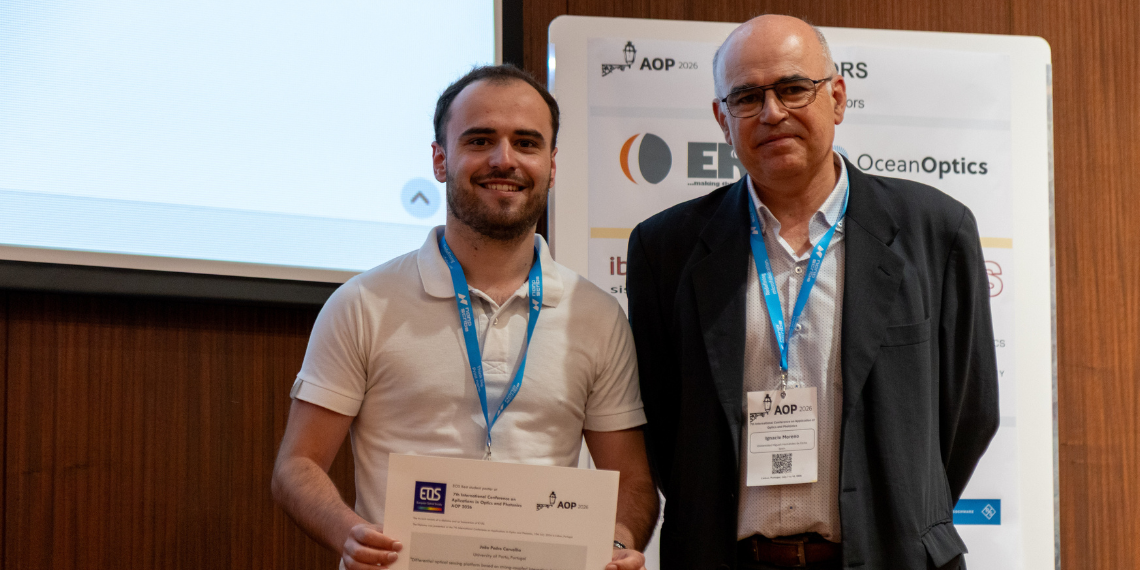
INESC TEC researchers won three scientific awards and one photography prize at the International Conference on Applications of Optics and Photonics (AOP2026). But their participation went beyond the awards: Orlando Frazão was elected Vice-President of the Portuguese Society for Optics and Photonics (SPOF), while Susana Silva became President of the organisation’s Supervisory Board; Orlando Frazão was also appointed President of the Portuguese Territorial Committee for Optics.
Rita Pereira de Faria, Pedro Madeira Silva, João Pedro Carvalho and Miguel Almeida received recognition for their work at the international conference, organised every two years by the Portuguese Society for Optics and Photonics (SPOF). The event brings together researchers, students and national and international experts to present and discuss scientific and technological advances in optics and photonics.
Optical sensors for monitoring concrete structures
Rita Pereira de Faria, a PhD student on the Doctoral Programme in Physics Engineering at the Faculty of Engineering of the University of Porto (PRODEF) – supervised by INESC TEC researchers Luís Coelho and João Mendes, together with Ian Muri from SINTEF (Norway) -, received the Best Presentation in Photonics award from the scientific journal Photonics (MDPI), thanks to the paper Two Optical-Fiber Approaches to Embeddable Concrete Monitoring: Interferometric and Intensity-Based Methods.
The study presents two complementary approaches for monitoring concrete structures using optical sensors: one based on interferometry and the other on intensity measurements.
The interferometric approach, developed as part of Rita Pereira de Faria’s master’s work, measures temperature and relative humidity using a single-mode optical fibre sensor with remote spectral interrogation.
The second approach, developed through Pedro Madeira Silva’s PhD research, uses intensity measurements to monitor a broader range of parameters, including temperature, the concrete curing process, carbonation, relative humidity and corrosion. In this case, the system processes the data locally before transmitting it via a wired connection to a computer.
Both technologies have been implemented and are currently being tested on a prototype concrete structure for floating offshore wind turbines, built in Setúbal as part of the ATE project.
José Almeida, Luís Coelho and João Mendes, all INESC TEC researchers, supervised the work.
New architecture for integrated optical sensing
João Pedro Carvalho received the EOS Best Student Poster Presentation award, presented by the European Optical Society, for the paper Differential Optical Sensing Platform Based on Strong-Coupled Interactions Between Plasmonic and Excitonic Materials.
The study presents a numerical analysis of a new optical sensing architecture based on nanoscale interactions between surface plasmons and excitons. The solution combines the optical properties of thin metallic films with those of two-dimensional materials.
Surface plasmons are widely used in optical sensors because they are highly sensitive to changes in the surrounding environment. However, conventional configurations often require prisms to couple light into the system, making practical implementation more challenging and increasing the risk of measurement errors.
To overcome this limitation, the researchers designed a multilayer optical structure that allows surface plasmons to propagate directly through incident light.
The integration of a tungsten disulphide monolayer, a semiconductor material with excitonic absorption bands in the visible spectrum, creates two absorption bands that respond to changes in the surrounding environment. This configuration enables a differential sensing architecture, expanding the sensing range while reducing the impact of signal fluctuations.
According to the researcher, the solution could offer an alternative to conventional optical sensors, particularly as integrated optics continues to evolve. The architecture could be miniaturised and incorporated into a photonic chip.
The research is part of João Pedro Carvalho’s PRODEF doctoral programme, under the supervision of José Almeida, Luís Coelho and João Mendes, and received funding from the WaveSense project, coordinated by Luís Coelho.
Smart platform supports sustainable aquaculture
João Mendes received the Sensors Best Talk award, presented by the scientific journal Sensors (MDPI), for the paper InnoAqua: Innovative Approaches for an Integrated Use of Algae in Sustainable Aquaculture Practices and High-Value Food Applications.
The INESC TEC researcher presented an integrated solution for the intelligent monitoring of water quality in Integrated Multi-Trophic Aquaculture systems, developed as part of the European INNOAQUA project.
The proposal addresses the challenges of sustainable aquaculture through an approach that follows the principles of the Blue Economy, circularity and the efficient use of resources.
In integrated multi-trophic aquaculture systems, nutrients contained in fish farming effluents are reused to cultivate macroalgae. The algae biofilter the water before recirculating, thus improving the efficiency and sustainability of the entire production process.
To support this model, the team developed an infrastructure capable of continuously monitoring key water quality indicators in real time. The solution integrates dedicated electronics, wireless communications, an automated sampling system and a fluidic circuit, allowing it to collect data autonomously from different points across the aquaculture system.
The architecture provides continuous information on the installation’s operation, reduces the need for manual intervention and enables operators to identify changes in water conditions at an early stage.
The system sends the collected information to a digital platform, where it is organised, processed and displayed through a visual dashboard. This allows changes in the ecosystem to be transformed into useful information that supports decision-making, optimises production conditions and improves biomass growth.
The platform was also designed to ensure robustness and scalability; the system manages communication between different modules, validates connected devices, controls data acquisition cycles and monitors the operational status of individual components. Automatic recovery mechanisms were also implemented to improve reliability in real-world operating environments.
Argon plasma confined by a magnetic field wins photography award
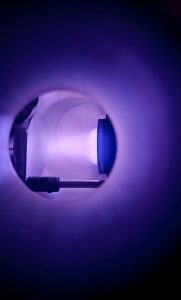
INESC TEC’s participation at AOP2026 also included the conference’s Photography Award, presented to Miguel Almeida, an INESC TEC researcher and PRODEF PhD student supervised by Luís Coelho, José Almeida and Isabel Pastoriza from CINBIO (Vigo).
The winning image shows argon plasma confined by a magnetic field generated around the material being deposited in an RF magnetron sputtering system. The plasma displays the usual blue glow and forms a beam directed towards the substrates where the material deposition takes place.
Researchers take on roles in national and international organisations
During the conference, the Portuguese Society for Optics and Photonics (SPOF) elected new governing bodies. INESC TEC researcher Orlando Frazão was designated Vice-President, while fellow INESC TEC researcher Susana Silva became President of the Supervisory Board.
SPOF is a non-profit scientific association affiliated with the European Optical Society, dedicated to promote science, technology and education in the fields of optics and photonics. The organisation brings together researchers, students, companies and professionals working in these areas across Portugal.
Orlando Frazão was also appointed President of the Portuguese Territorial Committee for Optics, the national committee associated with the International Commission for Optics (ICO). His responsibilities include promoting the committee’s activities in Portugal and coordinating the country’s representation at General Assemblies and other initiatives organised by the ICO.
“The awards and nominations announced during AOP2026 reinforce the recognition of the work carried out by INESC TEC in the fields of optics and photonics, as well as the presence of our teams in national and international scientific organisations,” Susana Silva said.
The 7th International Conference on Applications in Optics and Photonics (AOP2026) took place from 7 to 10 July at the Lisbon Institute of Engineering (ISEL). Organised every two years by the Portuguese Society for Optics and Photonics, the conference brings together researchers, students and national and international experts to present and discuss the latest scientific and technological developments in the fields of optics and photonics.
 News, current topics, curiosities and so much more about INESC TEC and its community!
