


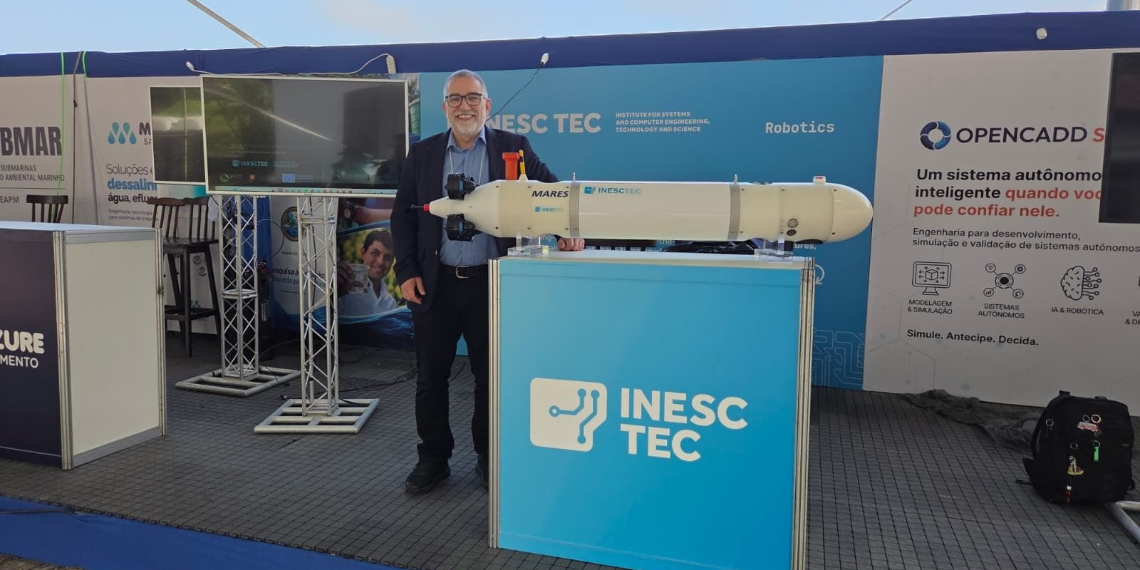
Imagine an underwater robot stationed near critical infrastructure, returning autonomously to a docking station to recharge batteries and download data before heading back to work. This is no work of fiction: it is the concept behind resident AUVs (Autonomous Underwater Vehicles), which INESC TEC researcher Nuno Cruz identified as one of the most promising approaches to protecting the underwater domain.
Nuno Cruz, who coordinates INESC TEC’s robotics domain (particularly autonomous systems), recently travelled to Brazil to take part in ARAMUSS (Aratu Maritime Unmanned Systems Simulation), an initiative organised by the Brazilian Navy and dedicated to unmanned maritime systems and technologies for both civilian and military applications. The event is particularly significant because it brings together the navy, academia, industry and government entities, providing a forum for dialogue and collaboration in which operational needs, research and technological development are discussed collectively.
Nuno Cruz represented INESC TEC in two different capacities; on the one hand, he took part in the technology exhibition, presenting one of INESC TEC’s flagship platforms, the AUV MARES. On the other, he spoke at two major panel sessions, addressing Critical Technologies and Artificial Intelligence and Robotics.
The concept of resident AUVs took centre stage during the panel dedicated to Critical Technologies, where the message was clear: there is no single solution. “Protecting the underwater domain will not depend on a single technology or type of vehicle”, said Nuno Cruz, who believes that a combination of mobile robots, fixed sensors, passive acoustic systems, smart cables, docking stations, recharging capabilities and onboard autonomy will be needed to ensure a “persistent presence at sea, without relying continuously on ships and human crews”.
And what happens when Artificial Intelligence (AI)s and robotics come together? The researcher showed that the connection between the two fields is now unavoidable. “We are moving from pre-programmed missions towards increasingly intelligent ones”, with AI playing a fundamental role at every stage, from planning and execution to data analysis.
The reason is a practical one: underwater communications are extremely limited, making it impossible to continuously transmit large volumes of information to shore. As a result, “perception, mapping, anomaly detection and mission replanning must all take place onboard the vehicle itself”.
In reality, the future may not be as unpredictable as it seems. Nuno Cruz pointed out that “Portugal has very strong expertise in every aspect of marine robotics, from autonomous vehicle design and navigation in GNSS-denied environments to sensor fusion, three-dimensional mapping using sonar and vision, acoustic systems, underwater docking and cooperation between multiple vehicles”. He went further, highlighting an additional advantage for INESC TEC: “these capabilities are backed by decades of experience in operations at sea, a diverse fleet of platforms and testing infrastructures that make it possible to work across the entire spectrum, from the laboratory to operational environments”.
One thing is certain: continuous and discreet monitoring of the underwater environment could transform the way critical infrastructures on the seabed are protected, including telecommunications cables, pipelines and other strategic resources. This is, at least, the view of the researcher, who argued that “the combination of passive sensors, smart cables, resident vehicles and artificial intelligence could significantly change the way we monitor and protect underwater infrastructure”.
This is because such a system would eliminate the need for a permanent surface vessel presence and leave no visible signs of surveillance in the area. This would make it virtually impossible for a potential adversary to know whether they were being monitored or whether an underwater vehicle was patrolling the site. This discreet operational capability also offers a significant practical advantage: when sensors detect suspicious activity, the autonomous vehicle is already nearby, potentially reducing response times from several hours or days to just a few minutes.
Projects such as NAUTILUS and SEAGUARD are already developing different components of this vision.
Strengthening cooperation with Brazil
This participation did not come out of the blue. INESC TEC has a significant track record of cooperation with Brazilian institutions, particularly in the field of underwater robotics. Looking back, Nuno Cruz highlighted several joint projects with the Federal University of Juiz de Fora – which led, among other developments, to TriMARES, an evolution of the MARES platform. More recently, collaboration with the Federal University of Santa Catarina has enabled the development of new technological solutions and joint experimental work, including variable buoyancy systems and acoustic localisation research associated with scientific diving operations.
However, the common ground between the two countries extends well beyond these examples. The researcher stressed that shared challenges provide the basis “for combining expertise, platforms, testing infrastructures and different operating environments”. “Both countries have extensive maritime areas, offshore and underwater infrastructure that needs to be monitored, and a growing need to use autonomous systems to extend operational endurance without proportionally increasing human resources and naval assets”, he added. These shared points also point to “significant potential for joint ocean trials, exchanges of researchers and students, the protection of offshore infrastructures and underwater cables, and the preparation of new research and innovation projects”.
 News, current topics, curiosities and so much more about INESC TEC and its community!

