


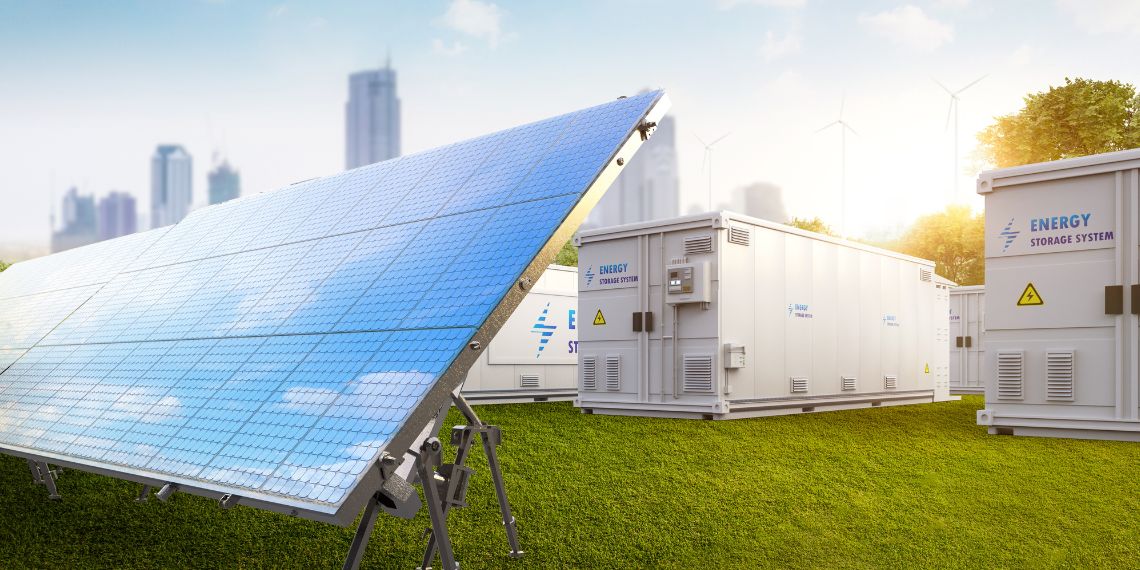
What if we could store renewable energy and use it when it was needed? It sounds simple, but it took three years of research across two European projects involving INESC TEC. InterSTORE and i-STENTORE show how different storage technologies can work together, communicate with each other and help make the energy system more flexible and efficient. The results have already moved beyond the laboratory: the solutions were tested in real-world pilot projects, including in Portugal, in an industrial environment and in the power grid of the island of Madeira.
Imagine a very sunny day when renewable generation exceeds demand. How can we ensure that the energy produced is not wasted and can later be used when it’s needed? The most obvious answer is batteries, but energy storage options go far beyond this technology. These include pumped hydropower storage, thermal systems, different battery technologies and solutions that combine several of these options.
Different systems “speaking the same language”
In InterSTORE, the challenge began with communication. As the number of batteries, PV panels, electric vehicle chargers and other distributed energy resources connected to the energy system increases, so does the need for these devices to communicate with each other in an interoperable and rapid manner.
The project developed and demonstrated open-source tools designed to facilitate interoperability and the integration of distributed storage systems. These include tools that enable communication and data exchange between different systems by combining NATS technology with the IEEE 2030.5 standard, as well as a converter that enables the integration of devices using legacy protocols.
Alexandre Lucas, a researcher at INESC TEC, explained that the tools developed within the scope of InterSTORE were validated across different use cases and European pilot projects. In Portugal, this validation extended to an industrial setting through a pilot project at CapWatt, integrating the solutions developed, particularly the optimisation of the joint operation of hybrid storage systems (combining lithium and vanadium batteries). In addition, an energy storage and management system was implemented in the car park to increase the simultaneity of electric vehicle charging.
“The combination of the interoperability enabled by IEEE 2030.5 with NATS’s asynchronous, fast and many-to-many communication could be a real game changer for distributed energy systems, unlocking intelligence at the edge and enabling fast, scalable grid services based on the near-real-time coordination of distributed energy resources,” explained Alexandre Lucas.
One of the areas explored focused precisely on hybrid storage systems. Rather than relying on a single technology, these systems combine solutions with different attributes and seek to leverage the individual strengths. “Under InterSTORE, INESC TEC developed several tools, including a joint-operation optimisation model for hybrid storage systems; a hybrid storage sizing model; and services for extracting value from data shared through connected data spaces,” he added.
What if a battery could work together with a dam?
i-STENTORE started with an even broader question: which storage technologies make the most sense for different applications, and how can we combine them to increase the use of renewable energy?
Throughout the project, standalone and hybrid solutions were studied in areas as diverse as industry, agriculture, mobility, buildings and heating, with demonstrations carried out in real-world settings.
Portugal was one of the locations selected to test this approach. On the island of Madeira, INESC TEC participated in the development and validation of tools to coordinate pumped hydropower storage and battery storage in an power grid where the ability to store renewable generation is particularly important. INESC TEC’s work focused not only on understanding which technologies work, but also on determining under which conditions they can be replicated and used efficiently.
According to Filipe Joel Soares, a researcher at INESC TEC, Madeira is a particularly relevant case because it has an isolated system, with no interconnection to other grids, in which production and consumption must be continuously balanced while ensuring system security. As wind and solar generation increases, so does the need for resources capable of absorbing surpluses and responding rapidly to fluctuations in renewable generation.
“INESC TEC developed tools to forecast inflows to hydropower plants, optimise the daily dispatch of different generation and storage resources, and dynamically assess whether these solutions keep the system within safe operating conditions,” explained Filipe Joel Soares.
Another major advantage explored by the project is the combination of different technologies. Batteries can respond very quickly, while pumped hydropower storage makes it possible to manage larger amounts of energy over longer periods. This coordination can reduce renewable energy waste and the need to rely on thermal generation, without compromising grid security.
“Solutions of this kind have particular potential in island or poorly interconnected systems, but also in grids with a high penetration of renewables and access to different forms of storage, where flexibility will play an increasingly important role,” the researcher concluded.
 News, current topics, curiosities and so much more about INESC TEC and its community!
