


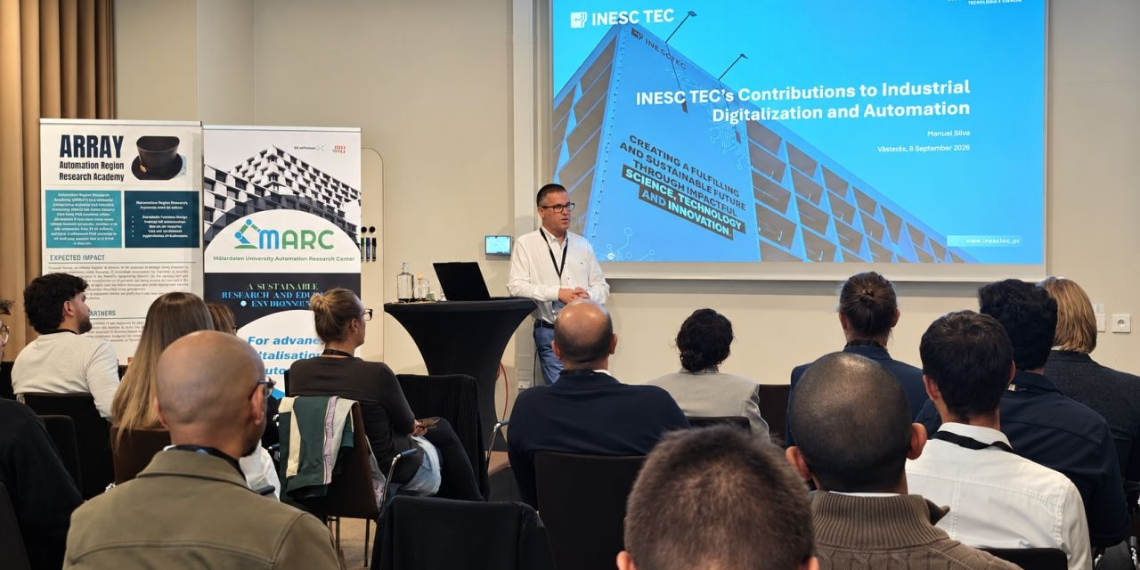
Manuel Silva, one of the coordinators of the Centre for Industrial Robotics and Intelligent Systems (CRIIS), recently joined a select group invited to speak at the workshop Digitalization and Automation for Production Flexibility, held as part of ETFA 2026 – the International Conference on Emerging Technologies and Factory Automation – a leading conference organised by the IEEE Industrial Electronics Society (IES) in the fields of industrial and factory automation.
The workshop addressed the technological, methodological and operational challenges involved in the digital transformation of industrial systems, focusing on achieving greater flexibility, intelligence and resilience in the production systems of the future.
The goal was to advance the level of digitalisation and automation in industry along three main lines: making automation solutions more flexible, further developing the application of automation, robotics and control, and strengthening digital infrastructure. Manuel Silva said that the event provided an opportunity to “present to a wider audience the work that has been carried out across several projects”, as well as to showcase INESC TEC’s vision for “research, development and technology transfer to industry”.
“The key message is that INESC TEC is developing and demonstrating advanced robotics, AI and automation technologies that enable companies to undertake the digital transformation needed to achieve a more flexible, efficient, sustainable and autonomous industry”, he explained.
In his presentation, Manuel Silva outlined INESC TEC’s model, based on a combination of research push and market pull that brings academia closer to companies’ real-world needs. He also highlighted the institution’s involvement across the entire innovation value chain, from scientific research to technology transfer, as well as consultancy, advanced training and spin-off creation.
More specifically, he emphasised that “INESC TEC develops and demonstrates practical solutions for the digital transformation of industry in areas like mobile and industrial robotics, mobile manipulators, autonomous mobile robot (AMR) fleet coordination, human-robot collaboration, machine vision, augmented and extended reality, artificial intelligence, and robot programming assisted by generative AI”.
Beyond the scientific dimension, the conference stands out particularly for bringing industry and academia together. Reflecting on these synergies, the researcher said that three topics were discussed during the session in which he took part: trends and challenges in digitalisation and automation; the areas best suited to co-production (understood as collaboration between academia, industry and technology providers in the development of automation and digitalisation solutions); and the forms of co-production that have proven beneficial in practice.
He explained that the objective “was to understand the digitalisation and automation needs that participating companies have identified for the coming years”, as well as “the challenges they face when digitalising their production processes”. The session also sought to gather the views of R&D institutions on future trends in these areas and discuss how both types of organisations could work together more effectively, ensuring that research results are successfully transferred to companies, to their mutual benefit.
As an example of co-production, Manuel Silva also presented one of INESC TEC’s research and innovation infrastructures, iilab – Industry and Innovation Laboratory – and the collaboration with NOS in the context of 5G communications networks.
 News, current topics, curiosities and so much more about INESC TEC and its community!

