


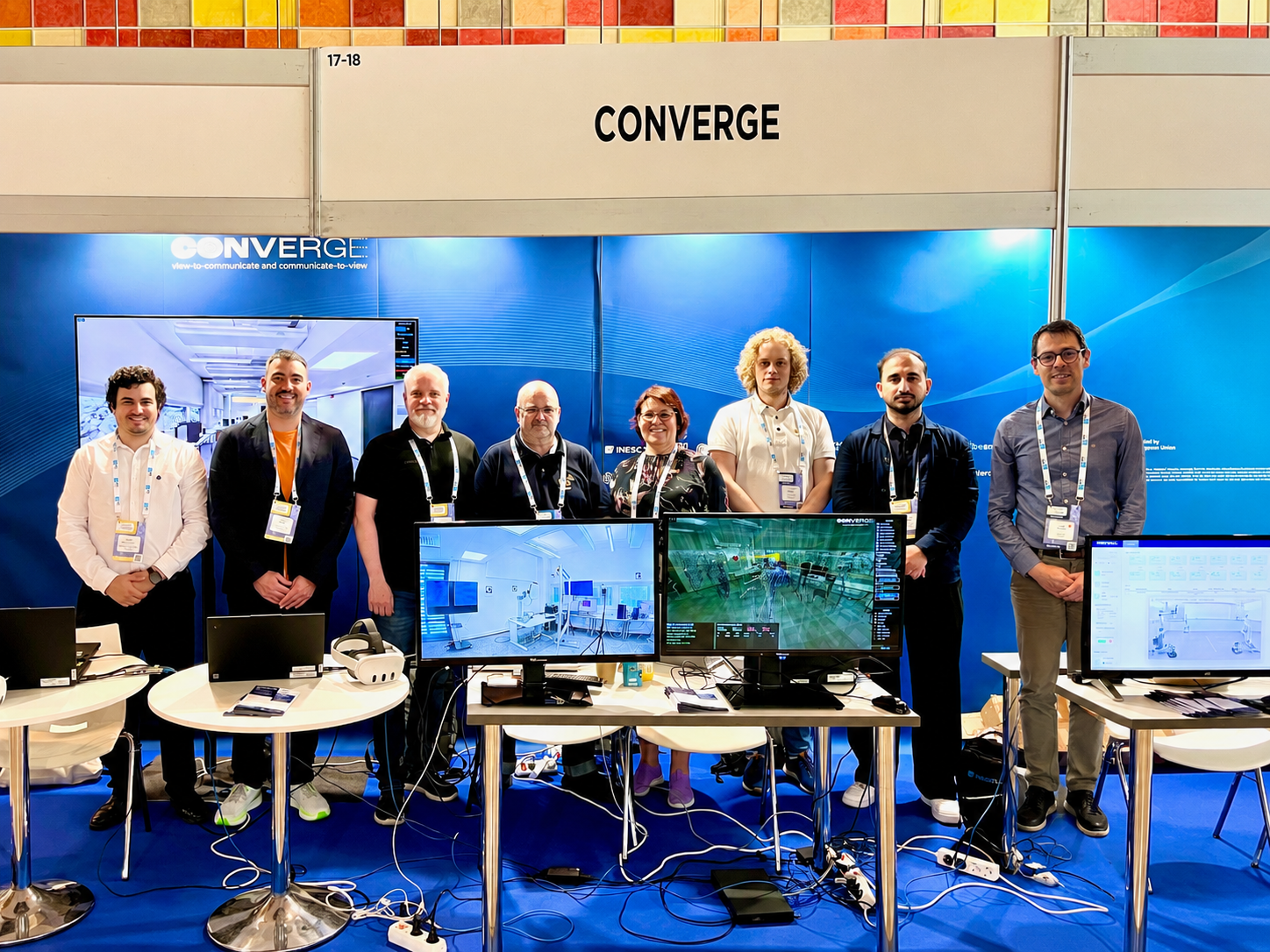
The Institute took part in the EuCNC & 6G Summit international conference, which took place in Málaga, Spain. Our researchers presented two demonstrations – as part of the European projects CONVERGE and TERRAMETA, both coordinated by INESC TEC-, organised two workshops, presented two scientific papers and a poster, and one researcher also served as co-chair of a conference session.
Digital twins and extended reality for distributed 6G experimentation
Visitors to the conference were able, through the INESC TEC stand, to enter a virtual reality environment and, from there, experience and control (in real time) physical equipment that was located in two places far from Málaga: one in Porto, at one of INESC TEC’s communications laboratories on the FEUP campus, and the other at the University of Oulu, in Finland. All this was possible without leaving the stand.
The demonstration was carried out as part of the European CONVERGE project, coordinated by INESC TEC, which aims to develop tools to test and control 6G networks – the next generation of mobile communications, offering higher speeds and greater capacity than 5G. The project was represented in the EuCNC & 6G Summit 2026 exhibition area with a dedicated stand showcasing new tools for the experimentation, monitoring and control of distributed 6G research infrastructures.
Entitled Digital Twins and XR for Real-Time 6G Experimentation and Control, the demonstration showed, according to Filipe Borges Teixeira, “how the convergence of wireless communications, sensing, computer vision, digital twins, machine learning and extended reality (XR) can create a new generation of intelligent experimentation platforms for 6G”.
The demonstration integrated multimodal sensing capabilities, combining video, radio signals, RF sensing data and contextual environmental information to create advanced digital representations of the experimental scenarios. It also featured a graphical platform for monitoring and controlling distributed testbeds, allowing users to visualise performance indicators, experimental resources and the operational status of the infrastructure in real time.
“The work demonstrated contributes to the European vision of open, interoperable and user-centric experimentation platforms for the development of future 6G networks,” added the INESC TEC researcher.
INESC TEC presented two demonstrations at the TERRAMETA stand
The European project TERRAMETA is also coordinated by INESC TEC and, as such, the Institute was represented at the project’s stand with two demonstrations: one focused on a telecommunications scenario and the other on a smart factory scenario.
TERRAMETA is developing communication technologies for future 6G networks, particularly communications using very high frequencies (known as sub-THz or D-band, at 140 GHz), which make it possible to share vast amounts of data at very high speed.
Within this context, the Institute’s team presented two demonstrations: concerning telecommunications, INESC TEC researchers showed that it is possible to replace an optical fibre cable with a 140 GHz wireless link while maintaining equivalent performance, something that “is particularly useful for bringing high-speed connectivity to areas where installing fibre is difficult or expensive”, as explained by INESC TEC researcher Luís Pessoa.
In the smart factory scenario, a mobile robot was used to capture 3D data from the surroundings. Once collected, the robot transmitted the data through a link assisted by intelligent surfaces so that it could be processed remotely. “The result was real-time 3D reconstruction, the kind of technology that could, in the future, be used for robots that ‘understand’ the space around them in automated factories,” explained Luís Pessoa, who is also a lecturer at the Faculty of Engineering of the University of Porto.
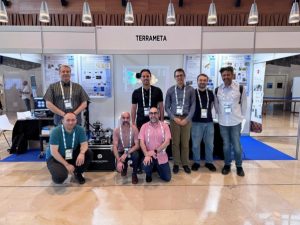 Through these demonstrations, the INESC TEC researchers showed that these technologies can provide very high-speed, low-latency communications in both industrial environments and telecommunications networks, and that they can contribute to the European vision for future 6G networks.
INESC TEC organised an international workshop on the integration of AI into 6G networks
INESC TEC also played a prominent role in the scientific programme of the conference by organising the international workshop International Cooperation for AI-Native RAN for 6G. The session was co-organised by Luís Pessoa together with representatives from leading institutions in Europe, the United States, Japan, South Korea and the European Commission.
The workshop brought together experts from international research projects, operators of experimental infrastructures, industry representatives and funding organisations to discuss the role of Artificial Intelligence in future Radio Access Network (RAN) architectures and the evolution of the experimentation platforms needed to support 6G research.
During the workshop, Luís Pessoa presented the progress achieved by the CONVERGE and 6G-XCEL projects in developing experimentation platforms for AI-native RAN research, highlighting topics such as AI model lifecycle management, digital twins, multimodal data integration, MLOps/AIOps and open infrastructures for validating 6G technologies.
Representatives from Asia, the Americas and Africa also presented their respective strategies for research and experimentation in artificial intelligence applied to 6G.
“The session concluded with an international panel discussion dedicated to the challenges and opportunities of global cooperation in AI-native RAN, where topics such as open architectures, AI data management, large-scale experimentation platforms and interoperability between research infrastructures were discussed,” explained the INESC TEC researcher. He added that “the initiative reinforced the importance of international cooperation in accelerating the development of interoperable and sustainable 6G networks with AI integrated as a native capability, while also strengthening the position of both INESC TEC and the CONVERGE project among Europe’s leading players in the field of 6G experimental infrastructures.”
6G hardware technologies were the focus of the second workshop organised by INESC TEC
As part of his role as Chair of the SNS Hardware Technologies Working Group, Luís Pessoa also organised a second international workshop, entitled Microelectronics and Photonics Hardware Challenges and Solutions towards 6G.
The workshop brought together experts from several European projects to discuss the main challenges associated with the development of advanced hardware for future 6G networks, including antennas and metasurfaces for mmWave and sub-THz frequencies, integrated photonics, phased arrays, measurement technologies and high-capacity communication systems.
On this occasion, the TERRAMETA project was represented through Novel Bonding Strategies and On-Chip Metasurfaces for D-Band Arrays, delivered by Antonio Clemente (CEA-Leti), which presented advances in innovative integration techniques and on-chip metasurfaces for systems operating in the D-band.
“The workshop provided an opportunity to foster collaboration between European projects and to discuss the strategic role of hardware technologies in enabling future 6G networks,” explained Luís Pessoa.
INESC TEC also contributed several scientific outputs
In addition to the two exhibition stands with dedicated demonstrations and the organisation of two workshops, INESC TEC’s participation in the EuCNC & 6G Summit 2026 also included several scientific contributions.
As part of the A-MoVeR project, the poster Design and Experimental Validation of a 1-Bit PIN Diode Based 6.4 GHz RIS Tile was presented, demonstrating the development and experimental validation of a reconfigurable intelligent surface for wireless applications.
Within the framework of Sofia Inácio’s PhD research, the paper Optically Transparent Transmissive Unit-Cell for FR3 Smart Building Integration was presented, focusing on the development of transparent transmissive metasurfaces for integration into smart buildings.
INESC TEC also contributed to the paper Sub-THz Programmable Metasurfaces: Design, Fabrication, and Performance Assessment, presented in the Components, Microelectronics, Photonics & Antennas technical session, which showcased results from the TERRAMETA project related to the design, fabrication and experimental evaluation of different programmable metasurfaces for sub-THz frequencies.
In addition, Luís Pessoa served on the conference’s Technical Programme Committee as Co-Chair of the Components, Microelectronics, Photonics & Antennas (CMA) track, contributing to the review process and organisation of the scientific programme in one of the conference’s main technological areas.
 News, current topics, curiosities and so much more about INESC TEC and its community!
