



Over the years, INESC TEC’s research into electric vehicles has largely involved testing technology developed at the Institute through pilot projects with several partners. In 2026, INESC TEC created a dedicated smart electric vehicle charging infrastructure. Installed at the headquarters (located on the Faculty of Engineering of the University of Porto campus), it enables the Institute’s internal community to charge their electric vehicles, but that is not all: at the same time, it serves as a living lab for developing the power grids of the future.
Charging an electric vehicle at INESC TEC today means more than simply plugging a car into a power supply. The charging infrastructure available at INESC TEC’s headquarters has been completely renewed and now incorporates a new generation of smart chargers developed by the Institute itself, as part of the European GREEN.DAT.AI project.
Unlike conventional chargers, the equipment developed by INESC TEC was designed to play an active role in the operation of the power grid; in addition to charging vehicles, the chargers can measure consumption, communicate with other equipment, process information locally, and perform advanced smart charging services.
According to INESC TEC researcher Gil Sampaio, this new generation of chargers is the result of “a technological evolution that began several years before the project”, with monitoring and control features being progressively improved. “Compatible with international standards such as IEC 61851, OCPP, and ISO 15118 – which enable features such as Vehicle-to-Grid (V2G), a bidirectional charging technology that allows an electric vehicle not only to draw electricity but also to feed the energy stored in the battery back into the power grid – these chargers also incorporate mobile data or Wi-Fi connectivity, their own APIs, and a local computing unit. In practice, they are no longer simply charging points, but cyber-physical devices prepared for future, smarter grids.”
The new chargers are connected to the microgrid of one of INESC TEC’s research infrastructures – the x-Energy Lab – as well as to the photovoltaic generation system installed at the headquarters. This means that charging sessions can be used to test the interaction between chargers and low-voltage grids under controlled conditions and can be adapted according to the availability of renewable energy or the needs of the grid. This will make it possible to study charging strategies aimed at making the most of locally generated renewable energy as the number of electric vehicles continues to grow.
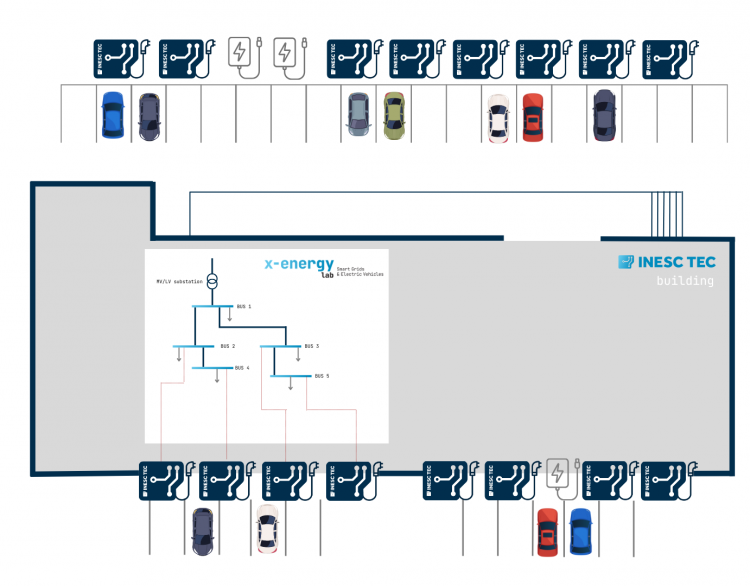
“When photovoltaic generation is available, charging should, whenever possible, be shifted to those periods; when the grid is subject to constraints, charging power should be adjusted so as not to worsen voltage or overload problems. The idea was never simply to install chargers. We wanted each piece of equipment to be able to operate as a point of measurement, communication, and control, capable of interacting with other equipment, with the power grid, and with integrated digital services. This approach is important because, as the number of electric vehicles grows, charging ceases to be an isolated event and becomes a relevant variable in the operation of the low-voltage distribution grid,” explained Gil Sampaio.
But the infrastructure’s real value lies in everyday use: each charging session generates information that helps researchers understand real-world usage patterns, energy needs, charging times, and interaction with local energy generation. All this data is collected through an application developed by INESC TEC for user authentication and is processed in an aggregated and pseudonymised manner to ensure privacy.
“A charger like this can measure, communicate, and participate in a coordinated decision. This does not mean that each piece of equipment operates in isolation: it means that it can contribute local information and receive instructions that are compatible with the overall state of the grid, the availability of renewable energy, and the needs of multiple users, while integrating into a distributed computing architecture,” added the researcher. By the end of June, the infrastructure had 16 chargers, 81 registered users, and 3,465 charging sessions, with 72,571 kWh of energy charged since the beginning of 2024. Figures that “represent more than just the volume of usage”.
Available free of charge to the INESC TEC community, this infrastructure represents a direct benefit for those who use electric vehicles daily, while also creating a real-world environment for testing new smart charging and energy management technologies.
“Research into smart charging depends on real-world usage data and on the diversity of user profiles, because it is the variation in distances travelled, arrival times, and length of stay that allows us to understand the impact that charging will have on the grid. Added to this is another contribution: a significant share of the electricity consumed during the day is generated by our solar photovoltaic installation, which ultimately reduces the carbon footprint associated with our people’s daily journeys. Hence, we’re providing those who work here with the conditions for more sustainable mobility, in line with our ESG policy. This is science with impact: we are testing it here today so that tomorrow we can extend it to society at large,” said Luís Seca, member of the INESC TEC Board of Directors.
Although it was driven by the European GREEN.DAT.AI project, the infrastructure will now remain at the service of INESC TEC and will continue to support new research, demonstration, and technology transfer activities, consolidating the headquarters as a living lab for the development of smart power grids.
 News, current topics, curiosities and so much more about INESC TEC and its community!
